

Class: Primary Four
Term: Second Term
subject: Basic Science and Technology
Curriculum theme: Physical & Health Education
Previous Lesson: Football as a Ball Game
Topic: Table Tennis
Content/learning Area: Table Tennis, Skills in Table Tennis, Equipment, Rules of Table Tennis, Benefits of Table Tennis
Time Allocation: 40 minutes
Performance Objectives
by the end of the lesson, pupils should be able to:
- Cognitive Domain:
- Define Table Tennis and describe its basic rules.
- Identify the equipment used in Table Tennis.
- Explain the benefits of playing Table Tennis.
- Psychomotor Domain:
- Demonstrate basic Table Tennis grips.
- Perform basic Table Tennis strokes (forehand and backhand).
- Affective Domain:
- Show an recognition for Table Tennis as a recreational activity.
- Exhibit sportsmanship during game play.
- Social Domain:
- work collaboratively with peers during practice sessions.
- Respect the rules and fair play in Table Tennis.
Reference Materials
- 9 – Years Basic Education Curriculum
- Abuja Educational Resource Center Scheme of Work
- NAPPS National Unified Scheme of Work
- Online Details
- Relevant Textbooks
Instructional Materials
To deliver this lesson, the teacher will employ the help of the following materials:
- Table tennis table
- Table tennis bats
- Table Tennis balls
- Whiteboard or chart paper
- Markers
Rationale for the lesson
This lesson introduces pupils to Table Tennis, a sport that promotes physical activity, hand-eye coordination, and social interaction. Understanding the rules and basic skills will encourage participation and enjoyment of the sport.
Prerequisite/Previous Knowledge
The teacher will start by asking pupils if they have ever played or seen Table Tennis. A brief discussion about the game will follow, generating excitement and curiosity about the lesson. The teacher will then introduce the topic,Table Tennis.
Lesson Content
Table Tennis
table Tennis, also known as ping-pong, is a sport where two or four players hit a lightweight ball back and forth across a table using small bats. It’s a fast-paced game needing rapid reactions and good coordination.
What is table Tennis?
Table Tennis is a racquet sport played on a rectangular table divided by a net. The goal is to hit a lightweight ball with a racquet so it bounces on your opponent’s side.It’s played with two players (singles) or four (doubles).
Skills in Table Tennis
These are the key skills required to play table tennis:
- Forehand Drive: A basic stroke emphasizing control and accuracy.
- Backhand Drive: Similar to the forehand, but using the backhand.
- Forehand Push: A defensive stroke for low balls.
- Backhand Push: The backhand version of the forehand push.
- Serve: Starting the play by hitting the ball so it bounces on both sides of the table.
- Smash: An offensive stroke used to hit the ball with power and speed.
- Block: A defensive stroke used to counter an opponent’s attack.
Equipment
These are the basic equipment needed to play table tennis:
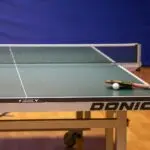
- Table Tennis Table: A rectangular table with a net.
- Table Tennis Bat: A flat bat with a rubber surface.
- Table Tennis ball: A small, lightweight ball.
- Net: Divides the table into two equal halves.
- Scoreboard: Used to keep track of the score during a match.
Rules of Table Tennis
These are the vital rules of table tennis:
- Serving: The server must hit the ball so it bounces on their side, then the opponent’s.
- Returning: Players must return the ball so it bounces on their side before bouncing twice on the opponent’s side.
- Scoring: points are scored when a player fails to return the ball or hits it out. the first to 11 points wins, by at least two points.
- Let: A let is called when the serve hits the net and lands on the opponent’s side, or when play is interrupted for any reason.
- Order of Play: In doubles, players must alternate hitting the ball.
Benefits of Table Tennis
Table Tennis is great for all ages and abilities. It’s good exercise and improves hand-eye coordination. These include:
- Improved hand-eye coordination: Using hands and eyes together to hit the ball.
- Increased reflexes: The fast pace improves reflexes.
- Improved concentration: Focusing on the game and opponents.
- Social interaction: Playing with friends or family improves social skills.
- Cardiovascular Health: Playing table tennis can improve cardiovascular health by increasing heart rate and blood flow.
- Mental Acuity: Table tennis can improve mental acuity by requiring players to think quickly and strategically.
Teaching Methods
To deliver this lesson, the teacher will adopt the following methods: Discussion,Exhibition,Practical Activity
Instructional Procedures
To deliver this lesson,the teacher will adopt the following steps:
Step 1: Introduction
Time: 5 minutes
Teaching Skill: Set Induction
Teacher’s activity: Introduces the topic,Table Tennis,and asks pupils if they are familiar with it.
Pupils’ Activity: Respond to teacher’s questions and share their prior knowledge.
Step 2: Explanation of Key Concepts
Time: 10 minutes
Teaching Skill: Explaining
Teacher’s Activity: Explains the basic rules and concepts of table Tennis using visual aids.
Pupils’ Activity: Listen attentively and ask clarifying questions.
Step 3: Demonstration/Guided Practice
Time: 15 minutes
Teaching Skill: Demonstrating
Teacher’s Activity: demonstrates basic grips and strokes. Guides pupils in practicing these skills in pairs.
Pupils’ Activity: Observe the demonstration and practice the skills under teacher’s guidance.
Step 4: Self-reliant Practice
Time: 5 minutes
Teaching Skill: Monitoring
Teacher’s Activity: Monitors pupils as they practice independently, providing feedback and support.
Pupils’ Activity: Practice Table Tennis skills independently in pairs.
Step 5: note-Taking
Time: 2 minutes
Teaching Skill: Summarizing
Teacher’s Activity: Summarizes key points of the lesson.
Pupils’ Activity: Take notes on the key points.
Step 6: Evaluation/Review
Time: 3 minutes
Teaching Skill: Questioning
Teacher’s Activity: Asks evaluation questions to assess pupils’ understanding.
Pupils’ Activity: Answer the evaluation questions.
Objective-aligned checks:
- Define Table Tennis and describe its basic rules.
- Identify the equipment used in Table Tennis.
- Explain the benefits of playing Table Tennis.
Step 7: Conclusion
Time: 2 minutes
Teaching Skill: Summarizing
Teacher’s Activity: Concludes the lesson by summarizing the key points and previewing the next topic.
Pupils’ Activity: Listen to the summary and ask any remaining questions.
Lesson Keywords
- Table Tennis – A racquet sport played on a table with a net.
- Forehand Drive – A basic stroke emphasizing control and accuracy.
- Backhand Drive – Similar to the forehand, but using the backhand.
- Serve – Starting the play by hitting the ball.
- Racket – The equipment used to hit the ball in table tennis.
Lesson Evaluation
To evaluate the learning, the teacher asks pupils to:
- What is Table Tennis?
- Name three pieces of equipment used in Table Tennis.
- What are two benefits of playing table Tennis?
- Explain the basic rule of serving in Table Tennis.
- What is a forehand drive?
Assignment/Homework
- Research and write about the history of Table Tennis.
- Practice the basic Table Tennis strokes with a partner.
- Watch a Table tennis match and write a summary of the game.
Differentiation
- For slower learners: Provide one-on-one assistance and simplified instructions.
- For advanced learners: Introduce more advanced strokes and strategies.
- For visual/auditory/kinesthetic learners: Use visual aids, verbal explanations, and hands-on activities to cater to different learning styles.
Note for Teachers
Ensure that pupils have enough space to practice the strokes safely. Provide clear demonstrations and feedback to help pupils improve their skills. encourage pupils to work collaboratively and exhibit sportsmanship during practice sessions.



Community Join the conversation Open discussion +