

Class: primary Four
Term: First Term
Subject: Basic Science and Technology
Curriculum Theme: Physical & Health Education
Previous Lesson: Moving Our Body Parts, Non, Locomotor Movements, Pushing and Pulling
Topic: Athletics
Content/Learning area: Defining athletics, Listing examples of athletics
Time Allocation: 40 minutes
Performance Objectives
By the end of the lesson, pupils should be able to:
- Cognitive Domain:
1. Define athletics.
2. List examples of athletics.
3. Identify skills needed for athletics.
- affective Domain:
1. Show interest in athletics.
2. Appreciate the importance of physical activity.
- Psychomotor Domain:
1. Participate in simple athletic activities.
- Social Domain:
1. Work cooperatively during activities.
reference Materials
- 9 – Years Basic Education Curriculum
- Abuja Educational Resource Center Scheme of Work
- NAPPS national Unified Scheme of work
- Relevant Textbooks
Instructional Materials
To deliver this lesson, the teacher will use the following materials:
- Whiteboard or chart paper
- Markers or pens
- Pictures or videos of athletic events
Rationale for the Lesson
This lesson introduces pupils to athletics, fostering an recognition for physical activity and healthy competition, laying a foundation for future physical education lessons and promoting a healthy lifestyle.
Prerequisite/Previous Knowledge
Pupils are familiar with different games and sports.
Lesson Content
Athletics
Athletics is a group of sports and physical activities where athletes use their physical skills and abilities to compete or participate in sports.
What is Athletics?
Athletics involves various activities that require strength, speed, agility, and endurance. Some activities include:
- Running: Racing over different distances, from short sprints to long marathons.
- Jumping: Events like the long jump, high jump, and triple jump.
- Throwing: Events like the shot put, discus throw, javelin throw, and hammer throw.
- Track and Field Events: A broad category including running, jumping, and throwing events.
- Swimming: Racing in water over various distances and strokes.
- Gymnastics: Performing exercises that demonstrate strength,balance,and control.
Examples of Athletics
Examples of athletics include:
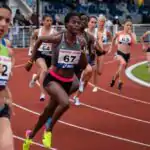
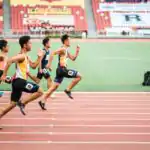
- Races: Competitions where athletes run against each other. Examples include the 100-meter sprint, 400-meter race, and 1500-meter race.
- Jumps: events where athletes try to jump as far or as high as possible. Examples include the long jump, high jump, and triple jump.
- Throws: Events where athletes try to throw an object as far as possible. Examples include the shot put, discus throw, javelin throw, and hammer throw.
- Track and field events: A broad category that includes various running, jumping, and throwing events.
- Relay Races: Team events where runners pass a baton to each other.
- Hurdles: Races where runners jump over obstacles.
Teaching Methods
To deliver this lesson, the teacher will adopt the following methods: Discussion, Question and answer, Visual aids
Instructional Procedures
To deliver this lesson, the teacher will adopt the following steps:
Step 1: Introduction
Time: 5 minutes
Teaching Skill: Set Induction
Teacher’s Activity: Asks pupils about their favorite games and introduces the topic of athletics.
Pupils’ Activity: Respond to questions and listen to the introduction.
Step 2: Description of Key Concepts
Time: 10 minutes
Teaching Skill: Explaining
Teacher’s activity: Explains what athletics is and shows pictures/videos of different athletic events.
Pupils’ Activity: Listen attentively and ask questions.
Step 3: demonstration/Guided Practice
Time: 10 minutes
Teaching Skill: demonstrating
Teacher’s Activity: Demonstrates simple athletic movements (running,jumping).Pupils’ Activity: Imitate the movements.
Step 4: Autonomous Practice
Time: 5 minutes
Teaching skill: Monitoring
Teacher’s Activity: Supervises pupils as they practice simple athletic activities.
Pupils’ Activity: Practice running, jumping, and throwing activities.
Step 5: Note-Taking
Time: 5 minutes
Teaching Skill: guiding
Teacher’s Activity: Guides pupils in taking notes on key concepts.
Pupils’ Activity: Write down importent points.
Step 6: Evaluation/Review
time: 5 minutes
Teaching Skill: Questioning
Teacher’s Activity: Asks questions to assess understanding.
Pupils’ Activity: Answer questions.
Objective-aligned checks:
- Define athletics.
- List examples of athletics.
- Identify skills needed for athletics.
Step 7: Conclusion
Time: 2 minutes
Teaching Skill: summarizing
Teacher’s Activity: Summarizes the key concepts of athletics and encourages pupils to stay active.Pupils’ Activity: Listen to the summary and ask any remaining questions.
Lesson keywords
- Athletics – A group of sports involving physical skills and abilities.
- Running – Racing over a distance.
- Jumping – Leaping over an obstacle or for distance.
- Throwing – Propelling an object as far as possible.
- Track and Field – A combination of running,jumping,and throwing events.
Lesson Evaluation
To evaluate the learning, the teacher asks pupils to:
- What is athletics?
- Give two examples of athletic events.
- What skills are crucial in athletics?
- Name a famous athlete.
Assignment/Homework
- Research and write about a famous Nigerian athlete.
- List three benefits of participating in athletic activities.
Differentiation
- For slower learners: Provide one-on-one assistance and use simpler explanations.
- For advanced learners: Encourage them to research famous athletes and different athletic events.
- For visual/auditory/kinesthetic learners: Use visual aids, verbal explanations, and hands-on activities to cater to different learning styles.
Note for Teachers
Encourage pupils to participate actively and provide positive reinforcement. Ensure a safe environment for physical activities.


Community Join the conversation Open discussion +