

class: Primary Four
term: First Term
Subject: Basic Science and Technology
Curriculum theme: Physical & Health Education
Previous Lesson: Long Distance Race
Topic: Skills In Athletics
Content/Learning Area: What are the Skills in Athletics?, Standing, Take Off, Running, Arm Action, Finishing
Time Allocation: 40 minutes
Performance Objectives
By the end of the lesson, pupils should be able to:
- Cognitive Domain:
- List and explain the skills in athletics for middle and long-distance races.
- Affective Domain:
- Appreciate the importance of practicing athletic skills.
- Psychomotor Domain:
- Demonstrate the skills in athletics for middle and long-distance races.
- Social Domain:
- Work cooperatively with peers during activities.
Reference Materials
- 9 – years Basic Education Curriculum
- Abuja Educational Resource Center Scheme of work
- NAPPS National Unified Scheme of work
- Relevant Textbooks
Instructional Materials
To deliver this lesson, the teacher will use the following materials:
- Whiteboard or chart paper
- Markers or pens
- Pictures or videos showing athletic skills
Rationale for the lesson
Understanding athletic skills is crucial for overall physical fitness and participation in sports. This lesson provides a foundation for future lessons on more advanced athletic techniques and promotes healthy habits.
Prerequisite/Previous Knowledge
The teacher will start by asking pupils about their favorite sports and any running experiences. A brief discussion about running will lead into the lesson’s topic, focusing on the importance of proper techniques in athletics.
Lesson Content
What are the Skills in Athletics?
Success in middle and long-distance races depends on mastering key athletic skills. These skills help runners run efficiently, save energy, and perform better. Five main skills are crucial:
Standing
Proper posture at the starting line is key to a good race.
These include:
- Proper posture at the starting line is key. Feet should be shoulder-width apart.
- Body should be slightly leaning forward.
- Arms should be ready to push forward.
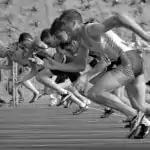
Take off
A strong start is vital in gaining an early advantage.
These include:
- A strong start is vital.
- Push off with the back foot while leaning forward to gain momentum.
- Maintain balance and coordination.
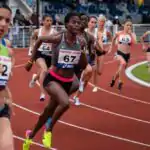
Running
Efficient running is essential for conserving energy and maintaining speed.
These include:
- efficient running is essential.
- Maintain a steady pace.
- Use correct breathing.
- Keep a relaxed posture.
Arm Action
Correct arm movement is crucial for balance and forward motion.
These include:
- Correct arm movement is important for balance and forward motion.
- Keep arms bent at a 90-degree angle.
- Swing them in time with your steps.
- Ensure arms are relaxed and not tense.
Finishing
How you finish matters, as it determines your final position.
These include:
- How you finish matters.
- Increase your speed towards the finish line.
- Maintain good posture.
- Fully extend your legs to cross the line with maximum effort.
teaching Methods
To deliver this lesson, the teacher will adopt the following methods: Discussion, Presentation, Practical Activity
Instructional Procedures
To deliver this lesson, the teacher will adopt the following steps:
Step 1: Introduction
Time: 5 minutes
Teaching Skill: Set Induction
Teacher’s Activity: Briefly review previous lesson and introduce the topic of athletic skills, emphasizing their importance in running.
Pupils’ Activity: Participate in discussion, share prior knowledge about running.
Step 2: Description of Key Concepts
Time: 10 minutes
Teaching Skill: Description
Teacher’s Activity: Explain and demonstrate each of the five main athletic skills (standing, take-off, running, arm action, finishing).
Pupils’ Activity: Listen attentively, observe demonstrations, ask clarifying questions.
Step 3: Presentation/Guided Practice
Time: 10 minutes
Teaching Skill: Guided Practice
Teacher’s Activity: Guide pupils through practicing each skill, providing individual feedback and corrections.
Pupils’ Activity: Practice each skill under teacher supervision, receive and implement feedback.
Step 4: Independent Practice
Time: 5 minutes
Teaching Skill: Monitoring
Teacher’s Activity: Observe pupils as they practice independently, offering assistance as needed.
Pupils’ Activity: Practice the skills independently, applying learned techniques.
Step 5: Note-Taking
time: 5 minutes
Teaching Skill: Note-Taking
Teacher’s activity: Guide pupils in summarizing key concepts and writing notes.
Pupils’ Activity: Take notes on the five main athletic skills and their importance.
Step 6: Evaluation/Review
Time: 5 minutes
Teaching skill: Assessment
Teacher’s Activity: Ask evaluation questions to assess understanding.
Pupils’ Activity: answer evaluation questions.
Objective-aligned checks:
- List and explain the skills in athletics for middle and long-distance races.
- Demonstrate the skills in athletics for middle and long-distance races.
step 7: Conclusion
Time: 5 minutes
Teaching Skill: Summarizing
Teacher’s Activity: Summarize the key skills learned and encourage pupils to practice regularly to improve their running technique and overall fitness.
Pupils’ Activity: Listen to the summary and ask any remaining questions.
Lesson keywords
- Athletics – A group of sporting events that include running, jumping, and throwing.
- Standing – The correct posture at the starting line.
- Take Off – The initial movement from the starting position.
- Running – The act of moving rapidly on foot.
- Arm Action – The movement of the arms while running.
- Finishing – The final part of a race.
Lesson Evaluation
To evaluate the learning, the teacher asks pupils to:
- Name one skill needed for running a long distance.
- Why is practicing these skills critically important?
- Explain the skill of “arm action” in running.
- What is the importance of a good “take off” in a long-distance race?
- How can you improve your “finishing” technique in a race?
assignment/Homework
- Practice the five athletic skills at home.
- Write a short paragraph on why athletic skills are important for overall fitness.
- Research and list three famous Nigerian athletes and their achievements.
Differentiation
- For slower learners: Provide one-on-one assistance and simplified instructions.
- For advanced learners: Challenge with additional practice activities or research on specific athletic techniques.
- For visual/auditory/kinesthetic learners: Use visual aids, verbal explanations, and hands-on activities to cater to different learning styles.
Note for Teachers
Ensure to provide clear demonstrations and hands-on practice for each athletic skill. encourage pupils to ask questions and provide constructive feedback during practice sessions. Emphasize the importance of safety and proper technique to prevent injuries.

Community Join the conversation Open discussion +