

Class: Primary Four
Term: First Term
Subject: Basic Science and Technology
curriculum Theme: Physical & Health Education
previous Lesson: Moving Our Body Parts, Non, Locomotor Movement
Topic: Moving Our body Parts (Non-Locomotor Movements)
Content/Learning Area: Non-locomotor movements, Stretching, Bending, Twisting, Swinging
Time allocation: 40 minutes
Performance Objectives
By the end of the lesson, pupils should be able to:
- Cognitive Domain:
1. Explain the concept of non-locomotor movements such as stretching, bending, twisting, and swinging.
- Affective Domain:
1. Appreciate the importance of non-locomotor movements for physical health and coordination.
- Psychomotor Domain:
1. demonstrate non-locomotor movements such as stretching,bending,twisting,and swinging.
- Social Domain:
1. Participate actively in class discussions and activities.
Reference materials
- 9 – Years Basic education Curriculum
- Abuja Educational Resource Centre Scheme of Work
- NAPPS National Unified Scheme of Work
- Relevant Textbooks
Instructional Materials
To deliver this lesson,the teacher will use the following materials:
- Whiteboard or chart paper
- Markers or crayons
- Pictures or videos showing non-locomotor movements
Rationale for the Lesson
Understanding non-locomotor movements is crucial for developing body awareness and coordination. This lesson lays the foundation for future lessons on physical activity and health.
Prerequisite/Previous Knowledge
The teacher will start by asking pupils to stand up and stretch their arms and legs. The teacher will then ask them to describe how their bodies felt. This will led into a discussion about different ways we can move our bodies.
Lesson Content
Moving Our Body Parts (Non-Locomotor Movements)
Non-locomotor movements are movements we do without changing our location. They are very crucial for our health and help us stay flexible and avoid injuries.
stretching
stretching means making yoru body parts longer or reaching as far as you can without hurting yourself.
Examples are:
- Reaching high to touch the sky.
- Stretching your arms wide.
- Stretching your legs to touch your toes.
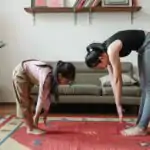
Bending
Bending is when you bend your body or a body part,like your waist or knees.
Examples are:
- Bending forward to touch your toes.
- Bending your knees to sit down.
- Bending sideways to touch the ground.
Twisting
Twisting is turning your body or a body part, like your torso or head, from side to side.
Examples are:
- Twisting to look behind you.
- Twisting your head to look sideways.
- Twisting your torso during exercise.
Swinging
Swinging is moving back and forth, like a pendulum.
Examples are:
- Swinging on a playground swing, moving back and forth in the air.
- Swinging your arms while walking.
- Swinging your legs while sitting.
Teaching Methods
To deliver this lesson, the teacher will adopt the following methods: Discussion, Demonstration, Guided Practice.
Instructional Procedures
To deliver this lesson, the teacher will adopt the following steps:
Step 1: Introduction
Time: 5 minutes
Teaching Skill: Set Induction
Teacher’s Activity: Introduce the topic of non-locomotor movements. Ask pupils what they think non-locomotor movements are.
Pupils’ Activity: Listen attentively and participate in the discussion.
Step 2: Description of Key Concepts
Time: 10 minutes
teaching Skill: Explaining, Demonstrating
Teacher’s activity: Explain and demonstrate each non-locomotor movement (stretching, bending, twisting, swinging).Pupils’ Activity: Observe the teacher’s demonstrations and listen attentively.
Step 3: Demonstration/Guided Practice
Time: 10 minutes
Teaching skill: Guiding, Monitoring
Teacher’s Activity: Guide pupils as they practice each non-locomotor movement.
Pupils’ Activity: Practice each movement under the teacher’s guidance.
Step 4: Self-Reliant Practice
Time: 5 minutes
Teaching Skill: Observing,Providing Feedback
Teacher’s Activity: Observe pupils as they practice the movements independently.
Pupils’ activity: Practice the movements independently.
Step 5: Note-Taking
Time: 5 minutes
Teaching Skill: Summarizing, Note-Taking
Teacher’s Activity: Summarize the key concepts and guide pupils in taking notes.
Pupils’ activity: take notes on the key concepts.
Step 6: Evaluation/Review
Time: 5 minutes
teaching Skill: Questioning, Assessing
Teacher’s Activity: Ask questions to assess pupils’ understanding.
Pupils’ Activity: Answer the questions.
Objective-aligned checks:
- Explain the concept of non-locomotor movements such as stretching, bending, twisting, and swinging.
- demonstrate non-locomotor movements such as stretching,bending,twisting,and swinging.
Step 7: Conclusion
Time: 2 minutes
Teaching Skill: summarizing, Assigning
Teacher’s Activity: Review the key concepts and assign homework.
Pupils’ Activity: Listen and note the homework assignment.
Lesson Keywords
- Non-locomotor movements – Movements done without changing location.
- Stretching – Lengthening body parts.
- Bending – Flexing body parts.
- Twisting – Turning body parts.
- Swinging – Moving back and forth.
Lesson Evaluation
To evaluate the learning,the teacher asks pupils to:
- What are non-locomotor movements?
- Show me a non-locomotor movement.
- Why are non-locomotor movements significant?
- Name some activities that use non-locomotor movements.
Assignment/Homework
- Practice non-locomotor movements at home.
- List three benefits of non-locomotor movements.
Differentiation
- For slower learners: Provide one-on-one assistance and simplified instructions.
- For advanced learners: Encourage them to create their own non-locomotor movement sequences.
- For visual/auditory/kinesthetic learners: Use pictures, verbal cues, and hands-on activities to cater to different learning styles.
note for Teachers
Ensure pupils perform the movements safely and avoid overexertion. Provide clear demonstrations and encourage active participation.



Community Join the conversation Open discussion +