

Class: Primary Three
Term: First Term
Subject: Basic Science and Technology
Curriculum Theme: Physical & health Education
Previous Lesson: Meaning, Importance and Methods of Physical Fitness
Topic: Athletics
Content/Learning Area: Defining athletics, Listing and explaining types of athletics: Track events, Field events, race-walking, and cross country
Time Allocation: 40 minutes
Performance Objectives
by the end of the lesson, pupils should be able to:
- Cognitive Domain:
1. Define athletics.
2. List and explain different types of athletics.
3. Identify examples of track and field events.
- Affective Domain:
1. Show interest in athletics.
2. Appreciate the importance of physical activity.
- Psychomotor domain:
1. Participate in simple athletic activities (if applicable).
- Social Domain:
1. Work cooperatively with peers during activities (if applicable).
Reference Materials
- 9 – Years Basic Education Curriculum
- Abuja Educational Resource Center Scheme of Work
- NAPPS National Unified Scheme of Work
- Relevant Textbooks
Instructional Materials
To deliver this lesson, the teacher will use the following materials:
- Whiteboard or chart paper
- Markers or pens
- Pictures or videos of athletic events (optional)
Rationale for the Lesson
Understanding athletics introduces pupils to various physical activities, promoting a healthy lifestyle and developing essential physical skills. This knowledge is beneficial for their overall physical and mental well-being.
Prerequisite/Previous Knowledge
The teacher will start by asking pupils what they know about sports and physical activities. A brief discussion will follow,leading into the introduction of athletics.
Lesson Content
What is Athletics?
Athletics is a group of sports involving running, jumping, and throwing. These activities test a person’s speed, strength, and how long they can keep going.
Types of Athletics
Athletics includes various events that test different physical skills.
The following are the main types of athletics:
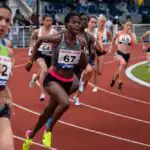
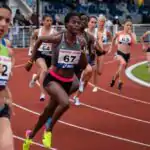
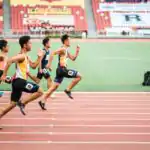
- Track Events: These are running events. Examples include:
1.Sprinting: Short races like the 100 meters and 200 meters.
2. Middle-distance running: Races between 400 meters and 1500 meters.
3. Long-distance running: Races longer than 1500 meters, such as 5000 meters and 10,000 meters.
4. Hurdling: Running while jumping over hurdles.
5.Relay Races: Team races where runners pass a baton to each other.
- Field Events: These involve jumping and throwing. Examples include:
1. Long jump: Jumping as far as possible.
2. High jump: jumping over a bar.
3. Triple jump: A hop, skip, and jump into a sandpit.
4. Pole Vault: Jumping over a high bar with the help of a pole.
5. Javelin throw: Throwing a javelin (a spear).
6. Discus throw: Throwing a discus (a heavy, flat disc).
7. Shot Put: Throwing a heavy metal ball as far as possible.
8. Hammer Throw: Throwing a heavy ball attached to a wire.
- other Types of Athletics:
1. Race-walking: Walking fast, always keeping one foot on the ground.
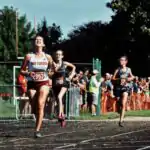
2. Cross country: Running across different types of land, like hills and fields.
3. Marathon: A long-distance running race, typically 42.195 kilometers (26.2 miles).
4. Steeplechase: A running race that includes obstacles such as water jumps and barriers.
Teaching methods
To deliver this lesson, the teacher will adopt the following methods: Discussion, Clarification, Question and Answer, Visual Aids
Instructional Procedures
To deliver this lesson, the teacher will adopt the following steps:
Step 1: Introduction
Time: 5 minutes
Teaching Skill: Set Induction
Teacher’s Activity: Engage pupils in a brief discussion about sports and physical activities.
Pupils’ Activity: Participate in the discussion,sharing their knowledge and experiences.
Step 2: Explanation of Key concepts
Time: 10 minutes
Teaching Skill: Explanation
Teacher’s Activity: define athletics and explain its importance.
Pupils’ activity: Listen attentively and ask clarifying questions.
Step 3: Exhibition/Guided Practice
Time: 10 minutes
Teaching Skill: Presentation, Guided Practice
Teacher’s Activity: Show pictures or videos of different athletic events (if available). Explain each type of event.
Pupils’ Activity: Observe the demonstrations and participate in discussions.
Step 4: Independent Practice
Time: 5 minutes
Teaching Skill: Independent practice
Teacher’s Activity: Guide pupils in completing simple activities related to athletics (if applicable).
Pupils’ Activity: Complete the activities independently or in small groups.
Step 5: Note-Taking
Time: 5 minutes
Teaching Skill: Note-taking
Teacher’s Activity: Guide pupils in taking notes on key concepts.
Pupils’ Activity: Take notes on the main points of the lesson.
Step 6: Evaluation/Review
Time: 5 minutes
Teaching Skill: Questioning,Review
Teacher’s Activity: Ask review questions to assess understanding.
Pupils’ Activity: Answer the review questions.
Objective-aligned checks:
- Define athletics.
- List and explain different types of athletics.
- Identify examples of track and field events.
Step 7: Conclusion
Time: 5 minutes
Teaching Skill: Summarizing
Teacher’s Activity: Summarize the main points about athletics and encourage pupils to participate in physical activities.
Pupils’ Activity: Listen to the summary and ask any remaining questions.
Lesson Keywords
- Athletics – A group of sports involving running, jumping, and throwing.
- Track Events – Running races that take place on a track.
- Field Events – Jumping and throwing sports.
- Race-walking – A walking race where one foot must always be on the ground.
- cross country – Running across natural terrain.
Lesson Evaluation
To evaluate the learning,the teacher asks pupils to:
- What is athletics?
- Name two main types of athletics.
- Give one example of a track event and one field event.
- What are race-walking and cross country?
- Why is athletics good for our health?
Assignment/Homework
- Research and write down three famous Nigerian athletes and the athletic events they participate in.
- Draw pictures of any two athletic events discussed in class.
- Explain in your own words why physical activity is vital for our bodies.
Differentiation
- For slower learners: Provide one-on-one assistance and use simpler language.
- For advanced learners: Encourage them to research other types of athletic events and present their findings to the class.
- For visual/auditory/kinesthetic learners: Use visual aids, verbal explanations, and hands-on activities to cater to different learning styles.
Note for teachers
Encourage pupils to participate in physical activities and sports to promote a healthy lifestyle. Use real-life examples of Nigerian athletes to inspire and motivate the pupils.
Community Join the conversation Open discussion +