

Class: Senior Secondary School 1 (SS1, SS 1, SSS1, SSS 1)
Term: 3rd Term
Week: 8
Age: 15 years
Duration: 45 minutes
Subject: Biology
Curriculum Theme: Biology
Previous Lesson: Applications of Biology in Food Production, Healthcare and Conservation.
Topic: AQUATIC HABITAT
Subject Matter: Aquatic habitat definition, types of aquatic habitats, aquatic organisms and adaptive features, characteristics of aquatic habitats, food chain and food web in aquatic habitats
Specific Objectives
By the end of the lesson, pupils should be able to:
Cognitive Domain:
- Define aquatic habitat.
- Identify and list different types of aquatic habitats.
- List various aquatic organisms and their adaptive features.
- Describe the characteristics of different aquatic habitats.
- Construct simple aquatic food chains and food webs.
Affective Domain:
- Appreciate the diversity of life in aquatic environments.
- Understand the importance of aquatic habitats to living organisms.
- Show interest in exploring local aquatic environments.
Psychomotor Domain:
- Record observations from study materials or actual water samples.
- Draw examples of aquatic organisms.
- Classify aquatic organisms based on their habitat and adaptations.
Social Domain:
- Work collaboratively in groups to identify and discuss aquatic features.
Reference Materials
The following resources were used in planning this lesson:
- 9 Years Basic Education Curriculum (Biology for Senior Secondary Schools)
- State Unified Scheme of Work for Biology SSS 1
- Modern Biology for Senior Secondary Schools by Ramalingam, S.T.
- Biology for Senior Secondary Schools by P.B. Usman
Instructional Materials
The teacher will teach this lesson with the aid of:
- Pictures or video clips of various aquatic habitats (e.g., pond, river, ocean).
- Water sample in a container (if available).
- Charts showing different aquatic organisms.
- Worksheets for recording observations and constructing food webs.
Rationale for the Lesson
This lesson helps pupils understand the diverse environments where water-dwelling organisms live. It enables them to appreciate how organisms adapt to their surroundings and how energy flows within these important ecosystems.
Prerequisite/Previous Knowledge
Pupils have prior knowledge of habitats and basic food chains from their Junior Secondary School Biology lessons.
Lesson Content/Board Summary
AQUATIC HABITAT
Definition of Aquatic Habitat
An aquatic habitat is a body of water that serves as a living environment for various organisms. These habitats can be freshwater, saltwater, or a mixture of both.
Types of Aquatic Habitats
Aquatic habitats are generally grouped into three main types:
- Freshwater Habitats: These include ponds, lakes, rivers, and streams. The water in these habitats has a low salt concentration.
- Marine Habitats: These are saltwater bodies such as oceans, seas, and coral reefs. They have a high salt concentration.
- Estuarine Habitats: These are transition zones where freshwater from rivers mixes with saltwater from the sea. Examples include river mouths, lagoons, and mangrove swamps. The salinity here fluctuates.
Characteristics of Aquatic Habitats
The following are general characteristics of aquatic habitats:
- Temperature: Water temperature is more stable than air temperature and varies with depth and season.
- Light Penetration: Light decreases with depth, affecting photosynthesis by aquatic plants.
- Dissolved Oxygen: Oxygen is dissolved in water and is essential for respiration by aquatic animals. It varies with temperature and turbulence.
- Salinity: The concentration of dissolved salts, which is very low in freshwater, high in marine, and fluctuating in estuarine habitats.
- Water Current: The movement of water, which can be slow in ponds or fast in rivers, affecting organism distribution.
- pH: The acidity or alkalinity of the water.
Aquatic Organisms and Adaptive Features
Aquatic organisms are classified based on their mode of life and possess specific adaptations to survive in water. They include:
- Plankton: Microscopic organisms that float freely in water.
- Phytoplankton: Plant-like plankton (e.g., algae); adaptations include small size for buoyancy, flagella for movement, and chlorophyll for photosynthesis.
- Zooplankton: Animal-like plankton (e.g., tiny crustaceans); adaptations include small size, cilia, or flagella for movement, and transparent bodies for camouflage.
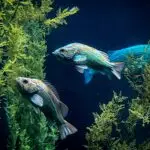
- Nekton: Free-swimming organisms that can move independently of water currents (e.g., fish, whales).
- Adaptations include streamlined bodies for reducing drag, fins for propulsion and steering, and gills for breathing dissolved oxygen.
- Benthos: Organisms that live at the bottom of aquatic habitats (e.g., crabs, snails, worms).
- Adaptations include flattened bodies for clinging to surfaces, shells for protection, and burrowing habits to hide from predators or currents.
Food Chain and Food Web in Aquatic Habitats
A food chain shows the flow of energy from producers to consumers. A food web is a network of interconnected food chains.
Example of an aquatic food chain:
- Phytoplankton → Zooplankton → Small fish → Large fish → Bird (e.g., kingfisher)
An aquatic food web involves multiple producers, primary consumers, secondary consumers, and tertiary consumers, with decomposers breaking down dead organic matter.
Teaching Methods/Instructional Techniques
Discussion, Lecture, Demonstration, Question and Answer, Visual Aids
Instructional Procedures
Step 1: Introduction
Time: 5 minutes
Teaching Skill: Set Induction
Teacher’s Activity: The teacher greets the pupils and asks them to mention different places where they can find water. The teacher then guides the discussion towards places where living organisms live in water.
Pupils’ Activity: Pupils mention various water bodies like rivers, ponds, oceans. They discuss animals living in water.
Learning Point: Pupils recall prior knowledge of water bodies and aquatic life, leading into the lesson topic.
Step 2: Definition of Aquatic Habitat
Time: 5 minutes
Teaching Skill: Explanation/Definition
Teacher’s Activity: The teacher defines an aquatic habitat and explains its general characteristics, using the board summary.
Pupils’ Activity: Pupils listen attentively, take notes, and ask questions for clarification.
Learning Point: Pupils understand the definition of an aquatic habitat.
Step 3: Types of Aquatic Habitats
Time: 10 minutes
Teaching Skill: Demonstration/Classification
Teacher’s Activity: The teacher displays pictures or video clips of different aquatic habitats (freshwater, marine, estuarine). The teacher explains the unique features and examples of each type.
Pupils’ Activity: Pupils observe the pictures/videos, identify the different types, and discuss their distinguishing features.
Learning Point: Pupils can identify and differentiate between freshwater, marine, and estuarine habitats.
Step 4: Characteristics of Aquatic Habitats
Time: 5 minutes
Teaching Skill: Explanation/Discussion
Teacher’s Activity: The teacher elaborates on the physical and chemical characteristics of aquatic habitats such as temperature, light, dissolved oxygen, and salinity, explaining how these factors influence life.
Pupils’ Activity: Pupils listen and contribute to the discussion on how these factors affect aquatic organisms.
Learning Point: Pupils understand the key characteristics that define aquatic environments.
Step 5: Aquatic Organisms and Adaptive Features
Time: 10 minutes
Teaching Skill: Illustration/Analysis
Teacher’s Activity: The teacher uses charts of aquatic organisms to discuss plankton, nekton, and benthos. The teacher explains their adaptive features for survival in water.
Pupils’ Activity: Pupils identify the organisms on the charts and discuss their adaptations. They may draw examples in their notebooks.
Learning Point: Pupils learn about different categories of aquatic organisms and their specific adaptations.
Step 6: Food Chain and Food Web in Aquatic Habitats
Time: 5 minutes
Teaching Skill: Elaboration/Construction
Teacher’s Activity: The teacher explains the concept of food chains and food webs in aquatic environments, giving examples and guiding pupils to construct simple ones.
Pupils’ Activity: Pupils participate by suggesting components of an aquatic food chain and work on constructing a simple food web.
Learning Point: Pupils understand how energy flows through aquatic ecosystems.
Step 7: Evaluation/Review
Time: 5 minutes
Teaching Skill: Questioning/Assessment
Teacher’s Activity: The teacher evaluates the learning by asking the following questions:
- Define an aquatic habitat.
- Mention two types of aquatic habitats and give one example for each.
- List three characteristics of aquatic habitats.
- Name two types of plankton and state one adaptation for each.
- Construct a simple aquatic food chain.
Pupils’ Activity: Pupils answer orally and in writing.
Learning Point: Pupils demonstrate understanding of the lesson.
Step 8: Conclusion
Time: 5 minutes
Teaching Skill: Summarization
Teacher’s Activity: The teacher summarizes the key points of the lesson, emphasizing the diversity and interconnectedness of life in aquatic habitats. The teacher assigns homework, asking pupils to research local aquatic organisms.
Pupils’ Activity: Pupils listen, ask final questions, and note down the homework.
Learning Point: Pupils consolidate their understanding of aquatic habitats and their importance.
Lesson Keywords
- Aquatic Habitat – A body of water where organisms live.
- Freshwater Habitat – Aquatic environment with low salt concentration (e.g., rivers, lakes).
- Marine Habitat – Saltwater aquatic environment (e.g., oceans, seas).
- Estuarine Habitat – Area where freshwater and saltwater mix.
- Plankton – Microscopic organisms that float in water.
- Nekton – Free-swimming aquatic animals.
- Benthos – Organisms living at the bottom of aquatic habitats.
- Adaptation – A feature that helps an organism survive in its environment.
- Food Chain – Sequence showing how energy flows from one organism to another.
- Food Web – Interconnected food chains in an ecosystem.
Differentiation
For pupils who grasp concepts quickly, the teacher can challenge them to research specific adaptations of organisms in extreme aquatic environments (e.g., deep-sea vents). For pupils needing more support, the teacher can provide simplified diagrams and pre-labeled charts to aid in identification and classification.
Note for teachers using this lesson plan
Encourage pupils to bring in small samples of pond water (if safe and accessible) for observation under a microscope, or use prepared slides if available, to make the lesson more practical. Emphasize the importance of conserving aquatic environments and their biodiversity.

Community Join the conversation Open discussion +