

Class: Senior Secondary School 1 (SS1, SS 1, SSS1, SSS 1)
Term: 2nd Term
Week: 2
Age: 15 years
Duration: 45 minutes
Subject: Biology
Curriculum Theme: Biology
Previous Lesson: Cell Structure, Organelles, Functions and Plant-Animal Cell Differences.
Topic: VERTEBRATE SKELETON
Subject Matter: Axial skeleton (skull and vertebral column), appendicular skeleton (limbs, sternum, ribs, and limb girdles), functions of major skeletal parts in protection and movement.
Specific Objectives
By the end of the lesson, pupils should be able to:
Cognitive Domain:
- Identify the major parts of the axial skeleton.
- Identify the major parts of the appendicular skeleton.
- Explain the protective and movement functions of the skull, ribs, vertebrae, and limb bones.
Affective Domain:
- Appreciate the importance of the skeletal system for support and protection in vertebrates.
- Show interest in observing different skeletal structures.
Psychomotor Domain:
- Construct a simple working model of a human arm.
- Record observations from specimens like snail shells and toad skulls.
Social Domain:
- Collaborate with peers during group activities and model construction.
Reference Materials
The following resources were used in planning this lesson:
- 9 Years Basic Education Curriculum for Biology (Senior Secondary).
- State Unified Scheme of Work for Biology SSS 1.
- Modern Biology for Senior Secondary Schools by Ramalingam.
- Biology textbooks and charts.
Instructional Materials
The teacher will teach this lesson with the aid of:
- Cardboard and pins for arm model construction.
- Snail shells.
- Toad skull specimen or diagram.
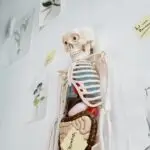
- Human skeleton charts or models.
Rationale for the Lesson
Understanding the vertebrate skeleton helps pupils to know how animals, including humans, are supported and protected. It also helps them to understand how movement is made possible, which is an important aspect of living organisms.
Prerequisite/Previous Knowledge
Pupils have some basic knowledge of animals, their body parts, and simple functions of movement and protection from their primary science lessons.
Lesson Content/Board Summary
VERTEBRATE SKELETON
Introduction to the Vertebrate Skeleton
The vertebrate skeleton is the internal framework of the body of vertebrates. It provides support, protection, and allows for movement.
Types of Vertebrate Skeleton
The vertebrate skeleton is broadly divided into two main parts:
- Axial skeleton
- Appendicular skeleton
Axial Skeleton
The axial skeleton forms the central axis of the body. It protects internal organs and provides support.
The main components of the axial skeleton are:
- Skull: Protects the brain and houses sensory organs.
- Vertebral Column (Backbone): Protects the spinal cord and provides main support for the body.
- Ribs: Form the rib cage, protecting the heart and lungs.
- Sternum (Breastbone): Connects the ribs at the front of the chest.
Appendicular Skeleton
The appendicular skeleton comprises the limbs and the girdles that attach them to the axial skeleton. It is primarily involved in locomotion and manipulation of objects.
The main components of the appendicular skeleton are:
- Limb Girdles:
- Pectoral girdle (shoulder girdle): Attaches the forelimbs/upper limbs to the axial skeleton.
- Pelvic girdle (hip girdle): Attaches the hindlimbs/lower limbs to the axial skeleton.
- Limbs:
- Bones of the forelimbs/upper limbs (e.g., humerus, radius, ulna, carpals, metacarpals, phalanges).
- Bones of the hindlimbs/lower limbs (e.g., femur, tibia, fibula, tarsals, metatarsals, phalanges).
Functions of Major Skeletal Parts
The skeletal system performs several important functions:
- Protection:
- The skull protects the brain.
- The vertebral column protects the spinal cord.
- The rib cage (ribs and sternum) protects the heart and lungs.
- Support:
- The vertebral column supports the head and the rest of the body.
- Limb bones support the body weight and provide a framework.
- Movement:
- Bones act as levers for muscle attachment, enabling movement of limbs and other body parts.
Teaching Methods/Instructional Techniques
Discussion, Lecture, Demonstration, Question and Answer, Visual Aids
Instructional Procedures
Step 1: Introduction
Time: 5 minutes
Teaching Skill: Set Induction
Teacher’s Activity: The teacher greets the pupils and asks them to state the importance of bones in the human body. The teacher then introduces the topic: “Vertebrate Skeleton.”
Pupils’ Activity: Pupils respond to the questions and listen to the introduction of the topic.
Learning Point: Pupils recall prior knowledge about bones and are introduced to the lesson topic.
Step 2: Explanation of Axial Skeleton
Time: 10 minutes
Teaching Skill: Explanation/Demonstration
Teacher’s Activity: The teacher uses a skeleton chart to explain the components of the axial skeleton (skull, vertebral column, ribs, sternum). The teacher asks pupils to identify these parts on the chart.
Pupils’ Activity: Pupils observe the chart, listen to the explanation, and identify the parts of the axial skeleton.
Learning Point: Pupils identify and understand the components of the axial skeleton.
Step 3: Explanation of Appendicular Skeleton
Time: 10 minutes
Teaching Skill: Explanation/Visual Aids
Teacher’s Activity: The teacher further explains the components of the appendicular skeleton, pointing out the limb girdles and the bones of the limbs on the skeleton chart. The teacher guides a discussion on how these parts attach to the axial skeleton.
Pupils’ Activity: Pupils observe the chart, participate in the discussion, and identify the parts of the appendicular skeleton.
Learning Point: Pupils identify and understand the components of the appendicular skeleton.
Step 4: Functions of Skeletal Parts
Time: 7 minutes
Teaching Skill: Discussion/Questioning
Teacher’s Activity: The teacher leads a discussion on the specific functions of the skull, ribs, vertebrae, and limb bones, focusing on protection and movement. The teacher encourages pupils to give examples.
Pupils’ Activity: Pupils explain the functions of different skeletal parts and provide examples.
Learning Point: Pupils explain the protective and movement functions of major skeletal parts.
Step 5: Practical Activity – Arm Model
Time: 5 minutes
Teaching Skill: Demonstration/Practical Application
Teacher’s Activity: The teacher provides cardboard and pins and demonstrates how to construct a simple working model of a human arm. Pupils are guided to start constructing their own models (to be completed as homework if time is short).
Pupils’ Activity: Pupils observe the demonstration and begin constructing their simple arm models.
Learning Point: Pupils begin to apply their knowledge by constructing a model illustrating skeletal movement.
Step 6: Observation of Protective Function
Time: 5 minutes
Teaching Skill: Observation/Analysis
Teacher’s Activity: The teacher presents snail shells and a toad skull (or diagrams) and guides pupils to observe how these structures provide protection to the soft parts of the animals.
Pupils’ Activity: Pupils observe the specimens and discuss how they offer protection.
Learning Point: Pupils understand the protective function of the skeleton through observation of different animal structures.
Step 7: Evaluation/Review
Time: 5 minutes
Teaching Skill: Questioning/Assessment
Teacher’s Activity: The teacher evaluates the learning by asking the following questions:
- Define the term “vertebrate skeleton.”
- List the two main divisions of the vertebrate skeleton.
- Mention two components of the axial skeleton.
- State one protective function of the skull.
- Explain how the limb bones contribute to movement.
Pupils’ Activity: Pupils answer orally and in writing.
Learning Point: Pupils demonstrate understanding of the lesson.
Step 8: Conclusion
Time: 3 minutes
Teaching Skill: Summarization/Consolidation
Teacher’s Activity: The teacher summarizes the key points of the lesson, emphasizing the importance of the axial and appendicular skeletons for support, protection, and movement. The teacher assigns homework: “Complete the arm model and list three differences between the axial and appendicular skeleton.”
Pupils’ Activity: Pupils listen to the summary and copy down the homework.
Learning Point: Pupils consolidate their learning and prepare for further study.
Lesson Keywords
- Vertebrate – An animal with a backbone or spinal column.
- Skeleton – The internal framework of bone or cartilage that supports the body of an animal.
- Axial Skeleton – The central part of the skeleton, including the skull, vertebral column, ribs, and sternum.
- Appendicular Skeleton – The part of the skeleton that includes the limb girdles and the limbs.
- Skull – The bony framework of the head, protecting the brain.
- Vertebral Column – The backbone, protecting the spinal cord.
- Limb Girdles – Structures that attach the limbs to the axial skeleton (pectoral and pelvic).
- Protection – The act of keeping something safe from harm or injury.
- Movement – The act of changing position or place.
Differentiation
The teacher will provide additional support for pupils who are struggling by using simplified diagrams and one-on-one explanations. Advanced learners will be encouraged to research specific bone structures and their evolutionary significance in different vertebrates.
Note for teachers using this lesson plan
Teachers should ensure that actual specimens or high-quality charts of the human skeleton are available. Encourage hands-on activities like the arm model to enhance understanding. Safety precautions should be observed if using actual animal skulls.


Community Join the conversation Open discussion +