

Note for teachers using this lesson plan
This lesson focuses on developing pupils’ ability to perform basic arithmetic operations with weights in kilograms and grams. Ensure you have actual weighting scales and labelled masses for practical demonstrations. Emphasise the importance of aligning units before calculation and guide pupils through step-by-step examples to build their confidence in solving weight-related problems.
Class: Primary 4
Term: Third Term
Week: 3
Age: 9 years
Duration: 45 minutes
Subject: General Mathematics
Curriculum Theme: Mensuration
Focal competence: Calculating weight of an object using basic arithmetic operations
Key competencies/values: Collaboration
Skills:
- Measuring and calculating weights using basic arithmetic operations
Previous Lesson: Addition and subtraction of lengths
Topic: Weight
Subject Matter: Addition, subtraction, multiplication and division of weights in kilograms and grams
Specific Objectives
By the end of the lesson, pupils/students should be able to:
Cognitive Domain
- Compute addition of weights using kg and g.
- Compute subtraction of weights using kg and g.
- Multiply weights by whole numbers.
- Divide weights by whole numbers.
Affective Domain
- Participate actively in solving problems involving weights.
- Appreciate the importance of accurate weight measurement in daily life.
Psychomotor Domain
- Demonstrate the correct steps for adding and subtracting weights.
- Practise multiplying and dividing weights by whole numbers.
Social Domain
- Collaborate with peers to solve weight-related word problems.
Reference Materials
The following resources were used in planning this lesson:
- 2025 Revised 9 Years Basic Education Curriculum
- Relevant State Unified Scheme of Work
- Universal Primary Mathematics Book 4
- The HeadTeacher Scheme of work
Instructional Materials
The teacher will teach this lesson with the aid of:
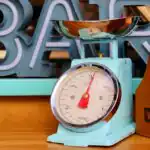
- Weighting scale
- Scale balance
- Flashcards with weight problems
- Chart showing units of weight (kg and g)
Rationale for the Lesson
This lesson is important as it equips pupils with essential skills to perform calculations involving weights, which is a fundamental aspect of daily life. Understanding these operations helps them solve practical problems related to buying, selling, and measuring various items. It also builds a strong foundation for more advanced mensuration concepts.
Prerequisite/Previous Knowledge
Pupils should have a basic understanding of weight, its units (kilograms and grams), and simple addition, subtraction, multiplication, and division of whole numbers.
Lesson Content/Board Summary
Weight: Addition, Subtraction, Multiplication and Division
Units of Weight
Weight is measured in kilograms (kg) and grams (g). Remember that:
- (1 text{ kg} = 1000 text{ g})
Addition of Weights
To add weights, arrange the numbers in columns, separating kilograms and grams. Add the grams first, then the kilograms. If the sum of grams is 1000g or more, convert it to kilograms and add to the kilogram column.
Example 1
Question: Add 5 kg 300 g and 2 kg 800 g.
Solution:
kg g
5 300
+ 2 800
—–
7 1100
Since (1100 text{ g} = 1 text{ kg } 100 text{ g}), we add 1 kg to the kg column.
kg g
5 300
+ 2 800
—–
8 100
Answer: (8 text{ kg } 100 text{ g})
Example 2
Question: A bag of rice weighs 10 kg 500 g and a bag of beans weighs 8 kg 750 g. What is their total weight?
Solution:
kg g
10 500
+ 8 750
—–
18 1250
Since (1250 text{ g} = 1 text{ kg } 250 text{ g}), we add 1 kg to the kg column.
kg g
10 500
+ 8 750
—–
19 250
Answer: (19 text{ kg } 250 text{ g})
Subtraction of Weights
To subtract weights, arrange the numbers in columns. Subtract the grams first, then the kilograms. If the grams to be subtracted are larger, borrow 1 kg (which is 1000 g) from the kilogram column and add it to the gram column.
Example 1
Question: Subtract 3 kg 400 g from 7 kg 200 g.
Solution:
kg g
7 200
– 3 400
—–
We cannot subtract 400 g from 200 g. Borrow 1 kg (1000 g) from 7 kg, leaving 6 kg. Add 1000 g to 200 g to get 1200 g.
kg g
6 1200
– 3 400
—–
3 800
Answer: (3 text{ kg } 800 text{ g})
Example 2
Question: A sack of yam weighs 25 kg 150 g. If 12 kg 300 g is sold, what is the remaining weight?
Solution:
kg g
25 150
– 12 300
—–
We cannot subtract 300 g from 150 g. Borrow 1 kg (1000 g) from 25 kg, leaving 24 kg. Add 1000 g to 150 g to get 1150 g.
kg g
24 1150
– 12 300
—–
12 850
Answer: (12 text{ kg } 850 text{ g})
Multiplication of Weights by Whole Numbers
To multiply weights, multiply the grams by the whole number first, then multiply the kilograms. Convert any excess grams (1000 g or more) to kilograms and add to the kilogram product.
Example 1
Question: Multiply 4 kg 250 g by 3.
Solution:
Multiply grams: (250 text{ g} times 3 = 750 text{ g})
Multiply kilograms: (4 text{ kg} times 3 = 12 text{ kg})
Combine: (12 text{ kg } 750 text{ g})
Answer: (12 text{ kg } 750 text{ g})
Example 2
Question: A box of mangoes weighs 3 kg 700 g. What is the total weight of 4 such boxes?
Solution:
Multiply grams: (700 text{ g} times 4 = 2800 text{ g})
Convert grams to kg: (2800 text{ g} = 2 text{ kg } 800 text{ g})
Multiply kilograms: (3 text{ kg} times 4 = 12 text{ kg})
Add the converted kg: (12 text{ kg} + 2 text{ kg} = 14 text{ kg})
Combine: (14 text{ kg } 800 text{ g})
Answer: (14 text{ kg } 800 text{ g})
Division of Weights by Whole Numbers
To divide weights, divide the kilograms by the whole number first. If there is a remainder in kilograms, convert it to grams (multiply by 1000) and add it to the existing grams. Then divide the total grams by the whole number.
Example 1
Question: Divide 9 kg 600 g by 3.
Solution:
Divide kilograms: (9 text{ kg} div 3 = 3 text{ kg})
Divide grams: (600 text{ g} div 3 = 200 text{ g})
Combine: (3 text{ kg } 200 text{ g})
Answer: (3 text{ kg } 200 text{ g})
Example 2
Question: A total of 10 kg 500 g of sugar is shared equally among 5 families. How much sugar does each family get?
Solution:
Divide kilograms: (10 text{ kg} div 5 = 2 text{ kg})
Divide grams: (500 text{ g} div 5 = 100 text{ g})
Combine: (2 text{ kg } 100 text{ g})
Answer: (2 text{ kg } 100 text{ g})
Teaching Methods/Instructional Techniques
Discussion, Demonstration, Guided Practice, Question and Answer, Explanation, Problem Solving, Individual Practice
Instructional Procedures
Step 1: Introduction
Time: 5 minutes
Teaching Skill: Recalling/Questioning
Teacher’s Activity: The teacher greets the pupils and asks them to name units of weight they know. The teacher then reminds them that 1 kg = 1000 g and displays a weighting scale.
Pupils’ Activity: Pupils respond by naming kilograms and grams. They observe the weighting scale.
Learning Point: Weight units recall
Step 2: Addition of Weights
Time: 8 minutes
Teaching Skill: Explanation/Demonstration
Teacher’s Activity: The teacher explains how to add weights, demonstrating with the weighting scale and using simple examples on the board, showing how to regroup grams into kilograms when necessary. (e.g., 5kg 300g + 2kg 800g).
Pupils’ Activity: Pupils listen attentively, ask questions, and observe the demonstration.
Learning Point: Adding kg and g
Step 3: Guided Practice (Addition)
Time: 5 minutes
Teaching Skill: Guided Practice
Teacher’s Activity: The teacher gives pupils a few addition problems involving weights to solve on their own or in pairs, providing support as needed. (e.g., A bag of rice weighs 10 kg 500 g and a bag of beans weighs 8 kg 750 g. What is their total weight?)
Pupils’ Activity: Pupils attempt to solve the problems in their notebooks, collaborating where necessary.
Learning Point: Weight addition practice
Step 4: Subtraction of Weights
Time: 8 minutes
Teaching Skill: Explanation/Demonstration
Teacher’s Activity: The teacher explains how to subtract weights, demonstrating with the weighting scale and using examples on the board, showing how to borrow 1 kg (1000g) when necessary. (e.g., Subtract 3kg 400g from 7kg 200g).
Pupils’ Activity: Pupils listen and observe the subtraction process.
Learning Point: Subtracting kg and g
Step 5: Multiplication of Weights
Time: 6 minutes
Teaching Skill: Explanation/Problem Solving
Teacher’s Activity: The teacher explains how to multiply weights by whole numbers, showing how to multiply grams and kilograms separately and regroup. (e.g., Multiply 4kg 250g by 3).
Pupils’ Activity: Pupils follow the steps and work through examples with the teacher.
Learning Point: Multiplying weights by whole numbers
Step 6: Division of Weights
Time: 4 minutes
Teaching Skill: Explanation/Problem Solving
Teacher’s Activity: The teacher explains how to divide weights by whole numbers, demonstrating how to divide kilograms first and convert any remainder to grams before dividing the grams. (e.g., Divide 9kg 600g by 3).
Pupils’ Activity: Pupils pay attention to the division process and ask questions.
Learning Point: Dividing weights by whole numbers
Step 7: Evaluation/Review
Time: 5 minutes
Teaching Skill: Questioning/Assessment
Teacher’s Activity: The teacher evaluates the learning by asking the following questions:
- Add: 6 kg 450 g + 3 kg 700 g
- Subtract: 8 kg 200 g – 4 kg 500 g
- Multiply: 2 kg 300 g by 4
- Divide: 15 kg 900 g by 3
Pupils’ Activity: Pupils answer orally and in writing.
Learning Point: Weight calculations assessment
Step 8: Note-Taking
Time: 4 minutes
Teaching Skill: Guided Writing
Teacher’s Activity: The teacher guides pupils/students to copy the essential Board Summary notes on addition, subtraction, multiplication, and division of weights into their notebooks.
Pupils’ Activity: Pupils/students copy the notes carefully into their notebooks.
Learning Point: Recording lesson notes
Step 9: Conclusion
Time: 2 minutes
Teaching Skill: Summarising
Teacher’s Activity: The teacher summarises the main points of the lesson, reiterating the importance of correctly performing operations with weights in daily life.
Pupils’ Activity: Pupils listen and participate in the summary.
Learning Point: Lesson consolidation
Continuous Assessment/Further Study
Type: Homework
Instruction: Solve the following problems in your mathematics notebook:
- A baker used 4 kg 800 g of flour and then another 3 kg 500 g. How much flour did he use in total?
- A watermelon weighs 7 kg 250 g. If a piece weighing 1 kg 800 g is cut off, what is the remaining weight?
- Each packet of sugar weighs 1 kg 200 g. What is the total weight of 5 such packets?
- If 18 kg 600 g of oranges are divided equally among 6 children, how much does each child get?
Lesson Keywords
- Kilogram (kg) – A unit of mass equal to 1000 grams.
- Gram (g) – A unit of mass, with 1000 grams making 1 kilogram.
- Weight – The measure of how heavy an object is.
- Addition – Combining two or more quantities.
- Subtraction – Taking one quantity away from another.
- Multiplication – Repeated addition of a quantity.
- Division – Sharing a quantity into equal parts.
Differentiation
Support for weaker learners: Provide simpler problems with no regrouping or borrowing initially. Use concrete materials like actual weights and scales for hands-on practice. Pair them with stronger learners for collaborative problem-solving.
Extension for faster learners: Challenge them with more complex word problems involving multiple steps or converting between kg and g before performing operations. Introduce problems with decimals for weights if appropriate.
Suggested Lesson Videos
Search on YouTube for: “Addition subtraction multiplication division of weights Primary 4”
Teacher Guide for Using This Lesson Plan
Before the lesson, ensure you have a functional weighting scale and various objects with known or easily estimable weights (e.g., bags of rice, sugar, fruit). Begin by reviewing the relationship between kilograms and grams. During the instructional procedures, demonstrate each operation clearly on the board, explaining the regrouping/borrowing steps thoroughly. Encourage pupils to participate actively by solving problems on the board and in their notebooks. Pay close attention to common errors, especially in regrouping during addition and borrowing during subtraction. Allow pupils to copy the Board Summary notes after the main concepts have been taught and practised. Ensure to check their understanding through the evaluation questions before concluding the lesson.


Community Join the conversation Open discussion +