

Class: Primary 3
Term: 3rd Term
Week: 2
Age: 8 years
Duration: 45 minutes
Subject: Mathematics
Curriculum Theme: Measurement and Geometry
Previous Lesson: Weight, Introducing Grams and Kilograms as Standard Units.
Topic: Weight
Subject Matter: Conversion of units of weight (1000 mg = 1 g, 1000 g = 1 kg), Mathematical problems involving weight in open sentences, Addition and subtraction of weight, Multiplication of weight by one-digit numbers and two-digit numbers
Specific Objectives
By the end of the lesson, pupils should be able to:
Cognitive Domain:
- Convert units of weight from one to another (mg to g, g to kg, and vice-versa).
- Carry out operations involving addition and subtraction of weight.
- Perform multiplication of weight by one-digit and two-digit numbers.
- Solve mathematical problems involving weight in open sentences.
Affective Domain:
- Appreciate the importance of accurate weight measurement in everyday life.
- Show interest in solving problems related to weight.
Psychomotor Domain:
- Accurately perform calculations for conversion and operations on weight.
- Write down solutions to weight problems clearly.
Social Domain:
- Work cooperatively with peers to solve weight-related problems.
Reference Materials
The following resources were used in planning this lesson:
- 9 Years Basic Education Curriculum
- State Unified Scheme of Work
- New Concept Mathematics for Primary 3
Instructional Materials
The teacher will teach this lesson with the aid of:
- Charts showing units of weight (mg, g, kg)
- Real-life objects with different weights (e.g., books, bags of rice/beans, small stones)
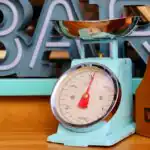
- Weighing scale
Rationale for the Lesson
This lesson enables pupils to understand how weight is measured and converted between different units. It helps them perform basic arithmetic operations with weight, which is important for understanding quantities in daily activities like shopping or cooking.
Prerequisite/Previous Knowledge
Pupils should have a basic understanding of numbers, simple addition, subtraction, and multiplication, and an idea of what weight means from their daily experiences.
Lesson Content/Board Summary
Weight
1. Conversion of Units of Weight
Weight is a measure of how heavy an object is. Common units of weight are milligrams (mg), grams (g), and kilograms (kg).
- 1000 milligrams (mg) = 1 gram (g)
- 1000 grams (g) = 1 kilogram (kg)
NOTE: When converting from a larger unit to a smaller unit, multiply. When converting from a smaller unit to a larger unit, divide.
Examples:
Example 1: Convert 4 kg to grams.
- Step 1: Identify the conversion factor: 1 kg = 1000 g.
- Step 2: Since we are converting from a larger unit (kg) to a smaller unit (g), we multiply.
- Step 3: 4 kg = 4 × 1000 g = 4000 g.
Example 2: Convert 7000 g to kilograms.
- Step 1: Identify the conversion factor: 1000 g = 1 kg.
- Step 2: Since we are converting from a smaller unit (g) to a larger unit (kg), we divide.
- Step 3: 7000 g = 7000 ÷ 1000 kg = 7 kg.
2. Addition of Weight
To add weights, ensure the units are aligned before adding. Add grams to grams and kilograms to kilograms.
Example: Add 3 kg 250 g and 2 kg 100 g.
- Step 1: Write the weights vertically, aligning the units.
- Step 2: Add the grams: 250 g + 100 g = 350 g.
- Step 3: Add the kilograms: 3 kg + 2 kg = 5 kg.
- Step 4: The total weight is 5 kg 350 g.
3. Subtraction of Weight
To subtract weights, ensure the units are aligned. Subtract grams from grams and kilograms from kilograms. Borrow from kilograms if necessary when subtracting grams.
Example: Subtract 1 kg 150 g from 4 kg 300 g.
- Step 1: Write the weights vertically, aligning the units.
- Step 2: Subtract the grams: 300 g – 150 g = 150 g.
- Step 3: Subtract the kilograms: 4 kg – 1 kg = 3 kg.
- Step 4: The remaining weight is 3 kg 150 g.
4. Multiplication of Weight
To multiply weight by a number, multiply the grams and kilograms separately. If the product of grams is 1000 g or more, convert it to kilograms and add to the kilogram total.
Example 1 (One-digit number): Multiply 2 kg 150 g by 3.
- Step 1: Multiply the grams: 150 g × 3 = 450 g.
- Step 2: Multiply the kilograms: 2 kg × 3 = 6 kg.
- Step 3: The total is 6 kg 450 g.
Example 2 (Two-digit number): Multiply 5 kg by 12.
- Step 1: Multiply the kilograms: 5 kg × 12 = 60 kg.
- Step 2: The total is 60 kg.
5. Mathematical Problems Involving Weight in Open Sentences
An open sentence is a number sentence with a missing value, often represented by a box or a letter. To solve, use inverse operations.
Example 1: A bag of rice weighs □ kg. If 5 kg is added, the total weight becomes 15 kg. Find the original weight.
- Step 1: Write the open sentence: □ kg + 5 kg = 15 kg.
- Step 2: To find the missing value, subtract the known weight from the total: 15 kg – 5 kg = 10 kg.
- Step 3: The original weight is 10 kg.
Example 2: If 3 boxes each weigh 4 kg, what is the total weight? (□ kg ÷ 3 = 4 kg)
- Step 1: Write the open sentence: □ kg ÷ 3 = 4 kg.
- Step 2: To find the missing value, multiply the known weight by the number of boxes: 4 kg × 3 = 12 kg.
- Step 3: The total weight is 12 kg.
Teaching Methods/Instructional Techniques
Discussion, Lecture, Demonstration, Question and Answer, Visual Aids
Instructional Procedures
Weight
Step 1: Introduction
Time: 5 minutes
Teaching Skill: Set Induction
Teacher’s Activity: The teacher greets the pupils and asks them to mention objects they know that have weight (e.g., books, bags of sugar, a person). The teacher then shows a weighing scale and asks what it is used for.
Pupils’ Activity: Pupils respond to the greetings and mention objects with weight. They state that a weighing scale is used to measure how heavy things are.
Learning Point: Pupils recall prior knowledge of weight and its measurement.
Step 2: Conversion of Units of Weight
Time: 10 minutes
Teaching Skill: Explanation/Demonstration
Teacher’s Activity: The teacher explains the different units of weight (milligrams, grams, kilograms) and their relationships (1000 mg = 1 g, 1000 g = 1 kg). The teacher demonstrates how to convert between grams and kilograms using simple examples on the board.
Pupils’ Activity: Pupils listen attentively, ask questions, and copy the conversion facts and examples into their notebooks.
Learning Point: Pupils learn the standard units of weight and how to convert between them.
Step 3: Addition and Subtraction of Weight
Time: 10 minutes
Teaching Skill: Guided Practice
Teacher’s Activity: The teacher explains how to add and subtract weights, ensuring units are aligned. The teacher works through examples on the board, involving both kg and g, and guides pupils through similar problems.
Pupils’ Activity: Pupils observe the examples, participate in solving problems, and practice adding and subtracting weights in their notes.
Learning Point: Pupils can correctly add and subtract different units of weight.
Step 4: Multiplication of Weight
Time: 7 minutes
Teaching Skill: Explanation/Practice
Teacher’s Activity: The teacher demonstrates how to multiply weight by a one-digit number and a simple two-digit number, showing how to regroup if grams exceed 1000.
Pupils’ Activity: Pupils pay attention to the steps and solve multiplication problems involving weight.
Learning Point: Pupils learn to multiply weight by whole numbers.
Step 5: Mathematical Problems in Open Sentences
Time: 5 minutes
Teaching Skill: Problem Solving
Teacher’s Activity: The teacher introduces the concept of open sentences with missing weights and guides pupils through solving simple word problems that require finding an unknown weight using addition, subtraction, or multiplication.
Pupils’ Activity: Pupils attempt to solve the open sentence problems as guided by the teacher.
Learning Point: Pupils can solve basic word problems involving weight in open sentences.
Step 6: Class Activity/Group Work
Time: 5 minutes
Teaching Skill: Collaborative Learning
Teacher’s Activity: The teacher divides pupils into small groups and gives each group a few problems combining conversion, addition, subtraction, and multiplication of weight, as well as an open sentence problem to solve.
Pupils’ Activity: Pupils work collaboratively in their groups to solve the given problems.
Learning Point: Pupils apply their understanding of weight operations in a collaborative setting.
Step 7: Evaluation/Review
Time: 5 minutes
Teaching Skill: Questioning/Assessment
Teacher’s Activity: The teacher evaluates the learning by asking the following questions:
- Convert 3 kg to grams.
- Add: 5 kg 400 g + 2 kg 300 g.
- Subtract: 7 kg 800 g – 4 kg 200 g.
- Multiply: 4 kg 50 g by 2.
- Complete the open sentence: □ g + 600 g = 1000 g.
Pupils’ Activity: Pupils answer orally and in writing.
Learning Point: Pupils demonstrate understanding of the lesson.
Step 8: Conclusion
Time: 3 minutes
Teaching Skill: Summarization
Teacher’s Activity: The teacher summarizes the key points of the lesson, emphasizing the importance of weight in daily life and encourages pupils to practice more at home. The teacher also gives homework.
Pupils’ Activity: Pupils listen to the summary and copy down the homework.
Learning Point: Pupils consolidate their understanding and are encouraged to continue learning.
Home Task: Solve three new exercises on Weight. Show each step and check each answer.
Lesson Keywords
- Weight – How heavy something is.
- Kilogram (kg) – A unit of mass, equal to 1000 grams.
- Gram (g) – A unit of mass, equal to 1000 milligrams.
- Milligram (mg) – A very small unit of mass, with 1000 mg in 1 gram.
- Conversion – Changing from one unit to another.
- Open Sentence – A mathematical statement with a missing value.
Differentiation
For struggling learners, the teacher will provide more one-on-one support and simpler problems involving only one unit of weight (e.g., only grams or only kilograms). Advanced learners will be given more complex problems, including word problems that require multiple steps and conversions, to challenge their understanding.
Note for teachers using this lesson plan
Ensure pupils have a solid grasp of basic arithmetic before introducing weight operations. Use real-life examples and practical demonstrations with a weighing scale to make the lesson relatable and engaging. Encourage pupils to verbally explain their steps when solving problems to reinforce their understanding.



Community Join the conversation Open discussion +