

Note for teachers using this lesson plan
This lesson focuses on developing pupils’ practical skills in telling time from a clock, interpreting information from a calendar, and correctly writing dates in various formats. Ensure you have real clocks (analogue and digital if possible) and a current calendar for demonstrations and pupil activities. By the end of the lesson, pupils should confidently be able to read and state time, identify dates on a calendar, and write any given date using different standard formats.
Class: Primary 4
Term: Third Term
Week: 4
Age: 9 years
Duration: 45 minutes
Subject: General Mathematics
Curriculum Theme: Mensuration
Focal competence: Calculating and telling time at any time of the day
Key competencies/values: Collaboration
Skills:
- Reading clocks and calendars
Previous Lesson: Addition, Subtraction, Multiplication and Division of Weights
Topic: Time
Subject Matter: Telling time on the clock, reading calendars, writing dates in different formats
Specific Objectives
By the end of the lesson, pupils/students should be able to:
Cognitive Domain
- Give time on the clock accurately.
- Read calendar entries to identify days, weeks, and months.
- Write dates in different specified formats.
Affective Domain
- Collaborate effectively with peers during group activities related to time and dates.
Psychomotor Domain
- Demonstrate how to set a clock to a given time.
- Point out specific dates and days on a calendar.
- Practically write dates using various formats.
Reference Materials
The following resources were used in planning this lesson:
- 2025 Revised 9 Years Basic Education Curriculum
- Relevant State Unified Scheme of Work
- Precious Primary Mathematics for Primary 4
- The HeadTeacher Scheme of work
Instructional Materials
The teacher will teach this lesson with the aid of:
- Clocks (analogue and digital)
- Calendar (a large wall calendar or printed calendar pages)
- Clock charts (showing different times)
- Whiteboard/Chalkboard
- Markers/Chalk
Rationale for the Lesson
Understanding how to tell time and read calendars is a fundamental life skill that helps pupils manage their daily schedules and plan activities. This lesson provides pupils with the practical knowledge to interpret time and date information, which is essential for personal organisation and academic success.
Prerequisite/Previous Knowledge
Pupils should have a basic understanding of numbers up to 60, counting, and some prior exposure to the concept of time and days of the week.
Lesson Content/Board Summary
Time: Telling Time on the Clock, Reading Calendars and Writing Dates in Different Formats
Telling Time on the Clock
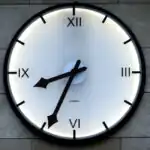
A clock helps us to know the time. It has numbers from 1 to 12 and usually has two or three hands:
- Hour hand: The short hand that points to the hour.
- Minute hand: The long hand that points to the minutes.
- Second hand: A very thin hand that moves fast, showing seconds.
Units of Time:
- 60 seconds = 1 minute
- 60 minutes = 1 hour
- 24 hours = 1 day
Reading Time:
- When the minute hand points to 12, it is “o’clock” (e.g., 3 o’clock).
- When the minute hand points to 6, it is “half past” the hour (e.g., half past 3).
- When the minute hand points to 3, it is “quarter past” the hour (e.g., quarter past 3).
- When the minute hand points to 9, it is “quarter to” the next hour (e.g., quarter to 4).
- Each number on the clock represents 5 minutes for the minute hand. We count by fives (5, 10, 15, 20, 25, 30, 35, 40, 45, 50, 55, 60).
Example 1
Question: What time is shown when the hour hand is on 7 and the minute hand is on 12?
Solution:
Step 1: Identify the hour hand and minute hand positions.
Hour hand on 7, minute hand on 12.
Step 2: Determine the hour and minutes.
Minute hand on 12 means “o’clock”. Hour hand on 7 means 7.
Answer: 7 o’clock
Example 2
Question: What time is shown when the hour hand is between 2 and 3, and the minute hand is on 6?
Solution:
Step 1: Identify the hour hand and minute hand positions.
Hour hand between 2 and 3, minute hand on 6.
Step 2: Determine the hour and minutes.
Minute hand on 6 means “half past”. Hour hand has passed 2.
Answer: Half past 2 or 2:30
Reading Calendars
A calendar shows us the days, weeks, and months of a year. It helps us keep track of dates and plan events.
Units of Time on a Calendar:
- 7 days = 1 week
- 12 months = 1 year
- 365 days = 1 year (366 days in a leap year)
Days of the Week:
- Sunday
- Monday
- Tuesday
- Wednesday
- Thursday
- Friday
- Saturday
Months of the Year:
- January
- February
- March
- April
- May
- June
- July
- August
- September
- October
- November
- December
To read a calendar, find the month, then locate the day of the week and the number for the date.
Example 1
Question: Using a calendar, find the day of the week for June 15th, 2024.
Solution:
Step 1: Locate the month of June on the calendar.
Step 2: Find the number 15 within the June calendar grid.
Step 3: Look up to the top of the column where 15 is located to find the corresponding day of the week.
Answer: Saturday (assuming a standard 2024 calendar)
Writing Dates in Different Formats
Dates can be written in several common ways:
- DD/MM/YYYY: Day, Month, Year (e.g., 04/03/2024 for March 4, 2024)
- MM/DD/YYYY: Month, Day, Year (e.g., 03/04/2024 for March 4, 2024)
- DD Month YYYY: Day, full Month name, Year (e.g., 4 March 2024)
- Month DD, YYYY: full Month name, Day, Year (e.g., March 4, 2024)
Example 1
Question: Write the date “August 21, 2025” in DD/MM/YYYY format.
Solution:
Step 1: Identify the day, month, and year.
Day = 21, Month = August (8th month), Year = 2025.
Step 2: Arrange them in DD/MM/YYYY format.
Answer: 21/08/2025
Example 2
Question: Write the date “1st January 2023” in Month DD, YYYY format.
Solution:
Step 1: Identify the day, month, and year.
Day = 1, Month = January, Year = 2023.
Step 2: Arrange them in Month DD, YYYY format.
Answer: January 1, 2023
Teaching Methods/Instructional Techniques
Discussion, Demonstration, Guided Practice, Question and Answer, Explanation, Observation, Individual Practice
Instructional Procedures
Step 1: Introduction
Time: 5 minutes
Teaching Skill: Recalling/Engaging
Teacher’s Activity: The teacher greets the pupils and asks them what they know about time and dates. The teacher then displays a clock and a calendar and asks pupils to identify them and state their uses.
Pupils’ Activity: Pupils respond to questions and identify the clock and calendar.
Learning Point: Introduction to time and dates
Step 2: Telling Time to the Hour and Half Hour
Time: 8 minutes
Teaching Skill: Demonstration/Explanation
Teacher’s Activity: The teacher uses a large demonstration clock to show how to tell time to the hour (o’clock) and half past the hour. The teacher explains the roles of the hour and minute hands and the units of time (minutes, hours). Pupils are asked to set the clock to various times like 1 o’clock, half past 4, etc.
Pupils’ Activity: Pupils observe the demonstration, listen to explanations, and practice setting the clock to given times.
Learning Point: Reading o’clock and half past
Step 3: Telling Time Using ‘Past’ and ‘To’
Time: 8 minutes
Teaching Skill: Guided Practice/Explanation
Teacher’s Activity: The teacher further explains how to tell time using ‘quarter past’, ‘quarter to’, and minutes ‘past’ or ‘to’ the hour. The teacher gives examples like 10 minutes past 2, 20 minutes to 5, quarter past 7, quarter to 11. Pupils are given different times to read from the clock chart or set on a practice clock.
Pupils’ Activity: Pupils practice telling time using ‘past’ and ‘to’ phrases, reading from clock charts, and setting clocks.
Learning Point: Using ‘past’ and ‘to’
Step 4: Reading Calendars
Time: 7 minutes
Teaching Skill: Observation/Discussion
Teacher’s Activity: The teacher displays a large calendar and explains its components: days of the week, months of the year, and how to locate specific dates. The teacher asks pupils to identify today’s date, their birthday, or other important dates on the calendar, and state the corresponding day of the week.
Pupils’ Activity: Pupils observe the calendar, identify days and months, and locate specific dates as instructed.
Learning Point: Identifying calendar components
Step 5: Writing Dates in Different Formats
Time: 7 minutes
Teaching Skill: Modelling/Writing
Teacher’s Activity: The teacher writes various dates on the board in different formats (e.g., DD/MM/YYYY, MM/DD/YYYY, DD Month YYYY, Month DD, YYYY). The teacher explains each format and guides pupils to write the current date, or a given date, in these different ways.
Pupils’ Activity: Pupils copy the examples and practice writing dates in different formats in their notebooks.
Learning Point: Date writing formats
Step 6: Practical Application
Time: 5 minutes
Teaching Skill: Problem Solving
Teacher’s Activity: The teacher presents simple word problems involving time and dates. For example: “If it is 3:00 PM now, what time will it be in 2 hours?” or “If today is Monday, March 4, what day will it be on March 7?” The teacher guides pupils to solve these problems.
Pupils’ Activity: Pupils attempt to solve the word problems, discussing their answers with peers.
Learning Point: Applying time and date skills
Step 7: Evaluation/Review
Time: 5 minutes
Teaching Skill: Questioning/Assessment
Teacher’s Activity: The teacher evaluates the learning by asking the following questions:
- What time is shown when the hour hand is on 9 and the minute hand is on 12?
- If the time is half past 6, where are the hour and minute hands pointing?
- Name three months of the year.
- Write today’s date in DD/MM/YYYY format.
Pupils’ Activity: Pupils answer orally and in writing.
Learning Point: Assessing time and date understanding
Step 8: Note-Taking
Time: 4 minutes
Teaching Skill: Guided Writing
Teacher’s Activity: The teacher guides pupils to copy the essential Board Summary notes on telling time, reading calendars, and writing dates into their notebooks.
Pupils’ Activity: Pupils copy the notes carefully into their notebooks.
Learning Point: Recording lesson summaries
Step 9: Conclusion
Time: 1 minute
Teaching Skill: Summarising
Teacher’s Activity: The teacher briefly recaps the importance of telling time and reading dates correctly in everyday life and encourages pupils to practice these skills at home.
Pupils’ Activity: Pupils listen and ask any final questions.
Learning Point: Consolidating time and date concepts
Continuous Assessment/Further Study
Type: Homework
Instruction: Answer the following questions in your notebook:
- Draw a clock face and show the time “quarter to 8”.
- Using a calendar, find out what day of the week December 25th of this year will be.
- Write your birthday in the format Month DD, YYYY.
- If a journey takes 3 hours and you start at 9:00 AM, what time will you arrive?
- Write the date “14th February 2026” in DD/MM/YYYY format.
Lesson Keywords
- Clock – An instrument used for telling time.
- Hour hand – The short hand on a clock that shows the hour.
- Minute hand – The long hand on a clock that shows the minutes.
- O’clock – Exactly on the hour.
- Half past – 30 minutes past the hour.
- Quarter past – 15 minutes past the hour.
- Quarter to – 15 minutes before the hour.
- Calendar – A chart or series of pages showing the days, weeks, and months of a particular year.
- Date – A particular day of the month or year.
- Month – One of the twelve periods of time into which a year is divided.
Differentiation
For slower learners, provide more one-on-one guidance with the demonstration clock and calendar, focusing on telling time to the hour and half-hour first, and writing dates in one format. Faster learners can be challenged with more complex time word problems (e.g., calculating duration between two times) or converting dates between multiple formats.
Suggested Lesson Videos
For further understanding, pupils can watch videos on YouTube by searching for:
telling time primary 4 mathematics
reading calendars for kids
writing dates different formats primary
Teacher Guide for Using This Lesson Plan
Before the lesson, ensure you have a working analogue clock (preferably one with movable hands for demonstration), a current calendar, and a clock chart ready. Start by engaging pupils with familiar questions about time and dates. When demonstrating time, move the clock hands slowly, explaining each step clearly. Encourage pupils to actively participate by setting the clock themselves and pointing out dates on the calendar. For writing dates, model each format on the board before asking pupils to practice. Pay attention to common errors such as confusing the hour and minute hands or mixing up date formats. Allow pupils to copy the Board Summary notes after the main teaching points have been covered and evaluated, ensuring they record the correct information for future reference.


Community Join the conversation Open discussion +