

Class: Primary 4
Term: 3rd Term
Week: 2
Age: 9 years
Duration: 45 minutes
Subject: General Mathematics
Curriculum Theme: Measurement
Previous Lesson: Meaning, Units and Areas of Rectangles and Squares.
Topic: AREA (Continued)
Subject Matter: Area of farmland classrooms and football fields, areas of towns and cities using formulas, more calculations of areas of shapes and structures in the environment, more examples on areas of rectangles and squares, quantitative aptitude on area
Specific Objectives
By the end of the lesson, pupils should be able to:
Cognitive Domain:
- Define area.
- State the formulas for calculating the area of rectangles and squares.
- Calculate the area of farmlands, classrooms, and football fields.
- Calculate the area of towns and cities using appropriate formulas.
- Solve quantitative aptitude problems involving area.
Affective Domain:
- Develop interest in finding areas of various shapes and structures in their environment.
- Appreciate the importance of area calculation in daily life.
Psychomotor Domain:
- Accurately apply formulas to calculate the area of given shapes.
- Draw simple shapes and label their dimensions for area calculation.
Social Domain:
- Work collaboratively to solve area-related problems.
Reference Materials
The following resources were used in planning this lesson:
- 9 Years Basic Education Curriculum (Primary 4 Mathematics)
- State Unified Scheme of Work for Primary 4 Mathematics
- New General Mathematics for Primary Schools 4
- www.waeconline.org.ng
- www.nerdc.gov.ng
Instructional Materials
The teacher will teach this lesson with the aid of:
- Table of dimensions
- Formula charts
- Textbooks
- Whiteboard/Blackboard
- Markers/Chalk
- Pictures of farmlands, classrooms, and football fields
Rationale for the Lesson
Understanding area helps pupils measure surfaces around them, such as their classroom floor or a football field. This knowledge is important for daily tasks like buying carpet or planning a garden, and it builds a foundation for more advanced mathematical concepts.
Prerequisite/Previous Knowledge
Pupils can identify basic shapes like squares and rectangles. They also have a basic understanding of multiplication and how to calculate the area of simple squares and rectangles.
Lesson Content/Board Summary
Area of Shapes and Structures
Definition of Area
Area is the amount of surface covered by a two-dimensional shape. It is measured in square units (e.g., square metres, square centimetres).
Area of Farmlands, Classrooms, and Football Fields
These are often rectangular or square in shape. Their areas can be calculated using the formulas for rectangles and squares.
The formulas are:
- Area of a rectangle = Length × Breadth (or Width)
- Area of a square = Side × Side (or Side2)
Area of Towns and Cities
The area of large landmasses like towns and cities can be determined by breaking them down into smaller, simpler shapes (if irregular) or using geographical survey data. For school-level calculations, they are often approximated as rectangular or square shapes.
More Examples on Areas of Rectangles and Squares
Calculating the area involves identifying the length and breadth (for rectangles) or the side (for squares) and multiplying them.
Examples:
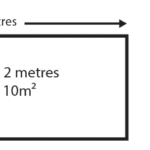
- A classroom with length 8 m and width 6 m has an area of 8 m × 6 m = 48 square metres.
- A square farmland with a side of 50 m has an area of 50 m × 50 m = 2500 square metres.
Quantitative Aptitude on Area
Quantitative aptitude problems on area test a pupil’s ability to apply area concepts to solve real-world problems or puzzles. These often involve finding missing dimensions, comparing areas, or solving word problems.
Teaching Methods/Instructional Techniques
Discussion, Lecture, Demonstration, Question and Answer, Visual Aids
Instructional Procedures
Step 1: Introduction
Time: 5 minutes
Teaching Skill: Set Induction
Teacher’s Activity: The teacher greets the pupils and reviews the previous lesson on the basic concept of area. The teacher then introduces the day’s topic by asking pupils to consider how they would find the amount of land needed for a farm or how much space their classroom occupies.
Pupils’ Activity: Pupils respond to questions and state what they remember about area.
Learning Point: Pupils recall prior knowledge and are prepared for the new lesson.
Step 2: Area of Farmlands, Classrooms, and Football Fields
Time: 10 minutes
Teaching Skill: Explanation/Demonstration
Teacher’s Activity: The teacher explains that farmlands, classrooms, and football fields are often rectangular or square. The teacher then guides pupils through examples of calculating their areas using the formulas for rectangles (Length × Breadth) and squares (Side × Side). The teacher uses a formula chart and a table of dimensions.
Pupils’ Activity: Pupils listen, observe, and practice calculating the areas of given dimensions for farmlands, classrooms, and football fields.
Learning Point: Pupils learn to apply area formulas to real-world structures.
Step 3: Area of Towns and Cities
Time: 8 minutes
Teaching Skill: Explanation/Guided Practice
Teacher’s Activity: The teacher explains that the area of large places like towns and cities can be found using similar principles, often by approximating their shapes or using survey data. The teacher provides a simplified example, treating a town as a large rectangle with given dimensions, and leads pupils to calculate its area.
Pupils’ Activity: Pupils listen, ask questions, and practice finding the area of a hypothetical town or city based on the teacher’s example.
Learning Point: Pupils understand that area calculation applies to larger geographical scales.
Step 4: Area of Shapes and Structures in the Environment
Time: 5 minutes
Teaching Skill: Encouragement/Engagement
Teacher’s Activity: The teacher encourages pupils to look around their environment (school compound, home) and identify shapes (like walls, tables, mats) whose areas they could calculate. The teacher guides them to develop interest in applying area concepts to everyday objects.
Pupils’ Activity: Pupils identify various shapes and structures in their environment and discuss how they might find their areas.
Learning Point: Pupils develop an interest in applying area concepts to their surroundings.
Step 5: More Examples on Areas of Rectangles and Squares
Time: 7 minutes
Teaching Skill: Problem Solving
Teacher’s Activity: The teacher presents more challenging examples involving areas of rectangles and squares, including problems where one dimension might need to be found given the area and the other dimension. The teacher guides pupils through the solution steps.
Pupils’ Activity: Pupils actively participate in solving the examples, asking questions, and attempting to solve on their own.
Learning Point: Pupils reinforce their understanding and problem-solving skills for area calculations.
Step 6: Quantitative Aptitude on Area
Time: 5 minutes
Teaching Skill: Analytical Thinking
Teacher’s Activity: The teacher introduces simple quantitative aptitude problems related to area, such as comparing the areas of two different shapes or finding the cost of tiling a floor given the area and cost per square unit. The teacher guides pupils on how to approach these problems.
Pupils’ Activity: Pupils attempt to solve the quantitative aptitude problems presented by the teacher.
Learning Point: Pupils develop analytical skills in applying area knowledge to solve practical problems.
Step 7: Evaluation/Review
Time: 5 minutes
Teaching Skill: Questioning/Assessment
Teacher’s Activity: The teacher evaluates the learning by asking the following questions:
- What is area?
- State the formula for the area of a rectangle.
- A classroom floor is 7 metres long and 5 metres wide. What is its area?
- Mention two places in your environment whose area can be calculated.
Pupils’ Activity: Pupils answer orally and in writing.
Learning Point: Pupils demonstrate understanding of the lesson.
Step 8: Conclusion
Time: 2 minutes
Teaching Skill: Summarization
Teacher’s Activity: The teacher summarizes the key points of the lesson, reiterating the formulas for area and their application to various shapes and structures. The teacher assigns homework, asking pupils to calculate the area of their living room at home.
Pupils’ Activity: Pupils listen to the summary and copy down the homework.
Learning Point: Pupils consolidate their learning and apply it at home.
Home Task: Solve three new exercises on AREA (Continued). Show each step and check each answer.
Lesson Keywords
- Area – The amount of surface covered by a flat shape.
- Farmland – An area of land used for farming.
- Classroom – A room where a class of pupils is taught.
- Football field – A rectangular ground for playing football.
- Formula – A mathematical rule expressed in symbols.
- Rectangle – A four-sided shape with four right angles and opposite sides equal.
- Square – A four-sided shape with all sides equal and four right angles.
- Quantitative Aptitude – The ability to solve numerical and mathematical problems.
Differentiation
For pupils who grasp concepts quickly, additional complex word problems involving composite shapes or finding missing dimensions can be provided. For pupils needing more support, the teacher can offer individual attention, provide simpler examples with smaller numbers, or use physical objects for hands-on measurement and calculation.
Note for teachers using this lesson plan
Encourage pupils to visualize the shapes discussed. Use real-life examples from the school environment for practical demonstrations. Ensure pupils understand the units of measurement for area (square units). Emphasize the importance of writing down the correct formula before calculating.

Community Join the conversation Open discussion +