

Class: Primary 4
Term: 1st Term
Week: 1
Age: 9 years
Duration: 45 minutes
Subject: General Mathematics
Curriculum Theme: Numbers and Numeration
Previous Lesson: .
Topic: WHOLE NUMBERS
Subject Matter: Counting and writing up to 10,000, counting and writing up to 100,000, counting in bundles of 10 and 100 up to 1,000,000, using overlay cards to form and write numbers, counting in 5s and 7s, counting in 60s using clock face, place value using abacus, place value of 4-digit numbers, quantitative reasoning on whole numbers.
Specific Objectives
By the end of the lesson, pupils should be able to:
Cognitive Domain:
- Count and write whole numbers up to 10,000 and 100,000.
- Count in bundles of 10 and 100 up to 1,000,000.
- Count in 5s, 7s, and 60s.
- Identify the place value of digits in 4-digit numbers.
- Use overlay cards to form and write numbers in expanded form.
- Solve simple quantitative reasoning problems involving whole numbers.
Affective Domain:
- Show enthusiasm in counting activities.
- Appreciate the use of whole numbers in daily life.
Psychomotor Domain:
- Construct a simple place value abacus.
- Make and use overlay cards to represent numbers.
- Demonstrate counting using various instructional materials like bundles and clock faces.
Social Domain:
- Work cooperatively with peers during group activities.
Reference Materials
The following resources were used in planning this lesson:
- 9 Years Basic Education Curriculum (Primary 4 Mathematics)
- State Unified Scheme of Work for Primary 4 Mathematics
- New General Mathematics for Primary Schools, Book 4
- https://www.education.gov.ng
- https://www.nerdc.gov.ng
Instructional Materials
The teacher will teach this lesson with the aid of:
- Bundles of sticks, seeds, or matchsticks
- Place value charts
- An abacus
- Overlay cards (prepared or made in class)
- Clock face model
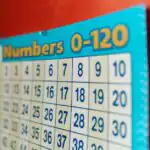
- Textbook and posters showing numbers
Rationale for the Lesson
This lesson helps pupils build a strong foundation in understanding and working with numbers, which is essential for everyday calculations. It enables them to accurately count, write, and understand the value of numbers they encounter daily.
Prerequisite/Previous Knowledge
Pupils can already count and write numbers up to 1,000 and identify simple place values (units, tens, hundreds).
Lesson Content/Board Summary
WHOLE NUMBERS
Definition of Whole Numbers
Whole numbers are the set of non-negative numbers {0, 1, 2, 3, 4, …}. They do not include fractions or decimals.
Counting and Writing Whole Numbers
Pupils learn to count and write numbers up to 10,000 and 100,000. This involves understanding how numbers are formed and arranged.
Examples:
- 1,000 (One thousand)
- 9,999 (Nine thousand, nine hundred and ninety-nine)
- 10,000 (Ten thousand)
- 100,000 (One hundred thousand)
Counting in Bundles and Specific Increments
This involves grouping items to count larger numbers efficiently.
Methods of counting:
- Counting in bundles of 10 and 100 up to 1,000,000.
- Counting in 5s (e.g., 5, 10, 15, 20…).
- Counting in 7s (e.g., 7, 14, 21, 28…).
- Counting in 60s using a clock face (e.g., 60 seconds = 1 minute, 60 minutes = 1 hour).
Place Value
Place value is the value of a digit based on its position in a number.
Using an abacus and place value chart helps to understand the position of each digit.
For a 4-digit number like 4,735:
- 4 is in the thousands place (value = 4000)
- 7 is in the hundreds place (value = 700)
- 3 is in the tens place (value = 30)
- 5 is in the units place (value = 5)
Using Overlay Cards
Overlay cards are tools used to show how numbers are formed from their place values (expanded form).
Example: To form 345, you can use cards for 300, 40, and 5.
Expanded form: 345 = 300 + 40 + 5
Quantitative Reasoning on Whole Numbers
This involves solving number puzzles and problems that require logical thinking and understanding of number patterns and relationships.
Example: If 3 + 4 = 7, then 30 + 40 = ?
Teaching Methods/Instructional Techniques
Discussion, Lecture, Demonstration, Question and Answer, Visual Aids
Instructional Procedures
Step 1: Introduction
Time: 5 minutes
Teaching Skill: Set Induction
Teacher’s Activity: The teacher greets the pupils and asks them to count from 1 to 100. The teacher then introduces the topic “Whole Numbers” by asking pupils about the importance of numbers in their daily lives.
Pupils’ Activity: Pupils respond to greetings, count from 1 to 100, and share ideas about the importance of numbers.
Learning Point: Pupils recall prior knowledge of counting and connect numbers to real-life situations.
Step 2: Counting and Writing Numbers
Time: 8 minutes
Teaching Skill: Explanation/Demonstration
Teacher’s Activity: The teacher guides pupils to count using bundles of sticks and seeds, demonstrating how to group them into tens, hundreds, and thousands. The teacher then writes numbers like 5,432 and 23,456 on the board and shows pupils how to write them in words and figures.
Pupils’ Activity: Pupils count using bundles of sticks/seeds, observe the teacher’s demonstration, and practice writing numbers in figures and words.
Learning Point: Pupils learn to count and write whole numbers up to 100,000.
Step 3: Counting in Bundles and Specific Increments
Time: 7 minutes
Teaching Skill: Activity/Guidance
Teacher’s Activity: The teacher guides pupils to count in 5s (e.g., by counting fingers), 7s (e.g., days of the week), and 60s using a clock face model. The teacher emphasizes the real-world application of these counting patterns.
Pupils’ Activity: Pupils participate in counting exercises, using their fingers and observing the clock face.
Learning Point: Pupils practice counting in various increments and understand their relevance.
Step 4: Place Value
Time: 8 minutes
Teaching Skill: Demonstration/Explanation
Teacher’s Activity: The teacher guides pupils to build a simple place value abacus and label columns (Units, Tens, Hundreds, Thousands). The teacher demonstrates how to place digits on the abacus for 4-digit numbers and explains the place value of each digit.
Pupils’ Activity: Pupils build or observe the abacus, place digits as guided, and state the place value of each digit in given numbers.
Learning Point: Pupils understand the concept of place value using an abacus and place value chart.
Step 5: Using Overlay Cards
Time: 5 minutes
Teaching Skill: Demonstration/Practical
Teacher’s Activity: The teacher demonstrates the use of pre-made overlay cards to form and write numbers in expanded form (e.g., showing 400 + 50 + 7 = 457). The teacher then guides pupils to make their own simple overlay cards.
Pupils’ Activity: Pupils observe the demonstration, participate in forming numbers with overlay cards, and make their own cards.
Learning Point: Pupils learn to use overlay cards to understand the expanded form of numbers.
Step 6: Quantitative Reasoning
Time: 5 minutes
Teaching Skill: Problem Solving
Teacher’s Activity: The teacher presents simple quantitative reasoning problems related to whole numbers on the board and guides pupils through solving them, encouraging logical thinking.
Pupils’ Activity: Pupils attempt to solve the problems, discussing their reasoning with the teacher and peers.
Learning Point: Pupils develop problem-solving skills related to whole numbers.
Step 7: Evaluation/Review
Time: 5 minutes
Teaching Skill: Questioning/Assessment
Teacher’s Activity: The teacher evaluates the learning by asking the following questions:
- Define whole numbers.
- Count in 5s from 10 to 30.
- What is the place value of 7 in the number 3,741?
- Write the number 15,203 in words.
Pupils’ Activity: Pupils answer orally and in writing.
Learning Point: Pupils demonstrate understanding of the lesson.
Step 8: Conclusion
Time: 2 minutes
Teaching Skill: Summarization
Teacher’s Activity: The teacher summarizes the key points of the lesson, reiterating the importance of whole numbers and their various applications. The teacher gives homework, asking pupils to write numbers from 1 to 100,000 in bundles of 100.
Pupils’ Activity: Pupils listen to the summary and copy down the homework.
Learning Point: Pupils consolidate their learning and are given an opportunity for further practice.
Home Task: Solve three new exercises on WHOLE NUMBERS. Show each step and check each answer.
Lesson Keywords
- Whole Numbers – The set of non-negative numbers {0, 1, 2, 3, …}.
- Place Value – The value of a digit based on its position in a number.
- Abacus – A counting frame with beads used for calculating.
- Overlay Cards – Cards used to show the expanded form of numbers.
- Quantitative Reasoning – Solving problems that involve numbers and logical thinking.
Differentiation
For fast learners, the teacher can provide more complex quantitative reasoning problems or ask them to count in larger increments (e.g., 25s, 50s). For slow learners, the teacher will provide extra bundles of sticks and one-on-one guidance in counting and identifying place values, focusing on numbers up to 1,000 before moving to larger numbers.
Note for teachers using this lesson plan
Ensure that all instructional materials are prepared before the lesson. Encourage active participation from all pupils and provide positive reinforcement. Adapt the pace of the lesson to suit the pupils’ understanding.

Community Join the conversation Open discussion +