

Class: Primary Four
term: First Term
Subject: Basic Science and Technology
Curriculum Theme: Physical & Health Education
Previous Lesson: Meaning of Athletics, Examples
Topic: Athletics: Middle Distance Races (800m and 1500m)
Content/Learning Area: Middle Distance Races: 800m and 1500m
Time Allocation: 40 minutes
performance Objectives
By the end of the lesson, pupils should be able to:
- Cognitive Domain:
1. Explain the concept of middle distance races (800m and 1500m).
2. Identify the distance covered in 800m and 1500m races.
3. Describe the strategies involved in middle-distance races.
- Affective Domain:
1. Show recognition for the importance of physical activity.
2. Express interest in participating in athletics.
- Psychomotor Domain:
1. Demonstrate proper running techniques for middle-distance races (if applicable).
- Social Domain:
1. Work cooperatively with peers during activities (if applicable).
Reference Materials
- 9 – Years basic education Curriculum
- Abuja Educational Resource Center Scheme of Work
- NAPPS National Unified Scheme of Work
- Relevant Textbooks
Instructional Materials
To deliver this lesson, the teacher will use the following materials:
- Whiteboard or chart paper
- markers or pens
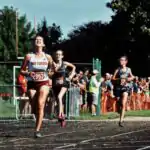
- Pictures or diagrams of athletes running middle-distance races
Rationale for the Lesson
Understanding middle-distance races introduces pupils to different aspects of athletics and promotes physical activity. This lesson builds a foundation for future lessons on othre athletic events and the importance of health and fitness.
Prerequisite/Previous Knowledge
The teacher will start by asking pupils about their favorite sports and if they have ever run a race. A brief discussion about running will lead into the introduction of middle-distance races.
Lesson Content
Middle Distance Races: 800m and 1500m
Middle-distance races are running competitions longer than sprints but shorter than long-distance races. These races need both speed and endurance.
800m Race
Also called the 800-meter race, athletes run two laps around a 400m track. It combines sprinting and endurance, requiring strategy and careful pacing.
1500m race
often called the metric mile, athletes run three and three-quarter laps around a 400m track. It’s longer than the 800m race.
Middle-Distance Technique
The 800-metre and 1500-metre races require a balance of speed and endurance. Runners should begin under control, settle into a steady pace, keep the head relaxed, swing the arms naturally and breathe rhythmically. Using all energy in the first few seconds often causes early fatigue.
Training should include warm-up, gradual running practice, rest and hydration. On a track, runners must obey starting instructions, remain aware of other athletes and avoid pushing. After finishing, they should slow down gradually rather than stopping suddenly.
Teaching Methods
To deliver this lesson, the teacher will adopt the following methods: Discussion, Description, Question and Answer.
Instructional Procedures
To deliver this lesson, the teacher will adopt the following steps:
Step 1: Introduction
Time: 5 minutes
Teaching Skill: Set Induction
Teacher’s Activity: Briefly review previous lesson and introduce the topic of middle-distance races. Ask pupils what they know about running.
Pupils’ Activity: Respond to teacher’s questions and listen attentively.
Step 2: Explanation of Key Concepts
Time: 15 minutes
Teaching Skill: Explaining, illustrating
Teacher’s Activity: Explain the concept of middle-distance races, focusing on 800m and 1500m races. Use visuals to illustrate the distances.
Pupils’ Activity: Listen attentively, ask clarifying questions, and take notes.
Step 3: Exhibition/Guided Practice
Time: 10 minutes
Teaching Skill: Demonstrating, Guiding
Teacher’s Activity: (If possible) Demonstrate proper running techniques. Guide pupils through a short practice run, focusing on pacing and endurance.
Pupils’ Activity: Participate in the practice run, following the teacher’s instructions.
Step 4: Autonomous Practice
Time: 5 minutes
Teaching Skill: Monitoring, Providing Feedback
Teacher’s activity: allow pupils to practice running individually or in small groups. Monitor their progress and provide feedback.
Pupils’ Activity: Practice running, focusing on techniques learned.
Step 5: Note-Taking
Time: 2 minutes
Teaching Skill: Guiding Note-Taking
Teacher’s Activity: Guide pupils in summarizing key concepts in their notebooks.
Pupils’ Activity: take notes on the key concepts.
step 6: Evaluation/Review
Time: 3 minutes
Teaching Skill: Questioning, Summarizing
Teacher’s Activity: Review the lesson by asking questions and summarizing key points.
Pupils’ Activity: Answer questions and participate in the review.
Objective-aligned checks:
- Explain the concept of middle distance races (800m and 1500m).
- Identify the distance covered in 800m and 1500m races.
- Describe the strategies involved in middle-distance races.
Step 7: Conclusion
time: 2 minutes
Teaching Skill: Summarizing
Teacher’s Activity: Summarize the key concepts of middle-distance races and encourage pupils to continue practicing running and other physical activities.
Pupils’ Activity: Listen attentively.
Lesson Keywords
- Middle-distance races – running competitions longer than sprints but shorter than long-distance races.
- 800m race – A race where athletes run two laps around a 400m track.
- 1500m race – A race where athletes run three and three-quarter laps around a 400m track.
- Pacing – Maintaining a consistent speed throughout a race.
- Endurance – The ability to sustain physical activity for an extended period.
Lesson Evaluation
To evaluate the learning, the teacher asks pupils to:
- what are middle-distance races?
- How many laps are in an 800m race?
- What is another name for the 1500m race?
- Why is pacing critically crucial in middle-distance races?
- What skills are needed for success in middle-distance races?
Assignment/Homework
- Research different strategies for middle-distance running.
- Practice running at a consistent pace for a set distance.
- Write a short paragraph about the importance of physical activity.
Differentiation
- For slower learners: Provide one-on-one assistance during practice.
- For advanced learners: Challenge them to research different strategies for middle-distance running.
- For visual/auditory/kinesthetic learners: Use visual aids, verbal explanations, and hands-on activities to cater to different learning styles.
Note for Teachers
Ensure to provide clear and concise explanations, use visual aids to illustrate distances, and offer individualized support during practice. Encourage pupils to ask questions and participate actively in discussions.

Community Join the conversation Open discussion +