

Class: Primary Two
Term: First Term
Subject: Basic Science and Technology
Curriculum Theme: Physical & Health Education
Previous Lesson: Dangers in Movement
Topic: Athletics – Short Distance Race
Content/Learning Area: What is a Short Distance Race?,What is a Race?,Importance of Practice,Steps of a Short distance Race,Example of a Short Distance Race
Time Allocation: 40 minutes
Performance Objectives
By the end of the lesson,pupils should be able to:
- Cognitive Domain:
1. Explain what a short distance race is.
2. Describe the steps involved in a short distance race.
3. Understand the importance of practice in athletics.
- Affective domain:
1. Show enthusiasm for participating in athletic activities.
2. Appreciate the importance of practice and teamwork.
- Psychomotor Domain:
1. Demonstrate the starting positions in a short distance race.
- Social Domain:
1.Work cooperatively with peers during activities.
Reference Materials
- 9 – years Basic Education Curriculum
- Abuja Educational Resource Center Scheme of Work
- NAPPS national Unified Scheme of Work
- Relevant Textbooks
Instructional Materials
To deliver this lesson, the teacher will use the following materials:
- Whiteboard or chart
- Markers or chalk
- Pictures or videos of short distance races
Rationale for the Lesson
Understanding short distance races introduces pupils to basic athletic concepts and the importance of practice and physical activity, laying a foundation for future lessons on sports and healthy lifestyles.
Prerequisite/Previous Knowledge
Pupils have likely watched or participated in informal races during playtime.
lesson Content
What is a Short Distance Race?
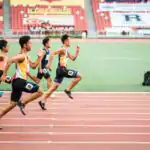
A short distance race, also called a sprint, is a race where runners compete over a short distance at their fastest speed.
Common examples include:
- 100-meter dash
- 200-meter dash
- 400-meter dash
What is a Race?
A race is a competition where people try to reach the finish line first. The person who finishes first wins.
Importance of Practice
Practice helps runners improve their speed, technique, and endurance.Regular training builds strength and skill needed to do well in short races.
These include:
- Improved speed
- Better technique
- Increased endurance
- Enhanced strength
Steps of a Short Distance race
The steps involved in a short distance race are crucial for a good start and performance.
They are:
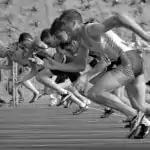
- Ready: Runners stand at the start, feet shoulder-width apart, knees bent, leaning forward.
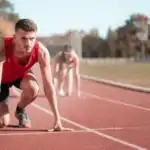
- Set: Runners lower their bodies, hands on the ground, knees bent, eyes on the finish line.
- Go: At the signal, runners sprint to the finish line.
Example of a Short Distance Race
Short distance races come in various forms, each testing different aspects of speed and endurance.
Examples are:
- 100-meter dash: A straight sprint of 100 meters.Top runners finish in about 10 seconds.
- 200-meter dash: A half-lap sprint around a track, needing speed and endurance.
- 400-meter dash: A full lap around a track, needing speed and stamina.
- 60-meter dash: An indoor sprint, common in winter competitions, focusing on explosive power.
A short distance race is a competition where people run a short distance as fast as they can. Some common short distance races include the 100-meter dash, the 200-meter dash, and the 400-meter dash.
Teaching Methods
To deliver this lesson, the teacher will adopt the following methods: Discussion, Presentation, Question and answer, Visual aids.
Instructional Procedures
To deliver this lesson, the teacher will adopt the following steps:
Step 1: Introduction
Time: 5 minutes
teaching Skill: Set Induction
Teacher’s Activity: Ask pupils about their experiences with races, introduce the topic of short distance races.
Pupils’ activity: Share their experiences, listen attentively.
Step 2: Description of Key Concepts
Time: 10 minutes
Teaching Skill: Explaining, illustrating
Teacher’s Activity: Explain what a short distance race is, using examples like the 100m, 200m, and 400m dashes.
Pupils’ activity: Listen attentively, ask clarifying questions.
Step 3: Demonstration/Guided Practice
Time: 10 minutes
Teaching Skill: Demonstrating, guiding
Teacher’s Activity: Demonstrate the three steps of a short distance race (Ready, Set, Go).
Pupils’ Activity: Imitate the teacher’s actions, practice the starting positions.
Step 4: Autonomous Practice
Time: 5 minutes
Teaching skill: Monitoring, guiding
Teacher’s Activity: Supervise pupils as they practice the starting positions.
Pupils’ Activity: Practice the starting positions independently.
Step 5: Note-Taking
Time: 5 minutes
Teaching Skill: Guiding, summarizing
Teacher’s Activity: Guide pupils in taking notes on key concepts.
Pupils’ Activity: Write down key points in their notebooks.
Step 6: Evaluation/Review
Time: 5 minutes
Teaching Skill: Questioning, summarizing
Teacher’s Activity: Ask review questions to assess understanding.
Pupils’ Activity: Answer questions, participate in discussion.
Objective-aligned checks:
- Explain what a short distance race is.
- Describe the steps involved in a short distance race.
- Show enthusiasm for participating in athletic activities.
Step 7: Conclusion
Time: 5 minutes
Teaching Skill: Summarizing, motivating
Teacher’s Activity: Summarize the key points and encourage pupils to practice the starting positions and continue learning about athletics.
Pupils’ Activity: listen to the summary, ask any remaining questions.
Lesson Keywords
- Sprint – A short distance race run at top speed.
- Dash – Another term for a short, speedy race.
- starting Position – The stance runners take at the beginning of a race.
- Technique – The specific way a runner moves to maximize speed and efficiency.
- Endurance – The ability to sustain running speed over a distance.
Lesson Evaluation
To evaluate the learning, the teacher asks pupils to:
- What is a short distance race?
- What are the three steps in a short distance race?
- Why is practice important for a race?
- Give examples of short distance races.
- What are some tips for running a short distance race?
assignment/homework
- Practice the “Ready, Set, Go” positions at home.
- Research famous Nigerian sprinters and write a short paragraph about one.
- Draw a picture of a short distance race.
Differentiation
- For slower learners: Provide one-on-one assistance and use simpler language.
- For advanced learners: Encourage them to research different types of short distance races and their world records.
- For visual/auditory/kinesthetic learners: use visual aids, verbal instructions, and hands-on practice to cater to different learning styles.
Note for Teachers
Ensure pupils have enough space to practice the starting positions safely. Emphasize the importance of following instructions and working cooperatively. Encourage pupils to ask questions and share their experiences.
Community Join the conversation Open discussion +