

Class: Primary 5
Term: 2nd Term
Week: 7
Age: 10 years
Duration: 45 minutes
Subject: General Mathematics
Curriculum Theme: Geometry and Measurement
Previous Lesson: Temperature, Thermometer Types, Reading Celsius and Word Problems.
Topic: AREA
Subject Matter: Calculating area of rectangles and squares, constructing right-angle triangles, calculating area of right-angle triangles, deriving area formula for triangles, quantitative aptitude on area.
Specific Objectives
By the end of the lesson, pupils should be able to:
Cognitive Domain:
- Calculate the area of rectangles and squares using the correct formulas.
- State the formula for calculating the area of a right-angle triangle.
- Solve quantitative aptitude problems involving area.
Affective Domain:
- Appreciate the importance of calculating area in daily life situations.
- Show attention and participation during the lesson.
- Develop a positive attitude towards solving mathematical problems.
Psychomotor Domain:
- Construct a right-angle triangle by dividing a rectangle along its diagonal.
- Apply the derived area formula (½ × base × height) to solve problems.
Social Domain:
- Work cooperatively with peers to solve area-related problems.
Reference Materials
The following resources were used in planning this lesson:
- 9 Years Basic Education Curriculum (Primary 4-6)
- State Unified Scheme of Work for Primary 5 Mathematics
- New General Mathematics for Primary Schools, Book 5
Instructional Materials
The teacher will teach this lesson with the aid of:
- Charts showing different geometric shapes (rectangles, squares, triangles)
- Charts displaying area formulas for rectangles, squares, and triangles
- Cut-out cardboard shapes of rectangles and squares
- Quantitative aptitude questions related to area.
Rationale for the Lesson
Understanding area helps pupils measure surfaces around them, like the size of a room or a piece of land. This knowledge is important for everyday tasks such as tiling floors, painting walls, or understanding spatial relationships, making it a practical skill for their lives.
Prerequisite/Previous Knowledge
Pupils have prior knowledge of basic plane shapes, multiplication, and the concept of measurement.
Lesson Content/Board Summary
Area
Area of Rectangles and Squares
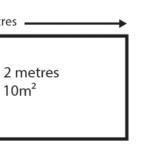
Area is the amount of surface covered by a two-dimensional shape. It is measured in square units (e.g., cm², m²).
The area of a rectangle is found by multiplying its length by its breadth (width).
Formula for Area of a Rectangle:
Area = Length × Breadth (or Width)
Example 1:
A rectangular garden is 10 meters long and 6 meters wide. Calculate its area.
Solution:
Length = 10 m
Breadth = 6 m
Area = Length × Breadth
Area = 10 m × 6 m
Area = 60 m²
Example 2:
Find the area of a rectangle with length 12 cm and breadth 5 cm.
Solution:
Length = 12 cm
Breadth = 5 cm
Area = Length × Breadth
Area = 12 cm × 5 cm
Area = 60 cm²
The area of a square is found by multiplying its side by itself (since all sides are equal).
Formula for Area of a Square:
Area = Side × Side (or Side²)
Example 3:
A square tile has a side length of 20 cm. What is its area?
Solution:
Side = 20 cm
Area = Side × Side
Area = 20 cm × 20 cm
Area = 400 cm²
Example 4:
Calculate the area of a square playground with sides measuring 15 meters.
Solution:
Side = 15 m
Area = Side × Side
Area = 15 m × 15 m
Area = 225 m²
How to solve for Length, Breadth, or Side if Area is given:
- For a Rectangle:
- If Area and Breadth are known, Length = Area / Breadth
- If Area and Length are known, Breadth = Area / Length
- For a Square:
- If Area is known, Side = √Area (square root of the Area)
Unit Conversion for Area:
When converting units for area, remember to square the conversion factor.
Conversion Table:
- 1 m = 100 cm, so 1 m² = (100 cm) × (100 cm) = 10,000 cm²
- 1 km = 1000 m, so 1 km² = (1000 m) × (1000 m) = 1,000,000 m²
NOTE: Remember that when converting from a smaller unit to a larger unit, you divide. When converting from a larger unit to a smaller unit, you multiply.
Constructing a Right-Angle Triangle from a Rectangle
A right-angle triangle can be formed by drawing a diagonal line across a rectangle. The diagonal divides the rectangle into two identical right-angle triangles.
Area of a Right-Angle Triangle
Since a diagonal divides a rectangle into two equal right-angle triangles, the area of one right-angle triangle is half the area of the rectangle.
If the rectangle has length (base) and breadth (height), then the area of the rectangle is base × height.
Therefore, the area of the right-angle triangle is ½ of (base × height).
Formula for Area of a Right-Angle Triangle:
Area = ½ × Base × Height
Example 1:
A right-angle triangle has a base of 8 cm and a height of 5 cm. Calculate its area.
Solution:
Base = 8 cm
Height = 5 cm
Area = ½ × Base × Height
Area = ½ × 8 cm × 5 cm
Area = ½ × 40 cm²
Area = 20 cm²
Example 2:
Find the area of a right-angle triangle with a base of 10 m and a height of 7 m.
Solution:
Base = 10 m
Height = 7 m
Area = ½ × Base × Height
Area = ½ × 10 m × 7 m
Area = ½ × 70 m²
Area = 35 m²
How to solve for Base or Height if Area is given:
- If Area and Height are known, Base = (2 × Area) / Height
- If Area and Base are known, Height = (2 × Area) / Base
Quantitative Aptitude on Area
Quantitative aptitude questions on area involve applying the area formulas to solve real-world problems or problems that require a combination of steps.
Example:
A rectangular field has an area of 120 m². If its length is 15 m, what is its breadth?
Solution:
Area = 120 m²
Length = 15 m
Breadth = Area / Length
Breadth = 120 m² / 15 m
Breadth = 8 m
Teaching Methods/Instructional Techniques
Discussion, Lecture, Demonstration, Question and Answer, Visual Aids
Instructional Procedures
Step 1: Introduction
Time: 5 minutes
Teaching Skill: Set Induction
Teacher’s Activity: The teacher greets the pupils and reviews the previous lesson on basic shapes. The teacher then asks pupils to identify common objects in the classroom that are rectangular or square (e.g., blackboard, desk top, floor tiles). The teacher introduces the concept of how much space these objects cover.
Pupils’ Activity: Pupils respond to greetings, recall previous lessons, and identify shapes in the classroom.
Learning Point: Pupils are reminded of basic shapes and introduced to the concept of area.
Step 2: Area of Rectangles and Squares
Time: 10 minutes
Teaching Skill: Explanation/Demonstration
Teacher’s Activity: The teacher explains what area means and introduces the formulas for the area of rectangles and squares. Using charts and cut-out shapes, the teacher demonstrates how to calculate the area, solving the examples provided in the board summary. The teacher guides pupils on how to find length or breadth when the area is given.
Pupils’ Activity: Pupils listen attentively, observe the demonstrations, copy notes, and ask questions. They follow along with the examples.
Learning Point: Pupils learn to calculate the area of rectangles and squares and understand how to find missing dimensions.
Step 3: Constructing a Right-Angle Triangle
Time: 5 minutes
Teaching Skill: Demonstration
Teacher’s Activity: The teacher takes a rectangular cut-out and demonstrates how to draw a diagonal line across it, showing that it forms two right-angle triangles. The teacher explains that these two triangles are equal in size.
Pupils’ Activity: Pupils observe the teacher’s demonstration and understand how a right-angle triangle can be formed from a rectangle.
Learning Point: Pupils understand the relationship between a rectangle and a right-angle triangle.
Step 4: Area of a Right-Angle Triangle
Time: 10 minutes
Teaching Skill: Explanation/Derivation
Teacher’s Activity: Building on the previous step, the teacher guides pupils to understand that the area of one right-angle triangle is half the area of the rectangle it came from. The teacher then derives the formula: Area = ½ × Base × Height. The teacher solves examples on the board.
Pupils’ Activity: Pupils participate in the derivation, ask questions for clarification, and copy the formula and examples.
Learning Point: Pupils learn to derive and apply the formula for the area of a right-angle triangle.
Step 5: Quantitative Aptitude on Area
Time: 5 minutes
Teaching Skill: Problem-Solving/Guidance
Teacher’s Activity: The teacher introduces the concept of quantitative aptitude questions related to area. The teacher presents and guides pupils through solving one or two aptitude questions from the instructional material, emphasizing the steps and logical reasoning required.
Pupils’ Activity: Pupils attempt to solve the problems with teacher guidance, contributing ideas and steps.
Learning Point: Pupils develop problem-solving skills for area-related quantitative aptitude.
Step 6: Classwork/Practice
Time: 5 minutes
Teaching Skill: Practice/Supervision
Teacher’s Activity: The teacher provides a few practice questions on calculating the area of rectangles, squares, and right-angle triangles, and one simple quantitative aptitude problem. The teacher moves around the classroom, assisting pupils and providing feedback.
Pupils’ Activity: Pupils work independently or in small groups to solve the given practice problems.
Learning Point: Pupils reinforce their understanding and application of area formulas.
Step 7: Evaluation/Review
Time: 5 minutes
Teaching Skill: Questioning/Assessment
Teacher’s Activity: The teacher evaluates the learning by asking the following questions:
- Define area.
- State the formula for the area of a rectangle.
- A square has a side of 7 cm. What is its area?
- How can a right-angle triangle be formed from a rectangle?
- Calculate the area of a right-angle triangle with a base of 12 cm and a height of 6 cm.
Pupils’ Activity: Pupils answer orally and in writing.
Learning Point: Pupils demonstrate understanding of the lesson.
Step 8: Conclusion
Time: 0 minutes
Teaching Skill: Summarization
Teacher’s Activity: The teacher summarizes the key points of the lesson, reiterating the formulas for the area of rectangles, squares, and right-angle triangles. The teacher assigns homework which includes calculating the area of various shapes and solving a simple word problem.
Pupils’ Activity: Pupils listen to the summary and copy down the homework assignment.
Learning Point: Pupils consolidate their learning and prepare for independent practice.
Home Task: Solve three new exercises on AREA. Show each step and check each answer.
Lesson Keywords
- Area – The amount of surface covered by a two-dimensional shape.
- Rectangle – A four-sided shape with four right angles and opposite sides equal.
- Square – A four-sided shape with four right angles and all sides equal.
- Triangle – A three-sided polygon.
- Right-angle triangle – A triangle with one angle measuring 90 degrees.
- Length – The longer side of a rectangle.
- Breadth (Width) – The shorter side of a rectangle.
- Base – The side of a triangle or other polygon on which it is considered to rest.
- Height – The perpendicular distance from the base to the opposite vertex (or side).
Differentiation
For struggling learners, the teacher will provide pre-drawn shapes and guide them step-by-step through the calculations using simpler numbers. They will be given extra practice on the basic formulas. For advanced learners, the teacher will provide more complex quantitative aptitude problems or challenge them to find the area of composite shapes made from rectangles and triangles.
Note for teachers using this lesson plan
Ensure that pupils have a strong grasp of multiplication before introducing area calculations. Use physical models and visual aids extensively to help pupils understand the concept of area and the formation of triangles from rectangles. Encourage pupils to always include the correct square units in their answers. Emphasize real-world applications of area to make the lesson more relatable.

Community Join the conversation Open discussion +