

Class: Junior Secondary School 1 (JSS1, JSS 1)
Term: 3rd Term
Week: 8
Age: 12 years
Duration: 45 minutes
Subject: Physical and Health Education
Curriculum Theme: Physical and Health Education
Previous Lesson: Features of a Computer.
Topic: PRACTICAL PERFORMANCE OF VOLLEYBALL
Subject Matter: Demonstration of volleyball skills, Application of volleyball techniques
Specific Objectives
By the end of the lesson, pupils should be able to:
Cognitive Domain:
- Identify basic volleyball skills.
- Explain the importance of proper technique in volleyball.
- State safety precautions while playing volleyball.
Affective Domain:
- Appreciate the value of teamwork in volleyball.
- Show interest in participating in volleyball activities.
- Exhibit good sportsmanship during practical sessions.
Psychomotor Domain:
- Demonstrate basic volleyball skills such as serving, passing, and setting.
- Apply learned techniques in a practical volleyball drill.
- Perform simple volleyball movements with coordination.
Social Domain:
- Cooperate with teammates during practical drills.
- Communicate effectively with peers during group activities.
- Respect rules and regulations of the game during practical performance.
Reference Materials
The following resources were used in planning this lesson:
- 9 Years Basic Education Curriculum for Physical and Health Education.
- State Unified Scheme of Work for Junior Secondary Schools.
- Ajayi, T. A. (2018). Physical and Health Education for Junior Secondary Schools 1. University Press Plc.
- YouTube: Basic Volleyball Skills Tutorial (e.g., from reputable sports channels).
Instructional Materials
The teacher will teach this lesson with the aid of:
- Volleyballs
- Volleyball net and posts
- Cones or markers
- A playground/volleyball court
- Video clips demonstrating volleyball skills and techniques
Rationale for the Lesson
This lesson helps pupils to develop fundamental movement skills and coordination through practical engagement in volleyball. It enables them to understand the importance of physical activity for health and fosters teamwork and communication skills that are useful in daily life.
Prerequisite/Previous Knowledge
Pupils are expected to have some basic knowledge of volleyball, including its general rules and the names of some basic skills, from previous lessons or observations.
Lesson Content/Board Summary
PRACTICAL PERFORMANCE OF VOLLEYBALL
I. Demonstration of Volleyball Skills
Volleyball skills are specific actions or movements performed by players to execute the game effectively. These skills involve various body parts and require practice for mastery.
The following are basic volleyball skills:
- Serve: The act of putting the ball into play by hitting it over the net from behind the end line.
- Pass (or Bump): Using the forearms to hit the ball upwards to a teammate, usually for setting up an attack.
- Set: Using fingertips to direct the ball accurately to a hitter for a spike, usually the second contact.
- Spike (or Attack): Hitting the ball forcefully downwards over the net to the opponent’s court.
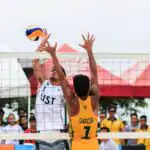
- Block: Intercepting the opponent’s spike at the net by jumping and extending hands above the net.
II. Application of Volleyball Techniques
Volleyball techniques refer to the specific methods or forms used to execute volleyball skills efficiently and effectively. Proper technique helps in controlling the ball, generating power, and preventing injuries.
Application of techniques for basic skills includes:
- Serving Technique:
- Underhand Serve: Holding the ball in one hand, swinging the other arm like a pendulum, and hitting the ball with an open hand or fist.
- Overhand Serve: Tossing the ball up, stepping forward, and hitting the ball with an open hand through its center.
- Passing/Bumping Technique:
- Form a platform with forearms, keep arms straight, bend knees, and use leg power to direct the ball.
- Keep eyes on the ball and move to get under it.
- Setting Technique:
- Form a “triangle” or “diamond” shape with thumbs and index fingers above the forehead.
- Use fingertips to push the ball upwards, extending arms and legs.
- Safety Precautions:
- Warm up properly before playing.
- Wear appropriate sports attire and footwear.
- Ensure the playing area is clear of obstacles.
- Listen to the teacher’s instructions carefully.
- Avoid rough play and maintain good sportsmanship.
Teaching Methods/Instructional Techniques
Discussion, Lecture, Demonstration, Question and Answer, Visual Aids
Instructional Procedures
Step 1: Introduction
Time: 5 minutes
Teaching Skill: Set Induction
Teacher’s Activity: The teacher greets the pupils and reminds them of the previous lesson. The teacher then tells them that today’s lesson will focus on the practical performance of volleyball skills.
Pupils’ Activity: Pupils respond to greetings, recall previous lesson, and listen attentively.
Learning Point: Pupils are prepared for the day’s lesson.
Step 2: Warm-up and Explanation of Skills
Time: 10 minutes
Teaching Skill: Explanation/Demonstration
Teacher’s Activity: The teacher leads pupils through a brief warm-up session (e.g., jogging, stretching, arm circles). The teacher then explains and briefly describes the basic volleyball skills: serving, passing, setting, spiking, and blocking, using simple language.
Pupils’ Activity: Pupils participate in the warm-up and listen to the explanation of skills.
Learning Point: Pupils get physically ready and understand the skills to be demonstrated.
Step 3: Teacher’s Demonstration of Skills
Time: 10 minutes
Teaching Skill: Demonstration/Modelling
Teacher’s Activity: The teacher demonstrates each basic volleyball skill (underhand serve, forearm pass/bump, overhead set) with proper technique. The teacher may use video clips to further illustrate correct techniques and common errors.
Pupils’ Activity: Pupils observe the demonstrations carefully, paying attention to the teacher’s movements and techniques.
Learning Point: Pupils visually learn the correct way to perform each skill.
Step 4: Supervised Practice of Serving and Passing
Time: 10 minutes
Teaching Skill: Coaching/Supervision
Teacher’s Activity: The teacher divides pupils into small groups and provides each group with a volleyball. The teacher guides pupils to practice the underhand serve and forearm pass/bump, providing immediate feedback and corrections on their techniques.
Pupils’ Activity: Pupils practice serving and passing in their groups, attempting to apply the techniques demonstrated by the teacher.
Learning Point: Pupils gain practical experience in performing basic volleyball skills.
Step 5: Supervised Practice of Setting and Application
Time: 5 minutes
Teaching Skill: Coaching/Correction
Teacher’s Activity: The teacher guides pupils to practice the overhead set, emphasizing proper hand positioning and ball contact. The teacher encourages pupils to combine skills (e.g., pass to a teammate, who then sets).
Pupils’ Activity: Pupils practice setting and try to apply combinations of skills with their teammates.
Learning Point: Pupils refine their setting technique and begin to understand skill application in a game context.
Step 6: Evaluation/Review
Time: 5 minutes
Teaching Skill: Questioning/Assessment
Teacher’s Activity: The teacher evaluates the learning by asking the following questions:
- Mention three basic volleyball skills.
- Demonstrate how to perform an underhand serve.
- Explain the importance of proper technique when passing the ball.
- State two safety precautions to observe during volleyball practice.
Pupils’ Activity: Pupils answer orally and in writing.
Learning Point: Pupils demonstrate understanding of the lesson.
Step 7: Cool-down and Conclusion
Time: 5 minutes
Teaching Skill: Closure
Teacher’s Activity: The teacher leads pupils through a brief cool-down session (e.g., light stretching). The teacher summarizes the main points of the lesson, emphasizing the importance of practice for skill development and safety. The teacher assigns homework.
Pupils’ Activity: Pupils participate in the cool-down, listen to the summary, and copy down the homework.
Learning Point: Pupils relax their muscles and consolidate their learning.
Lesson Keywords
- Volleyball – A team sport played with a ball over a net, where two teams of six players each try to score points by grounding a ball on the opposing team’s side of the court.
- Serve – The action of putting the ball into play.
- Pass (Bump) – Using forearms to hit the ball.
- Set – Using fingertips to direct the ball for an attack.
- Spike – A forceful hit of the ball downwards over the net.
- Block – Intercepting an opponent’s hit at the net.
- Technique – The specific method or form used to perform a skill.
Differentiation
For pupils who are finding the practical skills challenging, the teacher will provide more individual attention, simplify the movements, and offer additional demonstrations. More advanced pupils will be encouraged to practice combining skills in short rallies and to assist their peers, acting as peer coaches.
Note for teachers using this lesson plan
Ensure the playground is safe and clear of hazards before starting the practical session. Adequate volleyballs should be available to allow all pupils sufficient practice time. Emphasize safety and sportsmanship throughout the lesson. Adjust the pace of instruction based on the pupils’ learning speed and physical abilities.
Community Join the conversation Open discussion +