

Class: Junior Secondary School 1 (JSS1, JSS 1)
Term: 3rd Term
Week: 6
Age: 12 years
Duration: 45 minutes
Subject: Physical and Health Education
Curriculum Theme: Physical and Health Education
Previous Lesson: Execution of Basic Skills and Techniques, In.
Topic: BALL GAMES
Subject Matter: Concept and examples of ball games, history and description of volleyball, basic skills and techniques in volleyball, rules and regulations governing volleyball, officials of volleyball and their functions, facilities, equipment, values, and common injuries in volleyball.
Specific Objectives
By the end of the lesson, pupils should be able to:
Cognitive Domain:
- Define ball games and give examples.
- Describe the history of volleyball.
- List at least three basic skills and techniques in volleyball.
- State at least four rules and regulations of volleyball.
- Identify at least three officials of volleyball and their functions.
- Mention at least three facilities and equipment for volleyball.
- List common injuries associated with volleyball.
Affective Domain:
- Appreciate the importance of rules and fair play in ball games.
- Show interest in participating in volleyball activities.
- Value teamwork and cooperation during games.
Psychomotor Domain:
- Demonstrate at least two basic skills of volleyball (e.g., serving, forearm pass).
- Apply basic rules of volleyball during a game simulation.
Social Domain:
- Interact cooperatively with teammates during practical sessions.
- Exhibit sportsmanship and respect for officials in game situations.
Reference Materials
The following resources were used in planning this lesson:
- 9 Years Basic Education Curriculum for Physical and Health Education JSS 1-3.
- State Unified Scheme of Work for Physical and Health Education JSS 1.
- Physical and Health Education for Junior Secondary Schools Book 1 by O.A. Adeogun et al.
- https://www.fivb.com (International Volleyball Federation website)
Instructional Materials
The teacher will teach this lesson with the aid of:
- A volleyball
- A volleyball net and posts (or diagrams)
- A marked volleyball court (or diagram)
- Charts showing basic volleyball skills and rules
- Pictures of volleyball officials
Rationale for the Lesson
This lesson helps pupils understand the fundamentals of ball games, focusing specifically on volleyball. It enables them to learn the rules, skills, and safety measures, which promotes physical activity, teamwork, and healthy lifestyle choices.
Prerequisite/Previous Knowledge
Pupils are familiar with various types of games and understand the concept of playing with a ball from their primary school experiences.
Lesson Content/Board Summary
BALL GAMES AND VOLLEYBALL
1. Concept and Examples of Ball Games
Ball games are sports or recreational activities that involve the use of a ball. They often require physical skill, strategy, and teamwork.
The following are examples of ball games:
- Football (Soccer)
- Basketball
- Handball
- Tennis
- Table Tennis (Ping-Pong)
- Volleyball
- Baseball
- Hockey
2. History and Description of Volleyball
Volleyball was invented in 1895 by William G. Morgan in Holyoke, Massachusetts, USA. He created the game as a less strenuous alternative to basketball for older members of the YMCA.
Volleyball is a team sport where two teams are separated by a net. Each team tries to score points by grounding a ball on the opposing team’s side of the court, under organized rules.
3. Basic Skills and Techniques in Volleyball
The following are basic skills in volleyball:
- Serve: Used to put the ball into play. It can be an underhand or overhand serve.
- Forearm Pass (Bump): Used to receive an opponent’s serve or attack. The ball is contacted with the forearms.
- Set: Used to position the ball for an attacker, usually with the fingertips above the head.
- Spike (Attack): A powerful hit over the net, aimed at grounding the ball on the opponent’s side.
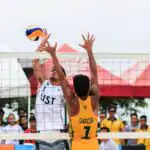
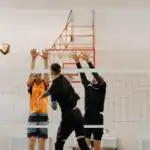
- Block: Used to stop an opponent’s spike at the net.
4. Rules and Regulations Governing Volleyball
The following are important rules in volleyball:
- A team consists of six players on the court.
- The ball can be hit a maximum of three times by a team before it must cross the net (a block does not count as a hit).
- A player cannot hit the ball twice in a row (except after a block).
- The ball must be served from behind the end line.
- Players rotate positions clockwise after gaining the serve back from the opponent.
- Touching the net during play is a fault.
- The ball must not be caught or thrown; it must be clearly hit.
- A game is played to 25 points, with a minimum two-point lead.
5. Officials of Volleyball and their Functions
The following are officials in volleyball and their functions:
- First Referee: The main official, stands on a high chair, controls the game, calls faults, and awards points.
- Second Referee: Stands opposite the first referee, assists with calls, watches for net faults, and oversees substitutions.
- Scorer: Records points, substitutions, and timeouts.
- Line Judges: Positioned at the corners of the court, they signal if the ball is in or out and detect foot faults.
6. Facilities, Equipment, Values, and Common Injuries in Volleyball
Facilities:
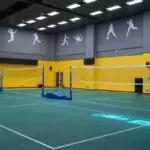
- Court: A rectangular area, typically 18 meters long and 9 meters wide.
- Net: Placed across the middle of the court, usually 2.43 meters high for men and 2.24 meters for women.
- Antennas: Vertical rods attached to the net, marking the playable area above the net.
Equipment:
- Volleyball: A spherical ball made of leather or synthetic leather.
- Posts: Support the net on either side of the court.
- Uniforms: Players wear jerseys, shorts, and athletic shoes.
Values Promoted by Volleyball:
- Teamwork and cooperation
- Discipline and adherence to rules
- Fair play and sportsmanship
- Physical fitness and health
- Communication skills
Common Injuries in Volleyball:
- Ankle sprains
- Knee injuries (e.g., patellar tendinitis, jumper’s knee)
- Finger sprains and dislocations
- Shoulder injuries (e.g., rotator cuff strains)
- Back pain
- Bruises and contusions
Teaching Methods/Instructional Techniques
Discussion, Lecture, Demonstration, Question and Answer, Visual Aids
Instructional Procedures
Step 1: Introduction
Time: 5 minutes
Teaching Skill: Set Induction
Teacher’s Activity: The teacher greets the pupils and asks them to mention different types of games they know that involve a ball. The teacher then introduces the topic “Ball Games” with a focus on Volleyball.
Pupils’ Activity: Pupils respond to the teacher’s questions by mentioning various ball games and listen attentively to the introduction.
Learning Point: Pupils recall previous knowledge about ball games and are introduced to the lesson topic.
Step 2: Concept and Examples of Ball Games
Time: 7 minutes
Teaching Skill: Explanation/Discussion
Teacher’s Activity: The teacher defines ball games and asks pupils to give more examples. The teacher lists and briefly explains some popular ball games.
Pupils’ Activity: Pupils offer definitions and examples of ball games, contributing to the discussion.
Learning Point: Pupils understand the concept of ball games and can identify various examples.
Step 3: History and Description of Volleyball
Time: 7 minutes
Teaching Skill: Lecture/Narration
Teacher’s Activity: The teacher narrates the history of volleyball, mentioning its inventor and origin. The teacher then describes what volleyball is as a sport.
Pupils’ Activity: Pupils listen to the historical account and description of volleyball, taking notes where necessary.
Learning Point: Pupils learn about the origin and fundamental nature of volleyball.
Step 4: Basic Skills and Techniques in Volleyball
Time: 8 minutes
Teaching Skill: Demonstration/Explanation
Teacher’s Activity: The teacher explains and demonstrates (or uses diagrams/charts to show) basic volleyball skills such as serving, forearm pass, and setting.
Pupils’ Activity: Pupils observe the demonstrations, ask questions, and practice simple movements where possible.
Learning Point: Pupils identify and understand the fundamental skills required in volleyball.
Step 5: Rules and Regulations, and Officials of Volleyball
Time: 7 minutes
Teaching Skill: Explanation/Questioning
Teacher’s Activity: The teacher explains the basic rules and regulations governing volleyball. The teacher also introduces the various officials and their roles in the game.
Pupils’ Activity: Pupils listen, ask questions for clarification, and note down important rules and officials.
Learning Point: Pupils comprehend the rules of play and the roles of officials in volleyball.
Step 6: Facilities, Equipment, Values, and Common Injuries in Volleyball
Time: 6 minutes
Teaching Skill: Discussion/Illustration
Teacher’s Activity: The teacher discusses the facilities and equipment needed for volleyball. The teacher also highlights the values promoted by the sport and common injuries associated with it.
Pupils’ Activity: Pupils contribute to the discussion, identify necessary facilities and equipment, and learn about the health aspects and values of volleyball.
Learning Point: Pupils understand the practical requirements, benefits, and potential risks associated with playing volleyball.
Step 7: Evaluation/Review
Time: 5 minutes
Teaching Skill: Questioning/Assessment
Teacher’s Activity: The teacher evaluates the learning by asking the following questions:
- Define ball games and give two examples.
- Who invented volleyball and in what year?
- List three basic skills in volleyball.
- Mention four rules and regulations of volleyball.
- Name two officials in volleyball and state one function for each.
- State two facilities and two pieces of equipment for playing volleyball.
- List two common injuries that can occur while playing volleyball.
Pupils’ Activity: Pupils answer orally and in writing.
Learning Point: Pupils demonstrate understanding of the lesson.
Step 8: Conclusion
Time: 1 minute
Teaching Skill: Summarization
Teacher’s Activity: The teacher summarizes the key points of the lesson, emphasizing the importance of playing safely and adhering to rules. The teacher gives pupils an assignment to draw a volleyball court in their notebooks.
Pupils’ Activity: Pupils listen to the summary and copy the assignment.
Learning Point: Pupils consolidate their learning and are given follow-up work.
Home Task: Describe or illustrate one lesson example of BALL GAMES and include one safety or performance rule. Do not practise a risky activity without adult supervision.
Lesson Keywords
- Ball Games – Sports or activities using a ball.
- Volleyball – A team sport where two teams hit a ball over a net.
- Serve – The action to start a rally in volleyball.
- Forearm Pass – A skill used to receive the ball with forearms.
- Set – A skill used to position the ball for a spike.
- Spike – A powerful hit in volleyball.
- Block – A defensive action at the net to stop an opponent’s attack.
- Referee – The main official in a volleyball game.
Differentiation
For pupils who grasp concepts quickly, the teacher will encourage them to demonstrate skills or explain rules in more detail. For those who need more support, the teacher will provide simplified explanations and one-on-one guidance during practical demonstrations.
Note for teachers using this lesson plan
Teachers should adapt the lesson to the specific needs and context of their pupils. Practical demonstrations and active pupil participation are important for effective learning in Physical and Health Education. Ensure safety precautions are taken during any practical activity.
Community Join the conversation Open discussion +