

Class: Primary 4
Term: 2nd Term
Subject: Creative And Cultural Arts
Curriculum Theme: Creative And Cultural Arts
Previous Lesson: Colour Wheel On Primary Colours and Traditional Dances In Nigeria
Topic: colour Wheel On Secondary Colours & Classification Of Local Musical instruments In Chordophone
Content/Learning Area: Colour Wheel On Secondary Colours & Classification Of Local Musical Instruments In Chordophone
Time Allocation: 40 minutes
Performance Objectives
By the end of the lesson,pupils should be able to:
- Cognitive Domain: Identify secondary colours and classify local chordophone instruments.
- Affective Domain: Appreciate the beauty and relevance of colours in everyday life and cultural music.
- Psychomotor Domain: Demonstrate how to mix primary colours to create secondary colours.
- Social Domain: Collaborate in identifying local chordophone instruments during group work.
Reference Materials
The following resources were used in planning this lesson:
- 9–Years basic Education Curriculum
- Abuja Educational Resource Center Scheme of Work
- NAPPS National Unified Scheme of Work
- Online details from: Wikipedia – Secondary color
- Relevant Textbooks
Instructional Materials
To deliver this lesson, the teacher will employ the help of the following materials:
- Colour wheel chart
- Paints (primary colours: red, blue, and yellow)
- Mixing palette and brushes
- Pictures of local chordophone instruments
- Flashcards with instrument names
Rationale for the Lesson
Understanding secondary colours enhances creativity and gratitude for art.Classifying local musical instruments fosters cultural awareness and respect for traditions.
Prerequisite/Previous Knowledge
Pupils already know the primary colours and basic concepts of traditional dances in Nigeria.
Lesson Content
Colour Wheel On Secondary Colours & Classification Of Local Musical Instruments In Chordophone
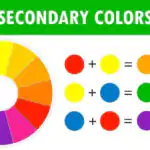
secondary Colours: These are colours formed by mixing two primary colours.
They are:
- orange (Red + Yellow)
- Green (blue + Yellow)
- Purple (Blue + Red)
Chordophone Instruments: These are local musical instruments that produce sound by vibrating strings.
Examples are:
- Kora
- Goje
- Zither
- Guitar (local variant)
- Molo
Using a Colour Wheel
A colour wheel arranges colours to show relationships. Mixing equal amounts of two primary paint colours produces a secondary colour: red and yellow make orange, yellow and blue make green, while blue and red make purple. Actual shades vary with the pigments and quantities used.
Chordophones
A chordophone produces sound mainly through vibrating strings. The strings may be plucked, bowed or struck, and the body of the instrument helps amplify the vibration. Kora, goje and molo are examples associated with African musical traditions. Pupils should classify an instrument by how its sound is produced, not merely by its shape.
Teaching Methods
To deliver this lesson, the teacher will adopt the following methods: Interactive discussion, Visual exhibition, Group work, Direct Instruction, Questioning, Summary.
Instructional Procedures
To deliver this lesson,the teacher will adopt the following steps:
Step 1: introduction
Time: 5 mins
Teaching Skill: Set Induction
Teacher’s Activity: Teacher asks pupils to recall primary colours and their importance in art.Pupils’ Activity: Pupils respond to questions about primary colours.
Step 2: Description of Secondary Colours
Time: 10 mins
Teaching Skill: Direct Teaching
Teacher’s Activity: Teacher explains secondary colours and demonstrates mixing primary colours using paints.
Pupils’ Activity: pupils observe and take notes on secondary colours.
Step 3: Interaction with chordophone Instruments
Time: 10 mins
Teaching Skill: Guided Discussion
Teacher’s Activity: Teacher introduces chordophone instruments and displays pictures, guiding pupils to classify them.
Pupils’ Activity: Pupils identify and discuss local chordophone instruments in groups.
Step 4: Note-taking
Time: 5 mins
Teaching skill: Direct Instruction
Teacher’s Activity: Teacher guides pupils to write a short note on secondary colours and chordophone instruments.
pupils’ Activity: Pupils copy notes into their notebooks.
Step 5: Evaluation/Review
Time: 5 mins
Teaching Skill: Questioning
Teacher’s Activity: Teacher asks questions based on secondary colours and chordophone instruments.
Pupils’ Activity: Pupils answer questions orally.
Objective-aligned checks:
- Identify secondary colours and classify local chordophone instruments.
- Demonstrate how to mix primary colours to create secondary colours.
Step 6: Conclusion
Time: 3 mins
Teaching Skill: Summary
teacher’s Activity: Teacher summarizes the lesson and connects it to real-life applications.
Pupils’ Activity: pupils listen attentively and ask questions for clarity.
Lesson Keywords
- Secondary Colours – Colours formed by mixing two primary colours.
- Chordophone Instruments – Musical instruments that produce sound by vibrating strings.
- Kora – A long-necked harp lute with 21 strings, originating from West Africa.
- Goje – A one-stringed fiddle used in traditional Hausa music.
- Zither – A stringed instrument with a flat body, played horizontally.
Lesson Evaluation
To evaluate the learning, the teacher asks pupils to:
- Mention the secondary colours and how they are formed.
- identify three local chordophone instruments.
- Mix primary colours to form one secondary colour.
- Explain the importance of chordophone instruments in cultural music.
Assignment/Homework
- List five examples of chordophone instruments found in Nigeria.
- Create a colour wheel showing primary and secondary colours.
- Research the cultural significance of a local chordophone instrument in your community.
Differentiation
- For slower learners: Provide simplified diagrams and one-on-one assistance during colour mixing.
- For advanced learners: Challenge them to create tertiary colours and research the history of chordophone instruments.
- For visual/auditory/kinesthetic learners: Use visual aids, play recordings of chordophone music, and allow hands-on exploration of colour mixing.
Note for Teachers
Prepare the instructional materials in advance to ensure smooth demonstrations. Encourage active participation by allowing pupils to mix colours themselves.Use local examples of chordophone instruments for better relatability. Happy teaching!
Community Join the conversation Open discussion +