

Class: Primary Six
Term: First Term
Subject: Basic Science and Technology
Curriculum Theme: Basic Technology
Previous Lesson:
Topic: Color: secondary Colours
Content/Learning area: Types of Secondary Colours
Time Allocation: 40 minutes
Performance Objectives
By the end of the lesson, pupils should be able to:
- Cognitive Domain:
1. Identify and list the types of secondary colours.
- Affective Domain:
1. Appreciate the importance of secondary colours in art and design.
- Psychomotor Domain:
1. Mix primary colours to create secondary colours.
- Social Domain:
1. Work collaboratively in groups to identify and create secondary colours.
Reference materials
- 9 – Years Basic Education Curriculum
- Abuja Educational Resource Center Scheme of Work
- NAPPS National Unified Scheme of Work
- Online Information from Color Meanings – What are Secondary Colors and How Are They Created?
- Relevant Textbooks
instructional Materials
To deliver this lesson, the teacher will employ the help of the following materials:
- Colour wheel
- Paints and brushes
- Mixing palette
- Chart showing primary and secondary colours
Rationale for the Lesson
understanding secondary colours is crucial for pupils’ artistic progress and general understanding of colour mixing. This knowledge enhances their creativity and ability to appreciate colour combinations in various contexts.
Prerequisite/Previous Knowledge
The teacher will begin by asking pupils to name the three primary colours (red, blue, and yellow). A brief discussion on their importance will follow, setting the stage for exploring how these colours combine to create new ones.
Lesson Content
Colour: Secondary Colours
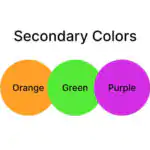
Secondary colours are created by mixing two primary colours. The primary colours are red, blue, and yellow. Mixing these creates secondary colours.
Examples of secondary colours are:
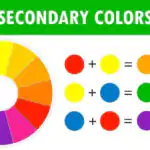
- Green – Created by mixing blue and yellow.
- Orange – Created by mixing red and yellow.
- Purple – Created by mixing blue and red.
Meaning and Examples of Secondary Colours
In basic paint mixing, secondary colours are made from pairs of primary colours: red and yellow make orange, yellow and blue make green, and blue and red make violet or purple. The exact shade depends on the pigments and amounts used.
Secondary colour describes the result of mixing; it does not mean the colour is less useful. Pupils should label the two starting colours and the observed result in a colour wheel.
Secondary Colours
In the traditional school paint model, secondary colours are made by mixing two primary colours: red and yellow make orange, yellow and blue make green, and blue and red make violet or purple. The exact result depends on the pigments and their proportions.
Mix small equal amounts first, record the combination and adjust one colour gradually. This paint-mixing model is different from mixing coloured light on a screen.
Teaching Methods
To deliver this lesson, the teacher will adopt the following methods: Discussion, Exhibition, Hands-on Activity, Interactive teaching, and Questioning.
Instructional procedures
To deliver this lesson, the teacher will adopt the following steps:
Step 1: Introduction
Time: 5 mins
Teaching Skill: Set Induction
Teacher’s Activity: The teacher asks pupils to name the three primary colours and discusses their meaning.
Pupils’ Activity: Pupils recall and mention the primary colours: red, blue, and yellow.
Step 2: Identifying Secondary Colours
Time: 10 mins
Teaching Skill: Demonstration
Teacher’s Activity: The teacher shows the colour wheel and explains that secondary colours are created by mixing two primary colours.
Pupils’ Activity: Pupils observe the colour wheel and listen to the teacher’s description.
Step 3: mixing Colours
Time: 10 mins
Teaching Skill: Hands-on Activity
Teacher’s Activity: The teacher instructs pupils to mix primary colours using paints to create secondary colours.
Pupils’ Activity: Pupils work in groups to mix colours and observe the new colours formed.
Step 4: Note Taking
Time: 5 mins
Teaching Skill: Interactive
Teacher’s Activity: The teacher guides pupils in taking notes on secondary colours and their creation process.
Pupils’ Activity: Pupils wriet down notes as instructed by the teacher.
Step 5: Evaluation/Review
Time: 5 mins
Teaching Skill: questioning
Teacher’s Activity: The teacher asks pupils questions to assess their understanding of secondary colours.Pupils’ Activity: pupils respond to questions, demonstrating their understanding of the lesson.
Step 6: conclusion
Time: 5 mins
Teaching Skill: Summarization
Teacher’s Activity: The teacher summarizes the lesson, highlighting the importance of secondary colours.
Pupils’ Activity: Pupils listen and reflect on what they have learned.
Lesson Keywords
- Primary Colours – The basic colours that cannot be created by mixing other colours.
- Secondary Colours – Colours created by mixing two primary colours.
- Colour Wheel – A visual portrayal of colours arranged according to their chromatic relationships.
- Mixing Palette – A surface used for mixing paints.
- Tertiary Colours – Colours created by mixing a primary colour with a secondary colour.
Lesson Evaluation
To evaluate the learning, the teacher asks pupils to:
- What are the three primary colours?
- List the secondary colours.
- How is the colour green created?
- Why are secondary colours critically important in art?
- Demonstrate mixing two primary colours to create a secondary colour.
Assignment/Homework
- List three examples of where you see secondary colours in everyday life.
- Mix two different sets of primary colours to create two different secondary colours.
- Write a short paragraph explaining why understanding secondary colours is important in art and design.
Differentiation
- For slower learners: Provide one-on-one assistance during the colour mixing activity and use simpler instructions.
- For advanced learners: Introduce tertiary colours and challenge them to create these by mixing primary and secondary colours.
- For visual/auditory/kinesthetic learners: Use visual aids like colour charts, explain the process verbally, and allow hands-on mixing activities.
Note for Teachers
Ensure that pupils have access to clean water and materials for mixing colours. Supervise the mixing activity closely to avoid wastage and ensure accurate colour creation. Encourage pupils to explore different combinations and observe the results.
Community Join the conversation Open discussion +