

Class: Primary Three
Term: Third Term
subject: Pre-vocational Studies
Curriculum Theme: home Economics
Previous Lesson: Classification of Food
Topic: Food Belonging To various Food groups
Content/Learning Area: What is a Food Group?, Food Groups and Their Functions, Examples of Foods in Each Group, Foods Belonging to More Than One Group
Time Allocation: 40 minutes
Performance objectives
By the end of the lesson, pupils should be able to:
- Cognitive Domain:
1. Identify different food groups and their functions.
2. Classify foods into their respective groups.
- Affective Domain:
1.Appreciate the importance of a balanced diet.
2. Discuss the benefits of eating foods from various groups with peers.
- Psychomotor Domain:
1. Sort pictures or models of food into their respective groups.
- Social Domain:
1. Work collaboratively in group activities.
Reference Materials
- 9 – Years Basic Education Curriculum
- Abuja Educational Resource Center Scheme of Work
- NAPPS National Unified scheme of Work
- relevant Textbooks
Instructional Materials
To deliver this lesson, the teacher will use the following materials: Charts showing food groups, Pictures of various foods, Flashcards with food names, Whiteboard or chart paper, Markers or crayons.
rationale for the Lesson
Understanding food groups is crucial for developing healthy eating habits. This lesson lays the foundation for future lessons on nutrition and balanced diets, promoting lifelong well-being.
Prerequisite/Previous Knowledge
Pupils have prior knowledge of different types of food.
Lesson Content
What is a Food Group?
A food group is a collection of foods with similar nutritional value.These groups help us understand the nutrients our bodies need.
Food groups and Their Functions
Food groups are categories of foods that share similar nutritional properties. They are essential for providing the body with the necessary nutrients for growth, repair, and energy.
The following are the food groups and their functions:
- Carbohydrates: These give us energy for daily activities.
- Proteins: These help us grow and repair our bodies.
- Fats and Oils: these provide energy and help our bodies use vitamins.
- Vitamins and Minerals: These keep us healthy and help our bodies work properly.
- Water: Essential for all bodily functions and keeps us hydrated.
Examples of Foods in Each Group
Different foods fall into different food groups based on their primary nutrients.
Examples are:
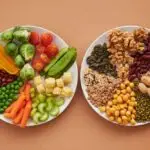
- Carbohydrates: Rice, bread, potatoes, pasta, corn, oats, and cereals.
- Proteins: Meat, fish, eggs, beans, lentils, nuts, seeds, and dairy products (milk and cheese).
- Fats and Oils: Butter, margarine, vegetable oils, avocados, nuts, and seeds.
- Vitamins and minerals: Fruits (oranges,apples,bananas,strawberries),vegetables (carrots,spinach,broccoli,tomatoes),dairy (milk,yogurt,cheese),and fish (salmon,tuna).
Foods Belonging to More Than One Group
Some foods contain meaningful amounts of nutrients from multiple food groups.
These include:
- Milk provides protein and vitamins.
- Nuts provide protein and fats.
- Vegetables can provide vitamins and carbohydrates.
- Legumes provide both protein and carbohydrates.
- Avocados provide healthy fats and some vitamins.
Teaching Methods
To deliver this lesson, the teacher will adopt the following methods: Discussion, Question and answer, Group work, Demonstration.
Instructional Procedures
To deliver this lesson,the teacher will adopt the following steps:
Step 1: Introduction
time: 5 minutes
Teaching Skill: Set Induction
Teacher’s Activity: Review previous lesson on food classification. Ask pupils to name some foods they know.
Pupils’ Activity: Respond to teacher’s questions, participate in discussion.
Step 2: Clarification of Key Concepts
Time: 10 minutes
Teaching Skill: Explanation
Teacher’s Activity: Explain the concept of food groups and their functions using charts and pictures.
Pupils’ Activity: Listen attentively, ask clarifying questions.
Step 3: Demonstration/Guided Practice
Time: 10 minutes
Teaching Skill: Demonstration
Teacher’s Activity: Demonstrate sorting foods into their respective groups using flashcards.
Pupils’ Activity: Observe the demonstration, participate in guided practice.
Step 4: Self-Reliant Practice
Time: 5 minutes
Teaching Skill: Monitoring
teacher’s Activity: Supervise pupils as they independently sort pictures of foods into groups.
Pupils’ Activity: Sort pictures of foods into their respective groups.
Step 5: note-Taking
Time: 5 minutes
Teaching Skill: Note-taking
Teacher’s Activity: Guide pupils in taking notes on the main points of the lesson.
Pupils’ Activity: Write down key data in their notebooks.
Step 6: Evaluation/Review
Time: 5 minutes
Teaching Skill: Questioning
Teacher’s Activity: Ask review questions to assess understanding.
Pupils’ Activity: Answer review questions.
Objective-aligned checks:
- Identify different food groups and their functions.
- Classify foods into their respective groups.
Step 7: Conclusion
Time: 2 minutes
teaching Skill: Summarizing
Teacher’s Activity: Summarize the main points and emphasize the importance of eating a balanced diet for good health. Assign homework.
Pupils’ Activity: Listen to the summary and note the homework assignment.
Lesson Keywords
- Food Group – A category of foods with similar nutritional properties.
- Carbohydrates – Nutrients that provide energy to the body.
- Proteins – nutrients that help in growth and repair of the body.
- Fats – Nutrients that provide energy and help the body absorb vitamins.
- Vitamins – organic compounds that are essential for health.
- minerals – Inorganic substances needed for various bodily functions.
lesson Evaluation
To evaluate the learning, the teacher asks pupils to:
- Name three food groups and their functions.
- Give two examples of foods from each group.
- Mention one food that belongs to more than one group.
- Explain why it is indeed indeed critically significant to eat a balanced diet.
Assignment/Homework
- List five foods from each food group.
- Research and write down the primary nutrients found in each of the foods you listed.
Differentiation
- For slower learners: Provide one-on-one assistance and use simpler language.
- For advanced learners: Encourage them to research additional foods and their respective groups.
- For visual/auditory/kinesthetic learners: Use visual aids, verbal explanations, and hands-on activities to cater to different learning styles.
Note for Teachers
Ensure to use real-life examples and locally available foods to make the lesson relatable for the pupils. Encourage active participation and create a fun learning surroundings.
Community Join the conversation Open discussion +