

Class: Primary Five
Term: First Term
Subject: Pre-vocational Studies
Curriculum Theme: Agricultural Science
Topic: Selection and Transplanting of Seeds
Previous Topic: How To Grow Crops
Time Allocation: 40 minutes
Learning Content: Selection of Seeds, Transplanting of Seeds
Previous Lesson: How To Grow Crops, Preparation Of Nursery Beds and Sowing
Performance Objectives
By the end of the lesson, pupils should be able to:
Cognitive Domain
- Explain the steps involved in selecting and transplanting seedlings.
- explain the importance of careful seed selection and transplanting.
Psychomotor Domain
- Demonstrate the process of transplanting seedlings correctly.
Affective Domain
- Appreciate the importance of careful seed selection and transplanting.
Social Domain
- Work cooperatively in groups to select and transplant seedlings.
Reference Material
- 9 – Years Basic Education Curriculum
- Abuja Educational Resource Center Scheme of Work
- NAPPS National Unified scheme of Work
- Online Details
- Relevant Textbooks
instructional Materials
To deliver this lesson, the teacher will make use of:
- Seeds
- Seedlings
- Containers
- Soil
- Compost
- Watering can
- Whiteboard or chart paper
- Markers or pens
Entry Behavior/Set Induction
The teacher will begin by asking pupils what they already know about planting seeds. The teacher will then show pictures of healthy and unhealthy seeds, prompting discussion on the differences. This will lead into a discussion about the importance of selecting good seeds for successful planting.
Rationale
This lesson is crucial for teaching pupils the basic skills of selecting and transplanting seeds,which are essential for successful crop production.Understanding these steps will help them in future agricultural endeavors and promote a deeper understanding of plant growth.
Applied Understanding: How To Grow Crops; Selection And Transplanting Of Seeds
A complete answer should define the central idea, give a clear class-appropriate example, explain its purpose or effect, and state a safe or responsible application. Examples should show the concept in use instead of repeating the definition.
Learners should compare a correct example with a non-example and explain the difference. Where facts, rules or office-holders can change, the teacher should verify the current position from an official or approved source before the lesson.
Teaching Method
To deliver this lesson, the teacher will adopt the following methods:
- Discussion
- Demonstration
- group work
Lesson Procedure
Step 1: Introduction
Time: 5 minutes
Teaching Skill: questioning, Discussion
Teacher’s Activity: Review previous lesson on growing crops. Introduce the topic of seed selection and transplanting.
Pupils’ Activity: Participate in discussion, answer questions.
Step 2: Clarification of Key Concepts
Time: 10 minutes
Teaching Skill: Explanation, Demonstration
Teacher’s Activity: Explain the importance of selecting healthy seeds and the steps involved in transplanting.
pupils’ Activity: Listen attentively, ask clarifying questions.
Step 3: Demonstration/Guided Practice
Time: 10 minutes
Teaching Skill: Demonstration, Guided Practice
Teacher’s Activity: Demonstrate the process of selecting and transplanting seedlings.
Pupils’ Activity: Observe the demonstration, participate in guided practice.
Step 4: Autonomous Practice
Time: 10 minutes
Teaching Skill: Monitoring, Feedback
Teacher’s Activity: Supervise pupils as they work in groups to select and transplant seedlings.
Pupils’ Activity: Work cooperatively in groups, apply learned skills.
Step 5: Note-Taking
Time: 2 minutes
Teaching Skill: Note-Taking
Teacher’s Activity: Guide pupils in taking notes on key concepts.
Pupils’ Activity: Take notes on key concepts.
Step 6: evaluation/Review
Time: 3 minutes
Teaching Skill: Questioning, Feedback
Teacher’s Activity: Ask questions to assess understanding.
Pupils’ Activity: Answer questions, participate in review.
Lesson Content
Selection of Seeds
To grow healthy crops, selecting the right seeds is vital. Before planting, carefully choose seeds that are healthy and likely to grow well. Good seeds are usually firm, free of blemishes, and uniform in size.
Factors to Consider
- Choose seeds that are healthy and free from disease. Look for signs of damage or discoloration.
- Avoid seeds that are too small, discolored, or damaged. These are less likely to germinate.
- Consider the climate and soil type. Different seeds thrive in different conditions.
Transplanting of Seeds
Transplanting involves several steps:
Steps in transplanting
- Prepare the soil by loosening it and adding compost.This helps seedlings establish strong roots.
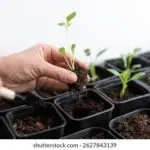
- Carefully remove the seedling from its container, avoiding root damage. Gently tap the container.
- Place the seedling in its new location, ensuring enough space.Plant it at the same depth as before.
- Water the seedling immediately after transplanting. This helps the roots settle and absorb water.
Differentiation
For pupils who need extra support, the teacher will provide one-on-one assistance during the guided practice. For advanced learners, the teacher will encourage them to research different types of seeds and their specific transplanting needs.
Evaluation
- What should you look for when selecting healthy seeds?
- Describe the steps involved in transplanting a seedling.
- Why is it critically important to water a seedling after transplanting?
- How can you tell if a seedling is ready to be transplanted?
- What are some benefits of transplanting seedlings?
Observation
- pupils’ participation in discussions
- Pupils’ ability to select healthy seeds
- Pupils’ ability to transplant seedlings correctly
- Pupils’ teamwork skills
Conclusion
To conclude the lesson, the teacher will summarize the key steps in selecting and transplanting seeds, emphasizing the importance of careful selection and proper technique for successful crop growth. The teacher will also encourage pupils to continue practicing these skills at home or in their school garden, and to ask any remaining questions.
Home Task: List four lesson examples connected with Selection and Transplanting of Seeds and add one correct use, step or safety rule.



Community Join the conversation Open discussion +