

Class: Primary Two
Term: First term
Subject: Cultural & Creative Arts
Curriculum Theme:
Previous Lesson: Types and Examples of Craft Making
Topic: Paper Craft Making and Decorations
Content/Learning Area: What is Paper Craft?,Types of Paper Craft,Making Paper Craft,Examples of Paper Craft
Time Allocation: 40 minutes
Performance Objectives
By the end of the lesson,pupils should be able to:
- Cognitive Domain:
– Identify different types of paper craft.
– Explain the process of making paper crafts.
– Describe examples of paper crafts.
- Affective Domain:
– Show interest and enthusiasm in paper craft activities.- Appreciate the creativity involved in paper craft.
- Psychomotor Domain:
– Build and join papers together to create simple paper crafts.
– Use scissors and glue safely and effectively.
- Social Domain:
– Work cooperatively with peers during group activities.
– Share ideas and materials respectfully.
Reference Materials
- 9 – Years Basic Education Curriculum
- Abuja Educational Resource centre Scheme of Work
- NAPPS National Unified Scheme of Work
- Relevant Textbooks
Instructional Materials
To deliver this lesson, the teacher will use the following materials:
- Colored paper
- Scissors
- Glue
- Markers
- Examples of different paper crafts
- Whiteboard or chart paper
Rationale for the Lesson
This lesson introduces pupils to the art of paper craft, fostering creativity and fine motor skills. Understanding paper craft techniques provides a foundation for future art projects and encourages self-expression.
Prerequisite/Previous Knowledge
Pupils have basic knowledge of using scissors and glue.
Lesson Content
What is Paper Craft?
Paper craft is the art of making things using paper. It can be simple, like folding a paper airplane, or complex, like creating detailed models.
Types of Paper Craft
Paper crafts come in various forms,each offering unique creative possibilities. The following are examples:
- kite: A toy that flies in the air, made of paper, string, and a frame.
- Aeroplane: A paper model of an airplane that can be flown by hand.
- Fan: A device to create a breeze, made of foldable paper.
- cap: A hat worn on the head, made of paper and decorated.
- Crown: A headwear for royalty, made of paper and decorated with embellishments.
- Paper Lantern: A decorative light covering made from folded or cut paper.
- Greeting Cards: Handmade cards with paper cutouts, drawings, and messages.
How to Make Paper Craft
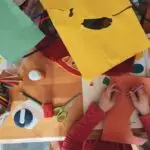
Making paper crafts is easy! You need colored paper, scissors, glue, and markers. Follow these steps:
- Choose a design.
- Cut out the shapes.
- Fold and glue the pieces together.
- Decorate your craft.
Examples of Paper craft
Paper crafts can be used to create a wide array of decorative and functional items. These include:
- Paper flowers: Made by cutting out petals and gluing them together.
- Paper animals: Created by cutting out shapes and gluing them together.
- Paper masks: Made by cutting out shapes and attaching them to cardboard.
- Paper Chains: Decorative chains made by linking paper strips together.
- Origami: The art of folding paper into decorative shapes and figures.
- Paper Weaving: Creating patterns by interlacing strips of paper.
Teaching Methods
To deliver this lesson, the teacher will adopt the following methods: Demonstration, Clarification, Discussion, and Practical Activity.
Instructional Procedures
To deliver this lesson, the teacher will adopt the following steps:
Step 1: Introduction
Time: 5 minutes
Teaching Skill: Set Induction
Teacher’s Activity: Introduces the topic, asks questions about crafts, shows examples of paper crafts.
Pupils’ Activity: Respond to questions, observe examples.
Step 2: Description of Key Concepts
Time: 10 minutes
Teaching Skill: Explanation
Teacher’s Activity: Explains what paper craft is and different types of paper crafts.
Pupils’ Activity: Listen attentively,ask clarifying questions.
Step 3: Demonstration/Guided Practice
Time: 15 minutes
Teaching Skill: Demonstration,Guided Practice
Teacher’s Activity: Demonstrates how to make a simple paper craft (e.g., a paper airplane or a simple origami shape). Guides pupils through the steps.
Pupils’ Activity: Observe the demonstration, follow instructions, attempt to make the craft.
Step 4: Independant Practice
Time: 5 minutes
Teaching Skill: Monitoring, Feedback
Teacher’s Activity: Monitors pupils as thay work independently, provides assistance as needed.Pupils’ Activity: Make their own paper crafts.
Step 5: Note-Taking
Time: 2 minutes
Teaching Skill: Note-taking
Teacher’s Activity: Guides pupils in taking notes on key concepts and steps.Pupils’ Activity: Write down important data.
Step 6: Evaluation/Review
Time: 3 minutes
Teaching Skill: Questioning, Feedback
Teacher’s Activity: Asks review questions, provides feedback.
Pupils’ Activity: Answer questions, reflect on learning.
Step 7: Conclusion
Time: 2 minutes
Teaching skill: summarizing
Teacher’s Activity: Summarizes the lesson and assigns homework.Pupils’ activity: Listen to the summary and note the homework.
Lesson Keywords
- paper Craft – The art of making objects from paper.
- Origami – The Japanese art of paper folding.
- Kite – A toy made of paper that flies in the wind.
- Decoration – Items used to adorn or embellish.
- Scissors – A tool used for cutting paper.
Lesson Evaluation
To evaluate the learning, the teacher asks pupils to:
- Name three types of paper craft we discussed.
- What are the steps to make a paper crown?
- What kind of paper craft would you like to make?
- (observation): Observe pupils’ participation, understanding of concepts, and ability to create paper crafts. Note any difficulties encountered.
Assignment/Homework
- Create a simple paper craft of your choice at home.
- Write down the steps you followed to make your paper craft.
- Bring your paper craft to class for show and tell.
Differentiation
- For slower learners: Provide one-on-one assistance and simpler craft designs.
- For advanced learners: Challenge them to create more complex designs and explore different decorative techniques.
- For visual/auditory/kinesthetic learners: Use visual aids,verbal instructions,and hands-on activities to cater to different learning styles.
Note for Teachers
Ensure all materials are readily available before the lesson. Supervise pupils closely during the practical activity to ensure safe use of scissors and glue. Encourage creativity and self-expression in their paper crafts.
Community Join the conversation Open discussion +