

Class: Primary Two
Term: Third Term
Subject: Cultural & Creative Arts
Curriculum Theme:
Previous Lesson:
Topic: Story Telling
Content/Learning Area: What is a story?, Elements of a story, Characters, setting, Plot, Conflict, Resolution
Time Allocation: 40 minutes
Performance Objectives
By the end of the lesson, pupils should be able to:
- Cognitive Domain:
1. Understand what a story is and identify its key elements.
2. Explain the importance of each element in storytelling.
- Affective Domain:
1. Appreciate the importance and enjoyment of storytelling.
2. Show enthusiasm for participating in storytelling activities.
- Psychomotor Domain:
1. Create simple stories using basic elements of storytelling.
2. Participate actively in group storytelling activities.
- social Domain:
1. Work collaboratively in group storytelling activities.
2. Communicate effectively with peers during group work.
Reference Materials
- 9 – Years Basic Education Curriculum
- Abuja Educational Resource Center Scheme of Work
- NAPPS National Unified Scheme of Work
- Relevant Textbooks
Instructional Materials
To deliver this lesson, the teacher will use the following materials:
- Whiteboard or chart paper
- Markers or crayons
- Storybooks (optional)
Rationale for the Lesson
This lesson introduces pupils to the fundamental elements of storytelling, fostering creativity and communication skills. Understanding story structure will benefit their reading comprehension and creative writing abilities in future lessons.
Prerequisite/Previous Knowledge
Pupils have likely heard stories before and can share some of their favorite ones.
Lesson Content
What is a Story?
A story is a way to share adventures, experiences, and lessons using words and actions.It’s like a journey with characters, exploring their world and learning from them.
Elements of a Story
A story is composed of several key elements that work together to create an engaging narrative. These elements help to structure the story and make it interesting for the audience.
Characters
Characters are the people, animals, or objects in the story. They experience events and drive the plot. Examples are:
- The hero (who faces challenges)
- The villain (who opposes the hero)
- The sidekick (who helps the hero)
- The protagonist (the main character)
- The antagonist (the character in conflict with the protagonist)
Setting
The setting is the time and place of the story. It can be real (like a school) or imaginary (like a magical kingdom). The setting helps us understand the characters and their actions. Examples include:
- A bustling city in the 1920s
- A remote village in the countryside
- A spaceship traveling through the galaxy
- A haunted house on a dark, stormy night
- A serene beach at sunset
Plot
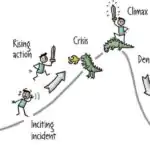
The plot is the sequence of events. It usually includes: exposition (the beginning), rising action (events building to the climax), climax (the most exciting part), falling action (events after the climax), and resolution (the end). Examples of plot elements include:
- exposition: introducing the main characters and setting the scene.
- Rising Action: A series of events that lead to the climax.
- Climax: The turning point of the story, were the conflict is most intense.
- Falling Action: Events that occur after the climax, leading to the resolution.
- Resolution: The conclusion of the story, where the conflict is resolved.
Conflict
Conflict is the main problem the characters face.It creates tension and keeps us interested. Conflict can be between characters, a character and nature, or within a character. Examples of conflict include:
- A disagreement between two friends
- A character struggling against a natural disaster
- An internal struggle with one’s own beliefs
- A battle between good and evil
- A competition between two rivals
Resolution
The resolution is how the conflict is solved. It’s the outcome and the final state of the characters.It can be happy, sad, or bittersweet.Examples of resolutions include:
- the hero defeats the villain and saves the day.
- Two characters reconcile after a long argument.
- A character learns a valuable lesson and grows as a person.
- A community comes together to overcome a challenge.
- The mystery is solved, and justice is served.
Teaching Methods
To deliver this lesson, the teacher will adopt the following methods: Discussion, Group work, Storytelling
Instructional Procedures
To deliver this lesson, the teacher will adopt the following steps:
Step 1: Introduction (set Induction)
Time: 5 minutes
Teaching Skill: Questioning, Discussion
Teacher’s Activity: Engage pupils by asking about their favorite stories and what makes a story engaging.
Pupils’ Activity: Share their favorite stories and participate in the discussion.
Step 2: Clarification of Key Concepts
Time: 10 minutes
teaching Skill: Clarification, Exhibition
Teacher’s Activity: Explain the key elements of a story (characters, setting, plot, conflict, resolution) using simple examples.Pupils’ Activity: Listen attentively and ask clarifying questions.
Step 3: Demonstration/Guided Practice
Time: 10 minutes
Teaching Skill: Modeling, Guided Practice
Teacher’s Activity: Tell a short story, highlighting the key elements. Guide pupils in identifying these elements in the story.
Pupils’ Activity: Listen to the story and identify the key elements.
Step 4: Self-reliant Practice
Time: 10 minutes
Teaching Skill: Monitoring, feedback
Teacher’s Activity: Divide pupils into groups and ask them to create their own short stories.
Pupils’ Activity: Work in groups to create and share their stories.
step 5: Note-Taking
Time: 2 minutes
Teaching Skill: Note-Taking
teacher’s Activity: Guide pupils in summarizing the key concepts of the lesson.
Pupils’ Activity: Take notes on the key elements of a story.
Step 6: Evaluation/Review
Time: 3 minutes
Teaching Skill: Questioning, Feedback
Teacher’s Activity: Ask review questions to assess understanding.
Pupils’ Activity: Answer the review questions.
Objective-aligned checks:
- Explain the importance of each element in storytelling.
- Show enthusiasm for participating in storytelling activities.
Step 7: Conclusion
Time: 2 minutes
Teaching Skill: Summarizing
Teacher’s Activity: Summarize the key elements of storytelling and encourage pupils to continue practicing their storytelling skills at home.
Pupils’ Activity: Listen to the summary and ask any remaining questions.
Lesson Keywords
- Characters – The people, animals, or beings in a story.
- Setting – The time and place where a story happens.
- Plot – the sequence of events in a story.
- Conflict – The main problem or struggle in a story.
- Resolution – How the conflict is solved at the end of a story.
Lesson Evaluation
To evaluate the learning, the teacher asks pupils to:
- what are the main parts of a story?
- describe the setting of a story you know.
- What is the problem (conflict) in a story you like?
- How was the problem solved (resolution)?
- What is the difference between a hero and a villain?
Assignment/Homework
- Think of a story you know and write down the names of the characters.
- Draw a picture of the setting of your favorite story.
- Write a short paragraph about the problem in a story you like.
Differentiation
- For slower learners: Provide one-on-one assistance and simpler story prompts.
- For advanced learners: Challenge them to create more complex stories with multiple characters and plot twists.
- For visual/auditory/kinesthetic learners: Use visual aids, storytelling with actions, and hands-on activities to engage different learning styles.
Note for Teachers
Encourage creativity and participation from all pupils. Provide positive feedback and create a supportive learning environment. adjust the lesson as needed based on the pupils’ understanding and engagement.



Community Join the conversation Open discussion +