

Class: Primary Two
Term: First Term
Subject: Cultural & Creative Arts
Topic: Craft Making
Previous Lesson: Introduction To Craft Making
Content/Learning Area: Identifying materials for craft making, Listing craft materials, Fabric types, Wood types
Time Allocation: 40 minutes
Performance Objectives
by the end of the lesson, pupils should be able to:
- Cognitive Domain:
1. Identify various materials used in craft making.
2. List at least three different craft materials.
3. Differentiate between different types of fabric and wood.
- Psychomotor Domain:
1. handle craft materials safely.
- Affective Domain:
1. Show interest in craft making activities.
2. Appreciate the creativity involved in craft making.
- Social Domain:
1. Work cooperatively with peers during craft activities.
Reference Materials
- 9 – Years Basic Education Curriculum
- Abuja Educational Resource Center Scheme of Work
- NAPPS National Unified Scheme of Work
- Relevant textbooks
Instructional Materials
To deliver this lesson, the teacher will use the following materials:
- pictures of various craft materials
- Samples of different fabrics and woods (if possible)
- Whiteboard or chart paper
- Markers
Rationale for the Lesson
This lesson introduces pupils to the world of craft making, fostering creativity and developing essential skills. Understanding craft materials is fundamental for future art and design projects.
Prerequisite/Previous Knowledge
Pupils have basic knowledge of common materials around them.
Lesson Content
Craft making
Craft making is a fun and creative way to express yourself using different materials to create stunning and unique objects.
What are Craft Materials?
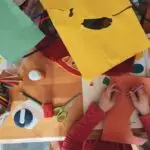
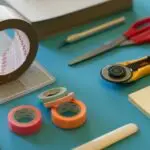
Craft materials are the things we use to make crafts.Examples are:
- Fabric: A soft, flexible material for clothes, bags, etc.
- Wood: A strong, durable material for furniture, toys, etc.
- Scissors: Tools for cutting paper, fabric, etc.
- knife: Sharp tool for cutting wood, fabric, etc.
- Glue: An adhesive used to stick materials together.
- Yarn: A long continuous strand of fibers used for knitting or weaving.
Fabric Types
Fabric comes in many colors, patterns, and textures. Examples are:
- Cotton: Soft, absorbent, and breathable.
- Wool: Warm, durable, and water-resistant.
- Silk: Soft, luxurious, and lustrous.
- Polyester: Strong, durable, and wrinkle-resistant.
- Linen: Strong, absorbent, and breathable, made from flax fibers.
- Nylon: strong, elastic, and resistant to damage from oil and many chemicals.
Wood Types
Wood is a strong, durable, and versatile natural material used for many objects. Examples are:
- Pine: softwood, easy to work with, and affordable.
- Oak: Hardwood, strong, durable, and beautiful.
- Maple: Hardwood, known for its beautiful grain and durability.
- Cherry: Hardwood, known for its rich color and beautiful grain.
- Mahogany: A durable reddish-brown hardwood often used for furniture.
- Cedar: A fragrant softwood that is resistant to decay and insects.
Teaching Methods
To deliver this lesson, the teacher will adopt the following methods: Discussion, question and answer, Show and tell
Instructional Procedures
To deliver this lesson, the teacher will adopt the following steps:
Step 1: Introduction
Time: 5 minutes
Teaching Skill: Set Induction
Teacher’s Activity: Asks pupils what they know about crafts and shows pictures of various crafts.Pupils’ Activity: respond to teacher’s questions and observe the pictures.
Step 2: Description of Key Concepts
Time: 10 minutes
Teaching Skill: Explaining
Teacher’s Activity: Explains the concept of craft making and introduces different craft materials.
Pupils’ Activity: Listen attentively and ask questions.
Step 3: Presentation/Guided Practice
Time: 10 minutes
Teaching Skill: Demonstrating
Teacher’s Activity: Shows examples of different fabrics and woods, highlighting their properties.
Pupils’ Activity: Observe the examples and participate in discussions.
Step 4: Autonomous Practice
Time: 5 minutes
Teaching Skill: monitoring
Teacher’s Activity: Guides pupils as they identify and list craft materials.
Pupils’ Activity: Identify and list craft materials independently.
Step 5: Note-Taking
Time: 5 minutes
Teaching Skill: Note-taking
Teacher’s Activity: Guides pupils in taking notes on key concepts.
pupils’ Activity: Take notes on key concepts.
Step 6: Evaluation/Review
Time: 5 minutes
Teaching Skill: Questioning
Teacher’s Activity: Asks evaluation questions to assess understanding.
Pupils’ Activity: Answer evaluation questions.
Objective-aligned checks:
- Identify various materials used in craft making.
- List at least three different craft materials.
- Show interest in craft making activities.
Step 7: Conclusion
Time: 2 minutes
Teaching Skill: Summarizing
Teacher’s Activity: Summarizes the key concepts learned.
Pupils’ Activity: Listen to the summary.
Lesson Keywords
- Craft – An activity involving skill in making things by hand.
- Fabric – A material made by weaving or knitting fibers.
- Wood – A hard fibrous material that forms the main substance of a tree or shrub.
- Cotton – A soft white fibrous substance that surrounds the seeds of a cotton plant.
- Pine – A type of softwood that is easy to work with.
Lesson evaluation
To evaluate the learning, the teacher asks pupils to:
- Name three craft materials.
- What are two types of fabric?
- What are two types of wood?
- What tools are used in craft making?
Assignment/homework
- List five different craft materials you can find at home.
- Bring a small sample of any fabric to the next class.
Differentiation
- For slower learners: Provide one-on-one assistance and use simpler language.
- For advanced learners: Encourage them to research additional craft materials and techniques.
- For visual/auditory/kinesthetic learners: Use visual aids,verbal explanations,and hands-on activities.
note for Teachers
Ensure to have a variety of craft materials available for pupils to see and touch. Encourage creativity and exploration during the craft activities.

Community Join the conversation Open discussion +