

Class: Primary 5
Term: 2nd Term
Subject: Basic Science And Technology
Curriculum Theme: Basic Science
Previous Lesson: Reproduction In Plants, Fertilization
Topic: Reproduction In Plants: Stages Of Growth From Flower Too Fruits
Content/Learning Area: Stages Of Development From Flower To Fruits
Time Allocation: 40 minutes
Performance Objectives
By the end of the lesson, pupils should be able to:
- Cognitive Domain: Explain the stages involved in the development of plants from flower to fruits.
- Affective Domain: Show recognition for the role of pollination in plant reproduction.
- Psychomotor Domain: Identify and draw the stages of development from flower to fruit.
- Social Domain: Collaborate with peers to discuss the importance of fruit development in nature.
Reference Materials
The following resources were used in planning this lesson:
- 9 – Years Basic Education Curriculum
- Abuja Educational Resource Center Scheme of Work
- NAPPS National Unified Scheme of Work
- Online Facts from: Wikipedia – Plant development
- Relevant Textbooks: Basic Science and Technology for Primary 5
Instructional Materials
To deliver this lesson, the teacher will use the following materials:
- Pictures of flowers and fruits
- Diagrams illustrating the stages of plant development
- Whiteboard and markers
Rationale for the Lesson
Understanding the stages of development from flower to fruit is vital as it helps pupils appreciate the process that allows plants to reproduce and provide food. This knowledge is directly linked to agriculture, food production, and environmental sustainability.
Prerequisite/Previous Knowledge
Pupils should already be familiar with the concept of fertilization in plants as well as the basic structure of flowers. They should know that pollination is an essential part of plant reproduction.
Lesson Content
Reproduction In Plants: Stages Of Development From Flower To Fruits
Plants grow and reproduce through a process that starts with the flower.
The stages of development from flower to fruit are:
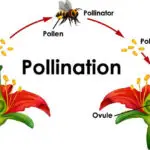
- pollination: This is the process where pollen is transferred from one flower to another, often with the help of insects or the wind. Pollination is essential for fertilization and subsequent fruit development.
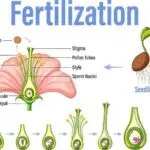
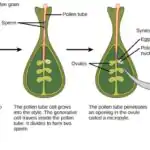
- Fertilization: After pollination, the sperm from the pollen joins with the egg in the flower to form a seed. Fertilization is the fusion of male and female gametes to form a zygote.
- Seed Development: The fertilized egg develops into a seed inside the flower’s ovary.The seed contains the embryo of the new plant.
- Fruit Formation: As the seed grows, the ovary begins to swell and develop into a fruit, protecting the seed. The fruit provides nutrients and protection for the developing seed.
- Maturation of Fruit: The fruit matures, becomes ready to release seeds, and eventually ripens for consumption or further reproduction. Maturation involves changes in color, texture, and taste.
Teaching Methods
To deliver this lesson, the teacher will adopt the following methods: Visual Aids, Questioning, Explanation, Discussion, Practical Activity.
Instructional Procedures
To deliver this lesson, the teacher will adopt the following steps:
Step 1: Introduction (Set Induction)
Time: 5 minutes
Teaching Skill: Set Induction
Teacher’s activity: Greet pupils, ask questions about flowers and fruits, introduce the topic.
Pupils’ Activity: Pupils respond, share prior knowledge about plants and flowers.
Step 2: Explanation of Stages
Time: 10 minutes
Teaching Skill: Direct teaching
Teacher’s Activity: Explain each stage from pollination to fruit development using the visual aids.
Pupils’ Activity: Pupils listen and observe the diagrams and pictures.
Step 3: Interactive Discussion
Time: 8 minutes
Teaching Skill: discussion
teacher’s Activity: Engage pupils in a discussion about the importance of pollination and fruit development.
Pupils’ Activity: Pupils actively participate in the discussion.
Step 4: Note-Taking
Time: 5 minutes
Teaching Skill: Guided writing
Teacher’s activity: Write the stages of development on the board for pupils to copy.
Pupils’ Activity: Pupils copy the information from the board.
Step 5: Practical Activity
Time: 5 minutes
Teaching Skill: hands-on activity
Teacher’s Activity: Instruct pupils to draw the stages of development from flower to fruit.Pupils’ Activity: Pupils draw the stages in groups or individually.
Step 6: Evaluation/Review
Time: 5 minutes
Teaching Skill: Questioning
Teacher’s Activity: Ask pupils questions to check understanding of the stages.
Pupils’ Activity: Pupils answer questions orally.
Objective-aligned checks:
- Explain the stages involved in the development of plants from flower to fruits.
- Show recognition for the role of pollination in plant reproduction.
- Identify and draw the stages of development from flower to fruit.
Step 7: Conclusion
Time: 2 minutes
Teaching Skill: Summing up
Teacher’s Activity: Summarize the lesson and highlight key points.
Pupils’ Activity: Pupils listen and review the lesson’s content.
Lesson Keywords
- Pollination – The transfer of pollen from the stamen to the pistil of a flower.
- Fertilization – The fusion of male and female gametes to form a zygote.
- Seed Development – The growth of a fertilized egg into a seed.
- Fruit Formation – The development of the ovary into a fruit.
- Maturation – The process by which a fruit ripens and becomes ready for consumption or seed dispersal.
Lesson Evaluation
To evaluate the learning, the teacher asks pupils to:
- What is pollination, and why is it important in the development of fruits?
- List the stages from flower to fruit in the correct order.
- Explain how the ovary transforms during fruit development.
- Draw and label the stages of development from flower to fruit.
- How does pollination contribute to fruit production?
Assignment/Homework
- Research different types of pollination (e.g., wind, insect) and provide examples of plants that use each method.
- Create a diagram illustrating the life cycle of a flowering plant, from seed to fruit.
- write a short paragraph explaining the importance of fruits in the ecosystem.
- Collect different types of fruits and identify the seeds inside them.
- Investigate how farmers use pollination techniques to improve crop yields.
Differentiation
- For slower learners: Provide simplified diagrams and one-on-one assistance during the drawing activity.
- For advanced learners: Encourage them to research and present on the hormonal changes during fruit development.
- For visual/auditory/kinesthetic learners: Use videos and real-life examples of fruits and flowers to enhance understanding.
Note for Teachers
Make sure to create an engaging and interactive environment where pupils feel agreeable to ask questions and contribute to discussions. Encourage them to ask about the role of various insects in pollination to enhance understanding. Also, be sure to walk around during the drawing activity to provide guidance.Happy teaching!
Community Join the conversation Open discussion +