

Class: Primary 5
Term: 2nd Term
Subject: basic Science And Technology
Curriculum Theme: Basic Science
Previous Lesson: Types And Agents Of Pollination
Topic: Reproduction In Plants: Fertilization
Content/Learning Area: fertilization
Time Allocation: 40 minutes
Performance Objectives
By the end of the lesson,pupils should be able to:
- Cognitive Domain: Describe the process of fertilization in plants.
- Affective Domain: Appreciate the role of fertilization in the reproductive process of plants.
- Psychomotor Domain: Identify and demonstrate the steps in the fertilization process using a diagram or model.
- Social Domain: Collaborate with peers to discuss the importance of fertilization in the plant lifecycle.
Reference Materials
The following resources were used in planning this lesson:
- 9 – Years Basic Education Curriculum
- Abuja Educational Resource Center Scheme of Work
- NAPPS National Unified scheme of Work
- Online Details from: Vedantu – Fertilization In Plants – Steps, Types and Diagram
- Relevant Textbooks
Instructional Materials
To deliver this lesson, the teacher will use the following materials:
- Diagrams of the fertilization process
- A model of a flower (or real flower samples)
- Chart showing stages of fertilization
Rationale for the Lesson
Understanding fertilization is crucial because it explains how plants reproduce and how seeds are formed. This process is essential for the growth of new plants, which provides us with food, medicine, and many other resources.Fertilization in plants ensures the continuation of plant species, making it a notable topic in basic Science.
Prerequisite/Previous Knowledge
Pupils are expected to have a basic understanding of pollination, which was taught in the previous lesson. They should be familiar with the different parts of a flower, including the stamen, pistil, and ovary, as these are involved in the fertilization process.
Lesson Content
Reproduction In Plants: Fertilization
Fertilization in plants is the process where the male gamete (pollen) and the female gamete (ovule) come together to form a seed. This process allows plants to produce new plants and ensure the survival of their species.
The Process of Fertilization:
The process of fertilization involves several key steps that lead to the formation of a seed.
These include:
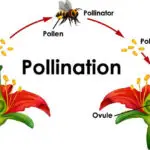
- The process begins when a pollen grain from the male part (anther) of a flower lands on the female part (stigma).
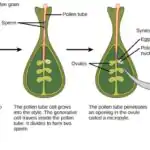
- The pollen grain travels down the style to the ovary,where it meets the ovule.
- The male gamete then fuses with the female gamete (ovule), resulting in fertilization.
- The fertilized ovule develops into a seed,which can grow into a new plant.
Steps in Fertilization:
Fertilization in plants occurs through a series of well-defined steps, each playing a crucial role in the reproductive process.
The following are the steps involved:
- Pollen grain lands on the stigma.
- The pollen tube grows down the style to reach the ovary.
- The sperm cell from the pollen fuses with the egg cell in the ovule.
- The fertilized egg becomes a seed, ready to grow into a new plant.
Teaching Methods
To deliver this lesson, the teacher will adopt the following methods: Explanation, Demonstration, Group Discussion, Visual Aids, questioning.
Instructional Procedures
To deliver this lesson, the teacher will adopt the following steps:
Step 1: Introduction
Time: 5 minutes
Teaching Skill: Set Induction
Teacher’s Activity: Greet the pupils and ask: “Do you know how plants make new plants?” Show a diagram of a flower and ask pupils to identify parts.
Pupils’ Activity: Pupils will respond and identify parts of the flower.
Step 2: Explanation of Fertilization
Time: 10 minutes
Teaching Skill: Explanation
Teacher’s Activity: Explain the meaning of fertilization and its importance in plant reproduction. Use the diagram to show where fertilization occurs.
Pupils’ Activity: Pupils will listen and take notes on fertilization.
Step 3: Steps in Fertilization
Time: 10 minutes
Teaching Skill: demonstration
Teacher’s Activity: Describe and demonstrate the steps of fertilization (pollen grain reaching the stigma, travel to ovary, fertilization).
Pupils’ Activity: Pupils will follow along, asking questions if needed.
Step 4: Pupils’ Participation
Time: 5 minutes
Teaching Skill: Group discussion
Teacher’s Activity: ask pupils to work in groups to draw and label a fertilization diagram.
Pupils’ Activity: Pupils will draw and label the diagram in groups.
Step 5: Note-taking
Time: 3 minutes
Teaching Skill: Individual work
Teacher’s Activity: Guide pupils in copying the lesson content on fertilization.
Pupils’ Activity: Pupils will write down the note in their notebooks.
Step 6: Evaluation/Review
Time: 5 minutes
Teaching Skill: Oral questioning
Teacher’s Activity: Ask the pupils questions based on the lesson, focusing on key concepts.
Pupils’ Activity: Pupils will answer the questions orally.
Objective-aligned checks:
- Describe the process of fertilization in plants.
- Identify and demonstrate the steps in the fertilization process using a diagram or model.
Step 7: Conclusion
time: 2 minutes
Teaching Skill: Recap and closure
Teacher’s Activity: summarize the main points of the lesson and clarify any misunderstandings.
Pupils’ Activity: Pupils will ask for clarification if necessary.
lesson Keywords
- Fertilization – The process where male and female gametes fuse to form a seed.
- Pollen – The male gamete in plants.
- Ovule – The female gamete in plants.
- Stigma – The part of the pistil where pollen lands.
- Ovary – The part of the pistil containing the ovules.
Lesson Evaluation
To evaluate the learning, the teacher asks pupils to:
- What is fertilization in plants?
- Describe the steps involved in fertilization.
- What role does pollen play in fertilization?
- Why is fertilization crucial for plants?
- How does fertilization result in the creation of new plants?
Assignment/Homework
- Draw a diagram illustrating the process of fertilization in plants.
- Write a short paragraph explaining the importance of fertilization for plant reproduction.
- List the steps involved in fertilization and describe what happens at each step.
differentiation
- For slower learners: Provide simplified diagrams and one-on-one assistance to explain the steps in fertilization.
- For advanced learners: Challenge them to research and present on different types of fertilization in plants.
- For visual/auditory/kinesthetic learners: Use visual aids like diagrams and models, explain the process verbally, and allow them to manipulate models to understand the steps.
Note for Teachers
This lesson requires active participation from pupils, especially when discussing the steps in fertilization. Use the flower diagrams to make the concept more visual and concrete. Encourage students to ask questions during the group activity to enhance learning.Review the content regularly to ensure students understand each stage of the process. Happy teaching!
Community Join the conversation Open discussion +