

class: Primary 5
Term: 2nd Term
Subject: Basic Science And Technology
Previous Lesson: Reproduction In Plants, Stages Of Development From Flower To Fruits
Curriculum Theme: Basic Science
Previous Lesson: Reproduction In Plants: Stages Of Development From Flower to Fruits
Topic: Differences Between Pollination And Fertilization In flowering Plants
Content/Learning Area: Distinguish between pollination and fertilization in flowering plants.
Time Allocation: 40 minutes
Performance Objectives
By the end of the lesson, pupils should be able to:
- Cognitive Domain: Identify the differences between pollination and fertilization in flowering plants.
- Affective Domain: appreciate the importance of pollination and fertilization in plant reproduction.
- Psychomotor Domain: Draw and label diagrams showing the processes of pollination and fertilization.
- Social Domain: Work in pairs to discuss and share their understanding of pollination and fertilization.
Reference Materials
The following resources where used in planning this lesson:
- 9 – Years Basic Education Curriculum
- Abuja educational Resource Center Scheme of work
- NAPPS National Unified Scheme of Work
- Online Information from: BYJU’S – Difference Between Pollination And Fertilization
- Relevant Textbooks: “Basic Science and Technology for Primary 5”
Instructional Materials
To deliver this lesson, the teacher will use the following materials:
- Charts of flowering plants
- Diagrams of pollination and fertilization processes
- Real flowers (if available)
- Markers and whiteboard
Rationale for the Lesson
Understanding pollination and fertilization is essential for plant reproduction, seed production, and a broader understanding of ecosystems and agriculture.
prerequisite/previous Knowledge
Pupils are expected to have prior knowledge of plant structures, including flowers and their parts, as learned in previous lessons.They should also understand basic reproductive terms.
Lesson Content
Differences Between Pollination and Fertilization In Flowering Plants
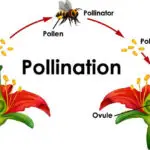
- Pollination: Is the process where pollen is transferred from the male part (anther) to the female part (stigma) of a flower.
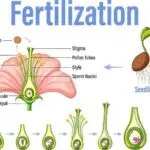
- Fertilization: Occurs when pollen reaches the ovule, and male and female gametes fuse to form a seed.
Differences Between pollination And Fertilization In Flowering Plants:
Pollination and fertilization are two distinct processes essential for plant reproduction.The following are key differences between them:
- Time: Pollination occurs before fertilization.
- Process: Pollination is the transfer of pollen, while fertilization is the fusion of gametes.
- Outcome: Pollination enables fertilization, while fertilization results in seed formation.
- Gametes: Pollination does not directly involve gametes, but fertilization involves the fusion of male and female gametes.
- External Factors: Pollination often requires external agents like wind or insects, while fertilization occurs internally.
Teaching methods
To deliver this lesson, the teacher will adopt the following methods: Explanation, Modeling, Questioning, Collaborative Learning, Writing, Recap/review
Instructional Procedures
To deliver this lesson, the teacher will adopt the following steps:
Step 1: Introduction (Set Induction)
Time: 5 mins
Teaching Skill: Set Induction
Teacher’s Activity: Ask pupils to recall what they know about plant reproduction.
Pupils’ Activity: Pupils share their thoughts.
Step 2: Explanation of Pollination
Time: 10 mins
Teaching Skill: Explanation/Modeling
Teacher’s Activity: Explain pollination using a diagram and show the transfer of pollen.
Pupils’ Activity: Pupils observe and listen carefully to the explanation.
Step 3: Explanation of Fertilization
Time: 10 mins
Teaching Skill: Explanation/Modeling
teacher’s Activity: describe fertilization and how pollen fertilizes the ovule.
Pupils’ activity: Pupils observe and listen attentively.
Step 4: Compare and Contrast Pollination and Fertilization
Time: 7 mins
Teaching Skill: Questioning
Teacher’s Activity: Guide pupils to list differences between pollination and fertilization.
Pupils’ Activity: Pupils actively participate in listing differences.
Step 5: Activity (Pair work)
Time: 5 mins
Teaching Skill: Collaborative Learning
Teacher’s Activity: Assign pairs to draw and label a diagram showing both processes.
Pupils’ Activity: Pupils collaborate to complete the task.
step 6: Note-Taking
Time: 2 mins
Teaching skill: Writing
Teacher’s Activity: Pupils write down the key differences in their notebooks.
Pupils’ Activity: Pupils copy down the differences.
Step 7: Conclusion (Summary)
Time: 1 min
Teaching Skill: Recap/Review
Teacher’s Activity: Quickly recap the lesson and emphasize the differences.
Pupils’ Activity: Pupils reflect on the key concepts.
Lesson Keywords
- pollination – The transfer of pollen from the anther to the stigma.
- Fertilization – the fusion of male and female gametes to form a seed.
- Gametes – Reproductive cells (sperm and egg).
- Ovule – The structure in the ovary that contains the egg cell.
- Anther – The part of the stamen that produces pollen.
- Stigma – The part of the pistil that receives pollen.
Lesson Evaluation
To evaluate the learning, the teacher asks pupils to:
- Define pollination and explain how it differs from fertilization.
- List two agents that can assist in pollination.
- explain the role of the pollen in fertilization.
- Draw a diagram that shows both pollination and fertilization.
- Discuss the importance of both processes in plant reproduction.
Assignment/Homework
Differentiation
- For slower learners: Provide simplified diagrams and one-on-one explanations.
- For advanced learners: Research different types of pollination and fertilization in various plants.
- For visual/auditory/kinesthetic learners: Use visual aids, verbal explanations, and hands-on activities with real flowers.
Note for Teachers
Encourage pupils to actively participate in the pair work and drawing activities, as it helps reinforce their understanding of the concepts. Additionally, use real-life examples to make the processes relatable. Happy teaching!
Community Join the conversation Open discussion +