

Class: Primary Three
term: Third Term
Subject: Basic Science and Technology
Curriculum Theme: Basic Science
Previous lesson: Purification Of Water
Topic: Parts of Plants and Their Uses
Content/Learning Area: Functions of Roots, Functions of Stems, Functions of Leaves
Time Allocation: 40 minutes
Performance Objectives
By the end of the lesson, pupils should be able to:
- Cognitive Domain:
1. Identify and describe the functions of roots, stems, and leaves as parts of plants.
2. Appreciate the importance of different parts of plants in everyday life.
- Affective Domain:
1. Work in groups to discuss and present the functions of different plant parts.
- Psychomotor Domain:
1.Draw and label the parts of a plant.
- Social Domain:
1. participate actively in group discussions.
Reference Materials
- 9 – Years Basic Education Curriculum
- Abuja Educational resource Center Scheme of Work
- NAPPS National Unified Scheme of Work
- relevant Textbooks
Instructional Materials
To deliver this lesson, the teacher will employ the help of the following materials:
- Charts showing parts of plants
- Real plants or plant specimens
- Drawing materials (pencils, crayons, paper)
Rationale for the Lesson
Understanding the parts of plants and their functions is crucial for appreciating the importance of plants in our ecosystem and daily lives. This knowledge forms a foundation for further studies in biology and environmental science.
Prerequisite/previous Knowledge
The teacher will start by asking pupils what they know about plants and their different parts. A brief discussion will follow, leading into the lesson’s main topic.
Lesson Content
Parts of Plants and Their Uses
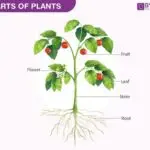
plants have different parts, each with specific functions that help them grow and survive. The main parts are roots, stems, and leaves.
Functions of Roots
Roots perform several vital functions for the plant, including absorption, anchorage, and storage. the following are the functions of roots:
- Absorb water and nutrients from the soil.
- Anchor the plant firmly in the ground.
- Store food and nutrients.
- Help in vegetative reproduction in some plants.
- Transport water and nutrients to the stem.
- Provide support to the plant, preventing it from falling over.
- Facilitate gas exchange in some aquatic plants.
Functions of Stems
Stems provide support, transport nutrients, and sometimes store food for the plant. These include:
- Support the plant and hold it upright.
- Transport water and nutrients from roots to leaves.
- Store food and nutrients.
- Produce new living tissue.
- In some plants, stems help in reproduction (e.g., runners in strawberries).
- Protect the plant from herbivores with thorns or prickles.
- Assist in photosynthesis in some plants with green stems.
Functions of Leaves
Leaves are essential for photosynthesis, gas exchange, and transpiration in plants. They are:
- Carry out photosynthesis to make food for the plant. You can learn more about photosynthesis here.
- Help in gas exchange (oxygen and carbon dioxide).
- Transpire water to cool the plant and transport nutrients.
- Store food in some plants (e.g., spinach).
- Protect the plant from herbivores (e.g., thorns).
- Attract pollinators with colorful bracts (modified leaves).
- Provide shelter for insects and small animals.
Teaching Methods
To deliver this lesson, the teacher will adopt the following methods: Discussion, Exhibition, Group work
instructional Procedures
To deliver this lesson, the teacher will adopt the following steps:
step 1: Introduction
Time: 5 minutes
Teaching Skill: Set Induction
Teacher’s Activity: Asks pupils what they know about plants and their parts. Introduces the lesson topic.Pupils’ Activity: Respond to teacher’s questions, participate in discussion.
Step 2: Explanation of Key Concepts
Time: 10 minutes
Teaching Skill: explanation, Demonstration
Teacher’s Activity: Explains the functions of roots, stems, and leaves using charts and real plants.
Pupils’ activity: Listen attentively, ask clarifying questions.
Step 3: Demonstration/Guided Practice
Time: 10 minutes
Teaching Skill: Demonstration, Guided practice
Teacher’s Activity: Demonstrates how to draw and label a plant diagram. Guides pupils in drawing their own diagrams.
Pupils’ Activity: Observe the demonstration, draw and label their own diagrams.
Step 4: Self-Reliant Practice
Time: 5 minutes
Teaching Skill: Monitoring, Feedback
Teacher’s Activity: Monitors pupils as they work independently, provides feedback.
Pupils’ Activity: Complete their drawings and labeling independently.
Step 5: Note-Taking
Time: 5 minutes
Teaching Skill: Note-Taking, Summarizing
Teacher’s Activity: Guides pupils in summarizing key concepts in their notebooks.
Pupils’ Activity: Write notes summarizing the lesson.
Step 6: Evaluation/Review
Time: 5 minutes
Teaching skill: Questioning, Assessment
Teacher’s Activity: Asks review questions to assess understanding.
Pupils’ Activity: Answer review questions.
Objective-aligned checks:
- Identify and describe the functions of roots, stems, and leaves as parts of plants.
- Draw and label the parts of a plant.
Step 7: Conclusion
Time: 5 minutes
Teaching Skill: Summarizing
Teacher’s Activity: Summarizes the main points of the lesson.
Pupils’ Activity: listen to the summary and ask any remaining questions.
Lesson Keywords
- Roots – The part of the plant that absorbs water and nutrients from the soil.
- Stems – the part of the plant that supports the leaves and flowers.
- Leaves – The part of the plant were photosynthesis occurs.
- Photosynthesis – The process by which plants make their own food using sunlight.
- Nutrients – Substances that plants need to grow and stay healthy.
Lesson Evaluation
To evaluate the learning,the teacher asks pupils to:
- Name the three main parts of a plant.
- Explain two functions of roots.
- Describe the role of stems in a plant’s life.
- List two functions of leaves.
- Draw and label a simple plant diagram showing roots, stems, and leaves.
Assignment/Homework
- Collect different types of leaves and identify their shapes.
- Research and write a short paragraph on a plant that stores food in its roots or stems.
- Draw and label a plant, indicating the functions of each part.
Differentiation
- For slower learners: Provide one-on-one assistance and simplified explanations.
- For advanced learners: Encourage further research on specific plant parts and their adaptations.
- For visual/auditory/kinesthetic learners: Use visual aids, verbal explanations, and hands-on activities to cater to different learning styles.
Note for Teachers
ensure to bring real plant samples to class for better understanding. Encourage pupils to ask questions and participate actively in discussions. Adjust the pace of the lesson based on pupils’ understanding and engagement.

Community Join the conversation Open discussion +