

Class: Senior Secondary School 1 (SS1 / SSS 1)
Term: 1st Term
Week: 1
Age: 15 years
Duration: 45 minutes
Subject: Dying and Bleaching
Curriculum Theme: Trade
Previous Lesson: .
Topic: COLOUR THEORY – INTRODUCTION TO COLOUR SCHEME
Subject Matter: primary colours, formation of secondary colours, process of mixing tertiary colours, colour scheme chart drawing
Specific Objectives
By the end of the lesson, pupils should be able to:
Cognitive Domain:
- Define colour theory and colour scheme.
- Identify primary, secondary, and tertiary colours.
- Explain how secondary and tertiary colours are formed.
Affective Domain:
- Appreciate the importance of understanding colour in dyeing and bleaching.
- Show interest in learning different colour combinations.
Psychomotor Domain:
- Mix primary colours to produce secondary and tertiary colours.
- Draw a basic colour scheme chart.
Social Domain:
- Collaborate with peers when discussing colour concepts and mixing.
Reference Materials
The following resources were used in planning this lesson:
- 9 Years Basic Education Curriculum for Cultural and Creative Arts (CCA).
- State Unified Scheme of Work for Senior Secondary School 1.
- Oluwole, A. A. (2018). Dyeing and Bleaching for Senior Secondary Schools. Lagos: Learnwell Publishers.
- https://www.youtube.com/watch?v=q1x8596-f6w
- https://www.youtube.com/watch?v=q1x8596-f6w
Instructional Materials
The teacher will teach this lesson with the aid of:
- Colour wheel chart
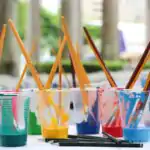
- Poster colours (red, yellow, blue)
- Drawing paper
- Pencil and ruler
- Water and mixing palettes
Rationale for the Lesson
Understanding colour theory is important for pupils as it forms the foundation for practical skills in dyeing and bleaching. This knowledge helps them to effectively combine colours and create desired effects in their craftwork. It also enables them to appreciate the aesthetic value of colours in everyday life.
Prerequisite/Previous Knowledge
Pupils are assumed to have basic knowledge of colours and have seen different colour combinations in their environment.
Lesson Content/Board Summary
COLOUR THEORY: INTRODUCTION TO COLOUR SCHEME
Definition of Colour Theory and Colour Scheme
Colour theory is a set of guidelines and principles used to understand how colours relate to each other and how they can be effectively combined. It explains the visual effects of colour mixing.
A colour scheme is a planned combination of colours used to create a particular aesthetic or mood. It involves selecting colours that work well together.
Primary Colours
Primary colours are fundamental colours that cannot be created by mixing other colours. They are the building blocks for all other colours.
The primary colours are:
- Red
- Yellow
- Blue
Formation of Secondary Colours
Secondary colours are formed by mixing two primary colours in equal proportions.
The secondary colours and their formation are:
- Green (Yellow + Blue)
- Orange (Red + Yellow)
- Purple/Violet (Red + Blue)
Process of Mixing Tertiary Colours
Tertiary colours are formed by mixing a primary colour with an adjacent secondary colour in equal proportions. They are also known as intermediate colours.
The tertiary colours and their formation are:
- Red-Orange (Red + Orange)
- Yellow-Orange (Yellow + Orange)
- Yellow-Green (Yellow + Green)
- Blue-Green (Blue + Green)
- Blue-Violet (Blue + Violet/Purple)
- Red-Violet (Red + Violet/Purple)
Colour Scheme Chart Drawing
A colour scheme chart, often represented as a colour wheel, is a circular diagram that shows the relationships between colours. It helps in understanding primary, secondary, and tertiary colours and their arrangements.
Drawing a colour scheme chart involves:
- Drawing a circle and dividing it into 12 sections.
- Placing primary colours (Red, Yellow, Blue) evenly spaced in three sections.
- Mixing and placing secondary colours (Orange, Green, Purple) in the sections between their parent primary colours.
- Mixing and placing tertiary colours (e.g., Red-Orange, Yellow-Green) in the sections between their parent primary and secondary colours.
Teaching Methods/Instructional Techniques
Discussion, Lecture, Demonstration, Question and Answer, Visual Aids
Instructional Procedures
Step 1: Introduction
Time: 5 minutes
Teaching Skill: Set Induction
Teacher’s Activity: The teacher greets the pupils and introduces the topic by asking them to identify different colours around the classroom. The teacher then asks what they think happens when different colours are mixed.
Pupils’ Activity: Pupils respond to the teacher’s questions and identify colours.
Learning Point: Pupils recall prior knowledge of colours and are mentally prepared for the lesson.
Step 2: Explanation of Colour Theory and Colour Scheme
Time: 7 minutes
Teaching Skill: Explanation/Lecture
Teacher’s Activity: The teacher explains the meaning of colour theory and colour scheme, using the colour wheel chart as a visual aid. The teacher emphasizes why understanding these concepts is important in dyeing.
Pupils’ Activity: Pupils listen attentively, observe the colour wheel, and ask questions for clarification.
Learning Point: Pupils understand the basic definitions and relevance of colour theory and colour schemes.
Step 3: Identification and Discussion of Primary Colours
Time: 6 minutes
Teaching Skill: Questioning/Demonstration
Teacher’s Activity: The teacher asks pupils to name colours that cannot be formed by mixing others. The teacher then explicitly states and shows the primary colours (red, yellow, blue) using poster colours.
Pupils’ Activity: Pupils name colours and identify the primary colours as demonstrated by the teacher.
Learning Point: Pupils can identify and list the three primary colours.
Step 4: Formation of Secondary Colours
Time: 8 minutes
Teaching Skill: Demonstration/Practical Activity
Teacher’s Activity: The teacher demonstrates how to mix two primary colours (e.g., yellow and blue to get green) to form secondary colours. The teacher then names the three secondary colours and their parent primary colours.
Pupils’ Activity: Pupils observe the mixing process carefully. Some may be called upon to try mixing.
Learning Point: Pupils understand how secondary colours are formed and can name them.
Step 5: Process of Mixing Tertiary Colours
Time: 7 minutes
Teaching Skill: Demonstration/Explanation
Teacher’s Activity: The teacher explains that tertiary colours are formed by mixing a primary colour with an adjacent secondary colour. The teacher demonstrates one or two examples (e.g., red + orange to get red-orange).
Pupils’ Activity: Pupils pay attention to the mixing process and the resulting colours.
Learning Point: Pupils understand the concept of tertiary colours and their formation.
Step 6: Drawing the Colour Scheme Chart
Time: 7 minutes
Teaching Skill: Guidance/Practical
Teacher’s Activity: The teacher guides pupils on how to draw a basic colour scheme chart (colour wheel) on their drawing paper, indicating where primary, secondary, and tertiary colours should be placed.
Pupils’ Activity: Pupils follow the teacher’s instructions to draw their own colour scheme charts using pencils and rulers.
Learning Point: Pupils begin to apply their knowledge by sketching a colour wheel.
Step 7: Evaluation/Review
Time: 5 minutes
Teaching Skill: Questioning/Assessment
Teacher’s Activity: The teacher evaluates the learning by asking the following questions:
- What is colour theory?
- Mention the three primary colours.
- How is a secondary colour formed?
- List two tertiary colours and state how they are formed.
Pupils’ Activity: Pupils answer orally and in writing.
Learning Point: Pupils demonstrate understanding of the lesson.
Step 8: Conclusion
Time: 2 minutes
Teaching Skill: Recap/Assignment
Teacher’s Activity: The teacher summarizes the key points of the lesson, reiterating the importance of colour theory. The teacher gives pupils an assignment to complete their colour scheme charts by colouring them correctly.
Pupils’ Activity: Pupils listen to the summary and copy down the assignment.
Learning Point: Pupils consolidate their learning and prepare for further practice.
Lesson Keywords
- Colour Theory – Principles that guide the understanding and use of colours.
- Colour Scheme – A planned combination of colours.
- Primary Colours – Fundamental colours (red, yellow, blue) that cannot be mixed from others.
- Secondary Colours – Colours formed by mixing two primary colours (orange, green, purple).
- Tertiary Colours – Colours formed by mixing a primary and an adjacent secondary colour (e.g., red-orange).
- Colour Wheel – A circular chart showing the relationships between colours.
Differentiation
For pupils who grasp the concepts quickly, the teacher can challenge them to identify analogous or complementary colour schemes on the colour wheel. For pupils who are struggling, the teacher can provide one-on-one guidance during the mixing and drawing activities, using simpler examples and more direct assistance.
Note for teachers using this lesson plan
Ensure all instructional materials, especially poster colours, mixing palettes, and water, are readily available before the lesson begins to facilitate smooth demonstrations and practical activities. Encourage pupils to actively participate in the colour mixing process, as hands-on experience enhances understanding. Monitor pupils closely during the chart drawing to correct any misconceptions early.

Community Join the conversation Open discussion +