

Class: Senior Secondary School 1 (SS1 / SSS 1)
Term: 1st Term
Week: 5
Age: 15 years
Duration: 45 minutes
Subject: Dyeing and Bleaching
Curriculum Theme: Trade
Previous Lesson: Formation of Traditional African Motif: Local Motif Stencil.
Topic: CREATION OF PATTERNS
Subject Matter: producing patterns with motif stencil, dabbing technique with poster colour on textile material, arrangement and repetition of motifs, neat pattern layout
Specific Objectives
By the end of the lesson, pupils should be able to:
Cognitive Domain:
- Define pattern.
- Explain the dabbing technique for applying colour.
- State principles for the arrangement and repetition of motifs.
Affective Domain:
- Appreciate the aesthetic value of well-arranged patterns.
- Develop patience and attention to detail when creating patterns.
Psychomotor Domain:
- Produce patterns on textile material using a motif stencil.
- Apply poster colour effectively using the dabbing technique.
- Arrange motifs neatly to create a balanced pattern layout.
Social Domain:
- Share materials and workspace responsibly with peers.
Reference Materials
The following resources were used in planning this lesson:
- 9 Years Basic Education Curriculum for Cultural and Creative Arts (Senior Secondary).
- State Unified Scheme of Work for Senior Secondary Cultural and Creative Arts.
- Cultural and Creative Arts for Senior Secondary Schools, Book 1.
- WAEC e-learning portal
- NECO e-learning portal
Instructional Materials
The teacher will teach this lesson with the aid of:
- Textile material
- Poster colours
- Sponge or dabber
- Motif stencils (pre-cut or pre-prepared)
- Masking tape
- Palette
- Examples of textile patterns
Rationale for the Lesson
This lesson helps pupils understand how to create decorative designs on fabrics, which is a useful skill in textile production and fashion. Learning pattern creation enables pupils to design and produce their own unique textile items, contributing to their creativity and potential for entrepreneurship.
Prerequisite/Previous Knowledge
Pupils have a basic understanding of art elements such as line, shape, and colour, and may have seen various patterns on clothes and other materials.
Lesson Content/Board Summary
CREATION OF PATTERNS
Definition of Pattern
A pattern is a repeated decorative design or motif. In textile arts, it refers to the systematic arrangement of shapes, lines, or colours to create an overall design on a fabric surface.
Motif Stencil and Dabbing Technique
A motif stencil is a thin sheet of material (e.g., cardboard, plastic) with a design cut out of it. It is used to transfer a repeated design onto a surface by applying colour through the cut-out areas.
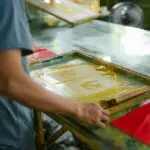
The dabbing technique is a method of applying colour by gently tapping or pressing a sponge or dabber loaded with colour onto the surface through a stencil. This technique helps to achieve a clear, crisp imprint of the motif.
The steps for dabbing technique are:
- Secure the stencil firmly on the textile material using masking tape to prevent movement.
- Load a sponge or dabber with a small amount of poster colour.
- Gently tap or dab the sponge through the cut-out areas of the stencil onto the textile.
- Ensure even coverage without overloading the sponge to avoid bleeding under the stencil.
- Carefully lift the stencil to reveal the motif.
Arrangement and Repetition of Motifs
Arrangement refers to how individual motifs are placed in relation to each other, while repetition is the act of using the same motif multiple times to create a continuous design.
Principles for effective arrangement and repetition include:
- Regular Repetition: Repeating the motif at consistent intervals, often in rows or columns.
- Alternating Repetition: Using two or more different motifs or variations of a single motif in an alternating sequence.
- Mirror Repetition: Reflecting a motif to create symmetry.
- Radial Repetition: Arranging motifs around a central point.
- Spacing: Ensuring adequate and consistent space between motifs for clarity and balance.
- Direction: Varying the direction of motifs to create movement or interest.
Neat Pattern Layout
A neat pattern layout means the motifs are evenly spaced, aligned correctly, and the colour application is clean with clear edges. This contributes to the overall professional appearance of the patterned textile.
Teaching Methods/Instructional Techniques
Discussion, Lecture, Demonstration, Question and Answer, Visual Aids
Instructional Procedures
Step 1: Introduction
Time: 5 minutes
Teaching Skill: Set Induction
Teacher’s Activity: The teacher greets the pupils and asks them to identify patterns on their clothes or in the classroom. The teacher then introduces the topic, “Creation of Patterns,” and explains that they will learn how to make their own patterns using stencils and a special technique.
Pupils’ Activity: Pupils respond to the teacher’s questions, identify patterns, and listen attentively to the introduction.
Learning Point: Pupils are introduced to the concept of patterns and the lesson’s focus.
Step 2: Explanation of Pattern and Motif Stencil
Time: 8 minutes
Teaching Skill: Explanation/Definition
Teacher’s Activity: The teacher defines “pattern” and explains what a “motif stencil” is, showing examples of pre-cut stencils and patterned textiles. The teacher explains their use in textile design.
Pupils’ Activity: Pupils listen, observe the examples, and ask questions for clarification.
Learning Point: Pupils understand the definitions of pattern and motif stencil.
Step 3: Demonstration of Dabbing Technique
Time: 10 minutes
Teaching Skill: Demonstration/Practical Application
Teacher’s Activity: The teacher demonstrates the dabbing technique step-by-step using a motif stencil, textile material, poster colour, and a sponge. The teacher emphasizes securing the stencil and applying colour with light, even dabs to avoid smudging or bleeding.
Pupils’ Activity: Pupils observe the demonstration carefully, noting the technique and precautions.
Learning Point: Pupils learn the practical application of the dabbing technique.
Step 4: Guiding on Arrangement and Repetition
Time: 7 minutes
Teaching Skill: Explanation/Guidance
Teacher’s Activity: The teacher explains the importance of arrangement and repetition for a visually appealing pattern. The teacher discusses various principles like regular repetition, spacing, and alignment, showing examples on a board or chart.
Pupils’ Activity: Pupils listen and understand the principles of motif arrangement and repetition.
Learning Point: Pupils grasp the concepts of arrangement and repetition for pattern design.
Step 5: Practical Activity (Pupils)
Time: 10 minutes
Teaching Skill: Practical/Supervision
Teacher’s Activity: The teacher distributes materials (textile, stencils, colours, sponges) and instructs pupils to start producing patterns on their textile materials, applying the dabbing technique and considering neat arrangement and repetition. The teacher moves around to provide individual guidance.
Pupils’ Activity: Pupils use their motif stencils, poster colours, and sponges to create patterns on their textile materials, applying the learned techniques.
Learning Point: Pupils practice creating patterns using the dabbing technique and principles of arrangement.
Step 6: Monitoring and Assistance
Time: 5 minutes
Teaching Skill: Observation/Correction
Teacher’s Activity: The teacher monitors pupils’ progress, offers constructive feedback, and assists those facing challenges with stencil placement, colour application, or motif arrangement. The teacher ensures safety and proper use of materials.
Pupils’ Activity: Pupils continue their practical work, seeking assistance when needed and applying feedback.
Learning Point: Pupils refine their pattern creation skills with teacher support.
Step 7: Evaluation/Review
Time: 5 minutes
Teaching Skill: Questioning/Assessment
Teacher’s Activity: The teacher evaluates the learning by asking the following questions:
- Define pattern in the context of textile design.
- Explain the dabbing technique for applying colour through a stencil.
- List two key materials needed to produce a pattern using a motif stencil.
- Mention two principles for arranging motifs neatly in a pattern.
Pupils’ Activity: Pupils answer orally and in writing.
Learning Point: Pupils demonstrate understanding of the lesson.
Step 8: Conclusion
Time: 2 minutes
Teaching Skill: Summarization/Consolidation
Teacher’s Activity: The teacher summarizes the key points of the lesson, reiterating the importance of neatness and proper technique in pattern creation. The teacher assigns homework, asking pupils to observe and sketch different patterns they see on fabrics at home.
Pupils’ Activity: Pupils listen to the summary and copy down the homework.
Learning Point: Pupils consolidate their learning and are encouraged to observe patterns in their environment.
Lesson Keywords
- Pattern – A repeated decorative design or motif.
- Motif – A single, recurring design element in a pattern.
- Stencil – A thin sheet with a design cut out, used to reproduce a pattern by applying colour through the cut-out.
- Dabbing Technique – A method of applying colour by tapping a sponge or dabber through a stencil.
- Arrangement – The way motifs are placed in relation to each other.
- Repetition – The act of using a motif multiple times to create a continuous design.
Differentiation
For pupils who grasp the concepts quickly, the teacher can challenge them to create a pattern using two different motifs or to experiment with colour blending within the stencil. For those needing more support, the teacher can provide pre-marked guidelines on their textile for stencil placement and offer more direct, step-by-step assistance during the practical activity.
Note for teachers using this lesson plan
Ensure all materials are prepared and readily accessible before the lesson begins. Pre-cut stencils are recommended to save time, or pupils can be asked to prepare their stencils as a pre-lesson activity. Emphasize safety when using materials and ensure proper ventilation if using strong-smelling colours. Encourage creativity while maintaining focus on the core techniques.


Community Join the conversation Open discussion +