

Class: Senior Secondary School 1 (SS1 / SSS 1)
Term: Second Term
Week: 6
Age: 15 years
Duration: 45 minutes
Subject: Dying and Bleaching
Curriculum Theme: Trade
Previous Lesson: Marbling Method: Squeezing Technique for Tie and Dye.
Topic: MARBLING BY TWISTING AND SPLASHING IN TWO COLORS.
Subject Matter: twisting method in tie and dye, splashing dye in spaced pattern, producing two colour marbling effect, controlling spacing and colour distribution
Specific Objectives
By the end of the lesson, pupils should be able to:
Cognitive Domain:
- Define marbling as a textile decoration technique.
- Explain the twisting method in tie and dye.
- Describe how to apply dye by splashing in a spaced pattern.
Affective Domain:
- Appreciate the artistic possibilities of tie and dye.
- Work carefully and neatly during the dyeing process.
- Show interest in creating unique textile designs.
Psychomotor Domain:
- Demonstrate the twisting technique on a cotton material.
- Apply two dye colours by splashing to create a spaced pattern.
- Produce a two-colour marbling effect on fabric.
Social Domain:
- Collaborate with peers when sharing materials and workspace.
- Adhere to safety measures while handling dyes.
Reference Materials
The following resources were used in planning this lesson:
- 9 Years Basic Education Curriculum for Cultural and Creative Arts (Senior Secondary Education).
- State Unified Scheme of Work for Senior Secondary Schools.
- Cultural and Creative Arts for Senior Secondary Schools 1 by J.B. Adekunle et al.
- www.culturalandcreativearts.org
- www.textiledyeingtechniques.com
Instructional Materials
The teacher will teach this lesson with the aid of:
- Cotton material
- Two dye colours
- Basins
- Gloves
- Apron
- Floor cover or plastic sheet
- Rubber bands or strings
Rationale for the Lesson
This lesson helps pupils to understand and practice a creative textile decoration technique. It enables them to transform plain fabrics into artistic designs using simple methods, developing practical skills that can be applied in everyday life or for vocational purposes.
Prerequisite/Previous Knowledge
Pupils are assumed to have basic knowledge of tie and dye techniques and general textile care.
Lesson Content/Board Summary
MARBLING BY TWISTING AND SPLASHING IN TWO COLORS
Introduction to Marbling
Marbling is a textile decoration technique that creates patterns similar to marble stone. It involves manipulating dyes on fabric to produce unique and often irregular designs, giving an artistic and abstract finish.
Twisting Method in Tie and Dye
The twisting method is a technique used in tie and dye to create circular, spiral, or fan-like patterns. It involves:
- Gathering a section of fabric by pinching it.
- Twisting the gathered fabric tightly from the base to the top, forming a rope-like structure.
- Securing the twisted section with rubber bands or strings at intervals to resist dye penetration in those areas.
Splashing Dye in Spaced Pattern
Splashing dye involves applying dye to specific areas of the fabric in an uncontrolled yet intentional manner to create a textured, speckled, or dotted effect. For a spaced pattern, dye is applied to distinct, separated areas rather than covering the entire surface, allowing for clearer separation of colours and patterns.
Producing a Two-Colour Marbling Effect
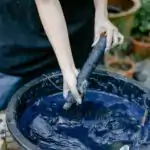
To produce a two-colour marbling effect using twisting and splashing, follow these general steps:
- Prepare the cotton material by washing it to remove any sizing and wringing it out.
- Prepare two different dye colours according to the manufacturer’s instructions in separate basins.
- Twist sections of the fabric and secure them firmly with rubber bands to create resist areas.
- Dip or splash the first colour onto specific twisted sections or desired areas of the fabric.
- Allow the first colour to set slightly or dry, if required, to prevent excessive blending with the second colour.
- Splash the second colour onto other twisted sections or remaining undyed areas, ensuring some spacing between the colours.
- Allow the dye to penetrate and set for the recommended time (e.g., 30-60 minutes).
- Rinse the fabric thoroughly under running water to remove excess dye.
- Untie the rubber bands, then wash the fabric with soap to remove any remaining loose dye.
- Dry and iron the marbled fabric.
Controlling Spacing and Colour Distribution
Controlling the spacing and distribution of colours is important for achieving a clear and appealing marbling effect. Ways to achieve this include:
- Using rubber bands to create clear boundaries for twisted sections, limiting where dye penetrates.
- Applying dye to distinct, non-overlapping areas initially to maintain separation.
- Allowing slight drying time between applying different colours to reduce bleeding.
- Using smaller quantities of dye for splashing to avoid oversaturation and uncontrolled spread.
- Planning the placement of colours mentally or by marking areas before application.
Teaching Methods/Instructional Techniques
Discussion, Lecture, Demonstration, Question and Answer, Visual Aids
Instructional Procedures
Step 1: Introduction
Time: 5 minutes
Teaching Skill: Set Induction
Teacher’s Activity: The teacher greets the pupils and asks them to recall any methods they know for decorating fabrics, especially using dyes. The teacher then introduces the topic: “Marbling by Twisting and Splashing in Two Colors,” explaining that it is a creative way to decorate fabric.
Pupils’ Activity: Pupils respond to the teacher’s questions and listen attentively to the introduction.
Learning Point: Pupils are reminded of previous knowledge and introduced to the new topic.
Step 2: Explanation of Marbling and Twisting Method
Time: 10 minutes
Teaching Skill: Explanation/Demonstration
Teacher’s Activity: The teacher explains what marbling is and describes the twisting method in tie and dye, using a plain cotton material to demonstrate how to gather and twist the fabric, securing it with rubber bands.
Pupils’ Activity: Pupils observe the demonstration and ask questions for clarification.
Learning Point: Pupils understand the concept of marbling and the twisting technique.
Step 3: Explanation and Demonstration of Splashing Dye
Time: 10 minutes
Teaching Skill: Demonstration/Instruction
Teacher’s Activity: The teacher explains the concept of splashing dye in a spaced pattern. The teacher demonstrates how to mix two different dye colours and carefully splash them onto the twisted fabric sections, showing how to control spacing to create distinct patterns. Safety precautions like wearing gloves and aprons are emphasized.
Pupils’ Activity: Pupils pay close attention to the demonstration, noting the dye application and safety measures.
Learning Point: Pupils learn how to apply dyes using the splashing technique while maintaining spacing.
Step 4: Guided Practice and Supervision
Time: 15 minutes
Teaching Skill: Guiding/Monitoring
Teacher’s Activity: The teacher distributes cotton materials, dyes, and other resources to the pupils. The teacher guides pupils as they attempt to twist their fabrics and apply two dye colours using the splashing technique, moving around to provide individual assistance and correct mistakes.
Pupils’ Activity: Pupils practice twisting the fabric and applying the two colours of dye under the teacher’s supervision.
Learning Point: Pupils develop practical skills in creating a two-colour marbling effect.
Step 5: Evaluation/Review
Time: 5 minutes
Teaching Skill: Questioning/Assessment
Teacher’s Activity: The teacher evaluates the learning by asking the following questions:
- Define marbling in the context of textile decoration.
- Describe the twisting method used in tie and dye.
- How can dye be applied by splashing to achieve a spaced pattern?
- Mention two ways to control colour distribution when producing a two-colour marbling effect.
Pupils’ Activity: Pupils answer orally and in writing.
Learning Point: Pupils demonstrate understanding of the lesson.
Step 6: Conclusion
Time: 5 minutes
Teaching Skill: Summarizing
Teacher’s Activity: The teacher summarizes the key points of the lesson, reinforcing the steps for marbling by twisting and splashing. The teacher encourages pupils to practice this technique at home with other materials.
Pupils’ Activity: Pupils listen to the summary and ask any final questions.
Learning Point: Pupils consolidate their understanding of the lesson.
Lesson Keywords
- Marbling – A textile decoration technique that creates patterns similar to marble stone.
- Twisting Method – A tie and dye technique where fabric is twisted and secured to create patterns.
- Splashing Dye – Applying dye to fabric by scattering or throwing small amounts to create a textured effect.
- Two-Colour Effect – Using two distinct dye colours to create a design on fabric.
- Spaced Pattern – A design where elements or colours are intentionally separated with clear areas in between.
Differentiation
For pupils who grasp the concept quickly, the teacher can challenge them to experiment with different twisting patterns or a wider range of colour combinations. For those who need more support, the teacher will provide more one-on-one guidance and simplify the steps, potentially demonstrating again for smaller groups.
Note for teachers using this lesson plan
Ensure all materials are prepared beforehand. Emphasize safety when handling dyes, including proper ventilation and disposal. Encourage creativity and allow pupils to experiment within the lesson’s framework. Provide positive feedback to build confidence.

Community Join the conversation Open discussion +