

Class: Primary 4
Term: 3rd Term
Week: 6
Age: 10 years
Duration: 40 minutes
Subject: Christian Religion Studies
Curriculum Theme: Christian Religion Studies
Previous Lesson: Uses Of Gifts And Talents
Topic: Consequences Of Abandoning Talents
Content/Learning Area: Consequences: loss of talent and condemnation at the end. (at home, church, school, communities)
Performance Objectives
By the end of the lesson, pupils should be able to:
Cognitive Domain:
- Explain the meaning of talent and describe what happens when it is not used.
Affective Domain:
2. Show concern about the wrong use or neglect of one’s God-given talents.
Psychomotor Domain:
3. Demonstrate through role play the effect of abandoning talents in daily life.
Social Domain:
4. Identify and list the consequences of abandoning talents at home, school, church, and community.
Reference Materials
The following resources were used in planning this lesson:
- 9 Years Basic Education Curriculum
- Abuja Educational Resource Centre Scheme of Work
- NAPPS National Unified Scheme of Work
- Online Information from: stoplearn – Consequences of wasted talents and undeveloped skills
- Relevant Textbooks
Instructional Materials
The teacher will teach this lesson with the aid of:
- Holy Bible
- Chart showing the parable of the talents
- Pictures or drawing of children using their talents
- Flash cards with key vocabulary
- Role play scripts
Rationale for the Lesson
To help pupils understand that God expects them to use their talents and that ignoring them leads to negative consequences.
Prerequisite/Previous Knowledge
Pupils have learned about different types of talents and how to use them to serve God and help others.
Lesson Content
Consequences Of Abandoning Talents
Every person has talents given by God. These talents must be used to serve God and help others. When we do not use our talents, we can lose them and face punishment from God.
Consequences of Abandoning Talents
The following are the consequences of abandoning talents:
- Loss of the unused talent
- Disappointment and regret
- Lack of progress or growth
- Condemnation by God
- Missed opportunity to help others
- Rejection and punishment by God
- Being called wicked or lazy
- Shame in the community or group
- Wasted potential and ability
- Failure to fulfill one’s purpose
Memory Verse; For unto every one that hath shall be given… but from him that hath not shall be taken away even that which he hath. — Matthew 25:29
Bible Readings
- Matthew 25:14–30
- Luke 19:12–27
The Parable of the Talents
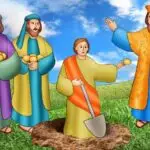
Jesus told a story about a man who gave talents to his servants. One servant got five talents, another got two, and the last got one. The ones with five and two talents used them wisely and gained more. But the one who got one talent hid it and did nothing with it. When the master returned, he praised the first two servants. But he was angry with the servant who hid his talent and punished him.
Lessons from the Parable
We learn from the parable that God wants us to use our talents. He is not happy when we waste what He gives us. Using our talents pleases God and blesses others.
Teaching Methods
To deliver this lesson, the teacher will adopt the following methods: Discussion, Storytelling, Role Play, Explanation, Visual Aids
Instructional Procedures
To deliver this lesson, the teacher will adopt the following steps:
Step 1: Introduction
Time: 5 mins
Teaching Skill: Set Induction
Teacher’s Activity: Tells a short story about a boy who can sing well but never sings in church or school. Asks pupils to share their talents.
Pupils’ Activity: Pupils listen and share their talents
Learning Point: Activates prior knowledge on talents
Step 2: Parable of the Talents
Time: 10 mins
Teaching Skill: Storytelling
Teacher’s Activity: Narrates the parable of the talents using the Bible and illustrations. Explains how each servant behaved.
Pupils’ Activity: Pupils listen and answer questions about the story
Learning Point: Understands biblical context of talents
Step 3: Lessons from the Parable
Time: 5 mins
Teaching Skill: Explanation
Teacher’s Activity: Explains what Jesus wants us to learn from the story. Emphasizes use of talent and God's reward or punishment.
Pupils’ Activity: Pupils discuss the lessons they learned from the parable
Learning Point: Learns moral lesson about talent use
Step 4: Consequences of Abandoning Talents
Time: 10 mins
Teaching Skill: Discussion
Teacher’s Activity: Discusses the bad things that happen when people abandon or hide their talents. Writes consequences on the board.
Pupils’ Activity: Pupils list consequences and discuss with examples
Learning Point: Learns effects of ignoring talents
Step 5: Role Play
Time: 5 mins
Teaching Skill: Group Work
Teacher’s Activity: Guides pupils to act out scenes where someone refuses to use a talent and another where a talent is used well.
Pupils’ Activity: Pupils act in groups and respond to teacher’s questions
Learning Point: Demonstrates understanding through drama
Step 6: Note Taking
Time: 2 mins
Teaching Skill: Writing
Teacher’s Activity: Dictates key points and consequences for pupils to write down
Pupils’ Activity: Pupils write notes in their exercise books
Learning Point: Retains important knowledge from lesson
Step 7: Evaluation
Time: 2 mins
Teaching Skill: Assessment
Teacher’s Activity: Asks oral questions on the parable and the consequences discussed
Pupils’ Activity: Pupils answer questions aloud
Learning Point: Measures pupils’ understanding
Step 8: Conclusion
Time: 1 min
Teaching Skill: Instructional/Cognitive/Social
Teacher’s Activity: Recaps key points, encourages pupils to discover and use their talents, gives praise to active participants.
Pupils’ Activity: Pupils repeat key points and promise to use their talents
Learning Point: Reinforces lesson and motivates action
Home Task: Write three lessons learned about Consequences Of Abandoning Talents and one suitable way to apply the teaching responsibly.
Lesson Keywords
- Talent – A special ability or gift from God
- Abandon – To leave or ignore something
- Condemnation – Being judged or punished
- Regret – Feeling sorry about something you did or did not do
- Purpose – The reason for doing something or why you are created
Lesson Evaluation
To evaluate the learning, the teacher asks pupils to:
- What is a talent?
- Who gave us our talents?
- Tell the story of the man who gave talents to his servants.
- What happened to the servant who did not use his talent?
- List four consequences of abandoning your talent.
- Say the memory verse for today.
- How can you use your talent at school?
- Why should you not abandon your talent?
Differentiation
Teacher will use pictures, storytelling, group activities, and simplified explanations to support learners of different abilities.
Note for teachers using this lesson plan
Encourage every child to identify and share one talent. Reinforce positive feedback for participation. Simplify biblical references for better understanding.


Community Join the conversation Open discussion +