

Note for teachers using this lesson plan
This lesson introduces pupils to the Ten Commandments, God’s fundamental laws for humanity. Ensure you have Bibles and charts ready to facilitate understanding and active participation. Guide pupils to appreciate these commandments not just as rules, but as principles for a good life and a healthy relationship with God and others. By the end, pupils should be able to list the commandments and understand their relevance.
Class: Primary 4
Term: First Term
Week: 8
Age: 9 years
Duration: 45 minutes
Subject: Christian Religious Studies
Curriculum Theme: God’s plan for us
Focal competence: Obeying rules and laws in the class, school, home and community
Key competencies/values: Communication; Leadership
Skills:
- list the Ten Commandments
Previous Lesson: Law and Its Importance
Topic: God Gives His Law To Us: The Ten Commandments
Subject Matter: The Ten Commandments
Specific Objectives
By the end of the lesson, pupils should be able to:
Cognitive Domain
- State the meaning of a commandment.
- Recall the story of God giving the Ten Commandments to Moses.
- List the Ten Commandments.
- Identify commandments that relate to God.
- Identify commandments that relate to other people.
Affective Domain
- Appreciate the importance of obeying God’s laws.
- Show willingness to obey rules and laws in class, school, home, and community.
Psychomotor Domain
- Recite the Ten Commandments.
- Write down the Ten Commandments.
Social Domain
- Discuss how the Ten Commandments promote good relationships with God and neighbours.
Reference Materials
The following resources were used in planning this lesson:
- 2025 Revised 9 Years Basic Education Curriculum
- Relevant State Unified Scheme of Work
- Christian Religious Studies for Primary 4
- The HeadTeacher Scheme of work
Instructional Materials
The teacher will teach this lesson with the aid of:
- Holy Bible
- Charts showing the Ten Commandments
- Copies of the Ten Commandments for each pupil or group
Rationale for the Lesson
This lesson is important because it introduces pupils to the fundamental laws given by God, which serve as a guide for moral living. Understanding these commandments helps pupils to build a strong foundation for their faith and to develop good character, promoting peaceful coexistence with God and fellow humans.
Prerequisite/Previous Knowledge
Pupils should have a basic understanding of God as their creator and the concept of rules and obedience from previous lessons or home experiences.
Lesson Content/Board Summary
God Gives His Law To Us: The Ten Commandments
Meaning of Commandment
A commandment is a rule or law given by God for people to follow. These rules guide us on how to live right and please God.
Bible Reading
The story of God giving the Ten Commandments to Moses can be found in the Bible in:
- Exodus 20:1-17
- Deuteronomy 5:6-21
God Gives Us His Commandments
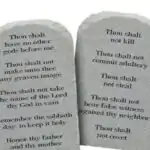
Long ago, God called Moses to Mount Sinai. There, God spoke to Moses and gave him ten special laws written on two stone tablets. These laws are called the Ten Commandments. They teach us how to love God and how to love our neighbours.
The Ten Commandments
- You shall have no other gods before me.
- You shall not make for yourself any carved image.
- You shall not take the name of the Lord your God in vain.
- Remember the Sabbath day, to keep it holy.
- Honour your father and your mother.
- You shall not murder.
- You shall not commit adultery.
- You shall not steal.
- You shall not bear false witness against your neighbour.
- You shall not covet your neighbour’s house; you shall not covet your neighbour’s wife, nor his male servant, nor his female servant, nor his ox, nor his donkey, nor anything that is your neighbour’s.
Memory Verse
Exodus 20:3: “You shall have no other gods before Me.”
Teaching Methods/Instructional Techniques
Discussion, Explanation, Question and Answer, Storytelling, Guided Reading, Group Work
Instructional Procedures
Step 1: Introduction
Time: 5 minutes
Teaching Skill: Recalling/Engaging
Teacher’s Activity: The teacher greets the pupils and asks them to mention some rules they follow at home and in school. The teacher then introduces the topic, “The Ten Commandments,” as God’s special rules for us.
Pupils’ Activity: Pupils respond by mentioning various rules they know. They listen attentively to the introduction.
Learning Point: Rules in daily life
Step 2: Meaning of Commandment
Time: 5 minutes
Teaching Skill: Explaining
Teacher’s Activity: The teacher explains the meaning of a commandment as a rule or law given by God. The teacher uses simple language and examples.
Pupils’ Activity: Pupils listen and ask questions for clarification. They repeat the meaning of commandment.
Learning Point: Meaning of commandment
Step 3: God Gives His Commandments (Bible Story)
Time: 8 minutes
Teaching Skill: Storytelling/Reading
Teacher’s Activity: The teacher narrates the story of God giving the Ten Commandments to Moses on Mount Sinai, using simple language. The teacher may also guide pupils to read Exodus 20:1-17 from their Bibles.
Pupils’ Activity: Pupils listen to the story and follow along in their Bibles if available. They answer simple questions about the story.
Learning Point: Story of Moses
Step 4: Listing the Ten Commandments
Time: 8 minutes
Teaching Skill: Guiding/Listing
Teacher’s Activity: The teacher displays charts of the Ten Commandments and guides pupils to read and arrange them in their biblical order. The teacher ensures pupils understand each commandment.
Pupils’ Activity: Pupils read the commandments from the charts and help to arrange them in order. They list the commandments orally.
Learning Point: Listing Ten Commandments
Step 5: Commandments Relating to God
Time: 6 minutes
Teaching Skill: Facilitating discussion
Teacher’s Activity: The teacher guides pupils to identify the commandments that talk about our relationship with God (e.g., having no other gods, not taking God’s name in vain, keeping the Sabbath holy).
Pupils’ Activity: Pupils discuss and identify the commandments that relate to God, explaining their understanding.
Learning Point: Commandments for God
Step 6: Commandments Relating to People
Time: 5 minutes
Teaching Skill: Facilitating discussion
Teacher’s Activity: The teacher guides pupils to identify the commandments that talk about our relationship with other people (e.g., honouring parents, not stealing, not lying, not killing, not coveting).
Pupils’ Activity: Pupils discuss and identify the commandments that relate to other people, giving examples of how to obey them.
Learning Point: Commandments for people
Step 7: Evaluation/Review
Time: 5 minutes
Teaching Skill: Questioning/Assessment
Teacher’s Activity: The teacher evaluates the learning by asking the following questions:
- What is a commandment?
- Who did God give the Ten Commandments to?
- Mention any three of the Ten Commandments.
- Which commandment tells us to honour our parents?
Pupils’ Activity: Pupils answer orally and in writing.
Learning Point: Understanding Ten Commandments
Step 8: Note-Taking
Time: 4 minutes
Teaching Skill: Guided Writing
Teacher’s Activity: The teacher guides pupils to copy the essential Board Summary notes on the meaning and list of the Ten Commandments into their notebooks.
Pupils’ Activity: Pupils copy the notes carefully into their notebooks.
Learning Point: Recording lesson notes
Step 9: Conclusion
Time: 4 minutes
Teaching Skill: Summarising
Teacher’s Activity: The teacher reminds pupils that the Ten Commandments are God’s loving rules to help us live happily and peacefully. The teacher encourages them to always obey these laws in their daily lives.
Pupils’ Activity: Pupils listen and promise to obey God’s laws.
Learning Point: Importance of obedience
Continuous Assessment/Further Study
Type: Homework
Instruction: In your exercise books, write down the Ten Commandments and draw a picture that illustrates one of them.
- List all the Ten Commandments.
- Pick one commandment that you find easy to obey and explain why.
- Pick one commandment that you find difficult to obey and explain why.
- Recite the memory verse to your parents.
Lesson Keywords
- Commandment – A rule or law given by God.
- Moses – The prophet who received the Ten Commandments from God.
- Sinai – The mountain where God gave Moses the Ten Commandments.
- Obey – To follow rules or instructions.
- Honour – To show great respect.
Differentiation
For weaker learners, provide simplified charts with pictures for each commandment and allow them to recite the commandments in pairs. For faster learners, encourage them to research and explain the consequences of breaking some of the commandments, or to write a short prayer asking for help to obey God’s laws.
Suggested Lesson Videos
For further understanding, search on YouTube for: Ten Commandments for Kids Primary 4 CRS
Teacher Guide for Using This Lesson Plan
Before the lesson, ensure you have a large chart of the Ten Commandments, Bibles, and any relevant pictures or visual aids. Begin by engaging pupils with familiar rules before introducing God’s laws. When narrating the story of Moses on Mount Sinai, make it engaging and clear. Guide pupils carefully through each commandment, explaining its meaning in simple terms. Encourage active participation in identifying commandments related to God and people. During note-taking, ensure pupils copy the Board Summary accurately. Emphasize the practical application of the commandments in their daily lives and check for understanding throughout the lesson by asking questions.
Community Join the conversation Open discussion +