

Class: Primary Six
Term: First Term
Subject: Basic Science and Technology
Curriculum Theme: Basic Science
Previous Lesson: Meaning of Solar System and Natural Bodies
Topic: Components and Location of Planets in the Solar System
Content/Learning Area: Components of the Solar System, location of Planets in the Solar System, dwarf Planets
Time Allocation: 40 minutes
Performance Objectives
By the end of the lesson, pupils should be able to:
- Cognitive domain:
1. Identify the components of the solar system and their respective locations.
2. Appreciate the order and structure of the solar system, recognizing the significance of each component.
3. arrange the planets in the correct order from the Sun.
- Affective Domain:
1. Show interest in learning about the solar system.
- Psychomotor Domain:
1. Participate in a hands-on activity to arrange planets in order.
- Social Domain:
1. Work collaboratively in groups to discuss the characteristics of different planets.
Reference Materials
- 9 – Years Basic Education Curriculum
- Abuja Educational Resource Center Scheme of Work
- NAPPS National Unified Scheme of work
- Relevant Textbooks
instructional Materials
To deliver this lesson, the teacher will use the following materials: Flashcards with planet names, a chart showing the solar system, pictures of planets, and a whiteboard or projector.
Rationale for the Lesson
This lesson builds upon prior knowledge of the solar system, providing a deeper understanding of its structure and components. this knowledge is crucial for future science lessons and fosters curiosity about space.
Prerequisite/Previous Knowledge
The teacher will start by asking pupils what they remember from the previous lesson about the solar system. A brief review of the Sun and planets will be conducted to refresh their memories before introducing the new lesson’s content.
Lesson Content
Components of the Solar System
The solar system is a vast region containing the Sun and everything that orbits it. The components include:
- The Sun: The central star, providing light and energy.
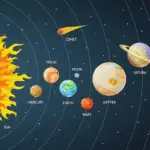
- Planets: eight planets orbiting the Sun (Mercury, Venus, Earth, mars, Jupiter, Saturn, Uranus, Neptune).
- Dwarf Planets: Smaller than planets, they don’t clear their orbits (Pluto, Eris, Haumea, Makemake, Ceres).
- Moons: Celestial bodies orbiting planets.
- Asteroids: Small, rocky objects, mostly in the asteroid belt.
- Comets: Icy bodies with tails when near the Sun.
- Meteoroids: Small rocky or metallic objects in space.
Location of Planets in the Solar System
The order of planets refers to their arrangement based on their distance from the Sun. The following are the planets in order from the sun:
-
Mercury is the first planet from the Sun. It is very small and has extreme temperatures, being hot in the day and freezing at night. Mercury has no moons.
-
Venus is the second planet from the Sun. It is about the same size as Earth but has a thick, poisonous atmosphere that traps heat. Venus has no moons.
-
Earth is the third planet from the Sun. It is mostly covered by water and has the right conditions for life. Earth has one moon called “the Moon.”
-
Mars is the fourth planet from the Sun. It is called the Red Planet because of its reddish soil and rocks. Mars has two small moons, Phobos and Deimos.
-
Jupiter is the fifth planet from the Sun. It is the largest planet and mostly made of gas. Jupiter has a giant storm called the Great Red Spot and more than 95 moons.
-
Saturn is the sixth planet from the Sun. It is famous for its rings made of ice and rock. Saturn has more than 145 moons, including Titan, which is bigger than Mercury.
-
Uranus is the seventh planet from the Sun. It is a blue-green ice giant that spins on its side. Uranus has 27 known moons.
-
Neptune is the eighth planet from the Sun. It is deep blue and has the strongest winds of all planets. Neptune has 14 known moons.
Dwarf Planets
Dwarf planets are celestial bodies that orbit the Sun, similar to planets, but they have not cleared their orbital region of other objects. Examples are:
- Pluto
- Eris
- Haumea
- Makemake
- Ceres
Teaching Methods
To deliver this lesson, the teacher will adopt the following methods: Clarification, presentation, hands-on activity, and question-and-answer sessions.
Instructional Procedures
To deliver this lesson, the teacher will adopt the following steps:
Step 1: Introduction
Time: 5 minutes
Teaching Skill: Set Induction
Teacher’s Activity: Review previous lesson on the solar system. Introduce the topic: Components and Location of Planets in the Solar System.
Pupils’ Activity: Answer questions about the previous lesson. Listen attentively to the introduction.
Step 2: Clarification of Key Concepts
Time: 10 minutes
Teaching Skill: Explaining, defining
Teacher’s Activity: Explain the components of the solar system (Sun, planets, moons, asteroids, comets, meteoroids). Explain the order of planets from the Sun.
Pupils’ Activity: Listen attentively, take notes, and ask clarifying questions.
Step 3: Exhibition/Guided Practice
Time: 10 minutes
Teaching Skill: Demonstrating, guiding
Teacher’s Activity: Show a chart or model of the solar system. Guide pupils through the arrangement of planets using flashcards.
Pupils’ Activity: Observe the demonstration, participate in the guided practice.
Step 4: Self-reliant Practice
Time: 5 minutes
Teaching Skill: Monitoring, assisting
Teacher’s Activity: Supervise pupils as they arrange the planets independently.
Pupils’ Activity: Arrange the planets in the correct order using flashcards.
Step 5: Note-Taking
Time: 5 minutes
Teaching Skill: Summarizing, guiding
teacher’s Activity: Guide pupils in summarizing key concepts and writing notes.
Pupils’ Activity: Write notes and summarize key concepts.
Step 6: Evaluation/Review
Time: 5 minutes
Teaching Skill: Questioning, assessing
teacher’s Activity: Ask evaluation questions to assess understanding.
Pupils’ Activity: Answer evaluation questions.
Objective-aligned checks:
- Identify the components of the solar system and their respective locations.
- Show interest in learning about the solar system.
Step 7: Conclusion
Time: 2 minutes
teaching Skill: Summarizing, concluding
Teacher’s Activity: Summarize the key concepts learned and assign homework.
Pupils’ Activity: Listen to the summary and note the homework assignment.
Lesson Keywords
- Solar System – A group of celestial bodies that includes the Sun and all the objects that orbit it.
- Planets – Celestial bodies orbiting a star, having cleared their orbit of other objects.
- Dwarf Planets – Celestial bodies orbiting a star, but not having cleared their orbit of other objects.
- Asteroids – Small, rocky objects orbiting the sun, mainly found in the asteroid belt.
- Comets – Icy celestial bodies that, when close to the Sun, display a visible tail.
Lesson Evaluation
To evaluate the learning, the teacher asks pupils to:
- List the planets in order from the Sun.
- What is a unique feature of Mercury?
- Why is Earth suitable for life?
- What is the main difference between inner and outer planets?
- What is the Sun’s role in the solar system?
- Which planet is known for its rings?
- what is the Great Red Spot?
- Which planet is farthest from the Sun?
Assignment/Homework
- draw a diagram of the solar system, labeling all the planets in their correct order.
- Write a short paragraph about your favorite planet, explaining why you find it interesting.
- Research and list three interesting facts about dwarf planets.
Differentiation
- For slower learners: Provide one-on-one assistance during the hands-on activity.
- For advanced learners: Encourage them to research additional facts about the planets.
- For visual/auditory/kinesthetic learners: Use visual aids, verbal explanations, and hands-on activities to cater to different learning styles.
Note for Teachers
Ensure to use visual aids and hands-on activities to make the lesson engaging and understandable for all pupils. Encourage questions and discussions to foster curiosity and deeper understanding.
Community Join the conversation Open discussion +