

Class: Primary 6
Term: First Term
Subject: Basic science
Previous Lesson:
Topic: the Meaning of Solar System
Content/Learning Area: What is the Solar System?,Natural Bodies in the Solar System,key Terms in the Solar System,Examples of Natural Bodies in the Solar System
Time Allocation: 40 minutes
Performance Objectives
By the end of the lesson,pupils should be able to:
- Cognitive Domain:
1. Define the Solar System and natural bodies.
2. Explain what celestial bodies are.
3. Describe how the Solar System works.
4. Understand the meaning of key terms like revolution, orbit, ellipse, and gravity.
5. List examples of natural bodies in the Solar System.
- Psychomotor Domain:
1. Draw a simple diagram of the Solar System.
- Affective Domain:
1. Show interest in learning about the Solar System.2. Appreciate the vastness of space.
- Social Domain:
1.Work collaboratively with peers in group activities.
Reference Materials
- 9 – Years Basic Education Curriculum
- Abuja Educational Resource Center scheme of Work
- NAPPS National Unified Scheme of Work
- Relevant Textbooks
Instructional Materials
To deliver this lesson, the teacher will employ the help of the following materials:
- Whiteboard or chart
- Markers or chalk
- Pictures or diagrams of the Solar System
- Relevant textbooks
Rationale for the Lesson
Understanding the Solar System is fundamental to grasping basic astronomy and our place in the universe. This lesson provides a foundation for future science lessons and fosters curiosity about space exploration.
Prerequisite/Previous Knowledge
Pupils should have basic knowledge of the Earth and the sky.
Lesson Content
What is the Solar System?
The Solar System is a group of celestial bodies, including the sun and everything that orbits it. This includes planets, moons, asteroids, comets, and dwarf planets. The Sun’s gravity holds everything together.
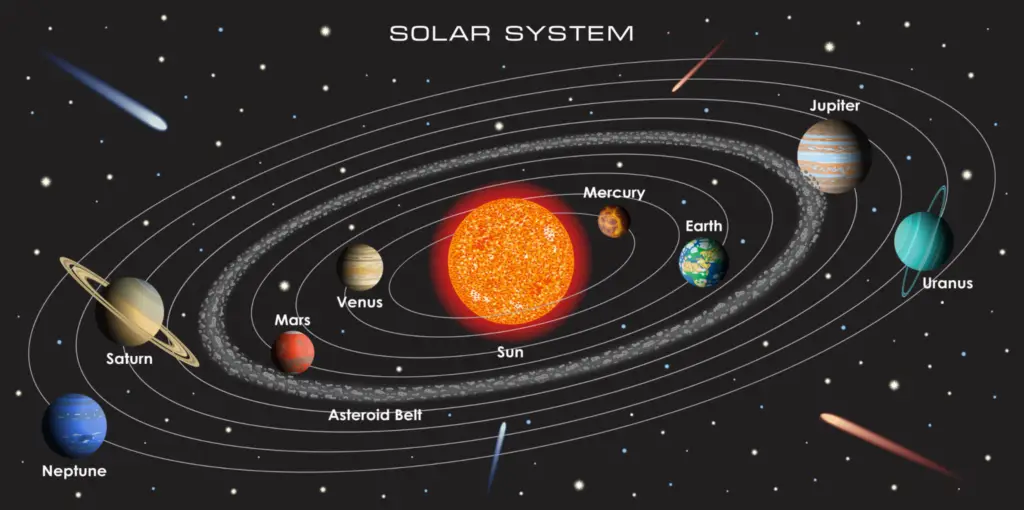
natural Bodies in the Solar System
Natural bodies are objects in space that are not man-made. They are also called celestial bodies and include planets, moons, asteroids, comets, dwarf planets, stars, and meteoroids. Learn more about celestial bodies here.
Key Terms in the solar System
Thes are critically important words to understand when studying the solar system:
Revolution
Revolution is the movement of a planet or object around the Sun. Earth takes 365 days to complete one revolution.
Orbit
An orbit is the path a planet or moon follows as it revolves around the Sun. it’s like an imaginary pathway.
Gravity
Gravity is the force that pulls objects together. it keeps planets in orbit around the Sun and makes things fall to Earth. The Sun’s gravity holds the Solar System together.
Examples of Natural Bodies in the Solar System
There are many natural bodies in the solar system. Examples are:
- Planets: Mercury, Venus, Earth, Mars, Jupiter, Saturn, Uranus, Neptune
- Moons: The Moon (Earth’s moon), Phobos and Deimos (Mars’ moons), Titan (Saturn’s moon)
- Asteroids: Found in the Asteroid belt, Ceres, Vesta
- Comets: like Halley’s Comet, Comet NEOWISE, Comet Hale-Bopp
- Dwarf planets: Like Pluto, Eris, Makemake
Teaching Methods
To deliver this lesson, the teacher will adopt the following methods: Discussion, Question and answer, Visual aids
Instructional Procedures
To deliver this lesson, the teacher will adopt the following steps:
Step 1: Introduction
Time: 5 minutes
Teaching Skill: Set Induction
Teacher’s Activity: Ask pupils what they know about space and planets. Show a picture of the solar system.
Pupils’ Activity: Share their prior knowledge and observe the picture.
Step 2: Explanation of Key Concepts
Time: 15 minutes
Teaching Skill: Explanation
Teacher’s activity: Explain the meaning of the solar System, natural bodies, revolution, orbit, and gravity using simple language and visual aids.
Pupils’ Activity: Listen attentively and ask clarifying questions.
Step 3: Demonstration/Guided Practice
Time: 10 minutes
Teaching Skill: Demonstration
Teacher’s Activity: Draw a simple diagram of the Solar System on the board, explaining the positions of the planets and the Sun.
Pupils’ Activity: Observe the demonstration and participate in drawing the diagram.
Step 4: Self-Reliant Practice
Time: 5 minutes
Teaching Skill: Guided Practice
Teacher’s Activity: Guide pupils to draw their own diagrams of the Solar System.
Pupils’ Activity: Draw their own diagrams.
Step 5: Note-Taking
Time: 2 minutes
Teaching Skill: Note-Taking
Teacher’s Activity: Guide pupils to write down key terms and definitions.
Pupils’ activity: Write down notes.
Step 6: Evaluation/Review
Time: 3 minutes
Teaching Skill: Questioning
Teacher’s Activity: Ask review questions to assess understanding.
Pupils’ Activity: Answer the questions.
Objective-aligned checks:
- Define the Solar System and natural bodies.
- Explain what celestial bodies are.
- Describe how the Solar System works.
Step 7: Conclusion
Time: 2 minutes
Teaching Skill: Summarizing
Teacher’s Activity: Summarize the key concepts learned and assign a short homework activity.
Pupils’ Activity: Listen to the summary and note the homework assignment.
Lesson Keywords
- Solar System – A group of celestial bodies including the Sun and everything that orbits it.
- Natural Bodies – Objects in space that are not man-made.
- Revolution – The movement of a planet around the Sun.
- Orbit – The path a planet follows around the sun.
- Gravity – The force that pulls objects together.
Lesson Evaluation
To evaluate the learning, the teacher asks pupils to:
- What is the Solar System?
- Name three natural bodies in the Solar System.
- What is revolution?
- What is an orbit?
- What is gravity and why is it important to the Solar System?
Assignment/Homework
- Draw a detailed diagram of the Solar System.
- Research a specific planet and write a short paragraph about it.
Differentiation
- for slower learners: Provide one-on-one assistance and simplified explanations.
- For advanced learners: Encourage further research on specific planets or celestial bodies.
- For visual/auditory/kinesthetic learners: use visual aids, discussions, and hands-on activities to cater to different learning styles.
Note for Teachers
Ensure to use visual aids and real-life examples to make the lesson engaging. Encourage pupils to ask questions and participate actively in discussions. Provide additional support to pupils who need it and challenge advanced learners with more complex tasks.
Community Join the conversation Open discussion +