

Class: Primary 6
Term: 2nd Term
Subject: Basic Science and Technology
Curriculum Theme: Basic Science
Previous Lesson: Meaning And Purposes Of Reproduction
topic: Male Reproductive Organs
Content/Learning Area: Male Reproductive Organs
Time Allocation: 40 minutes
Performance Objectives
By the end of the lesson, pupils should be able to:
- Cognitive Domain: Identify and describe the main male reproductive organs and their functions.
- Affective Domain: Appreciate the importance of understanding human reproduction for personal growth and health.
- Psychomotor Domain: Demonstrate knowledge by drawing and labeling the male reproductive system.
- Social Domain: Discuss in groups the role of reproduction in human life and societal progress.
Reference Materials
The following resources were used in planning this lesson:
- 9 – Years Basic Education Curriculum
- Abuja Educational Resource Center Scheme of Work
- NAPPS National Unified Scheme of Work
- Online Information from: WebMD – The Male Reproductive System: Organs, Function, and More
- Relevant Textbooks: “Understanding Science: Reproduction and Growth”
Instructional Materials
To deliver this lesson, the teacher will use the following materials:
- Chart of male reproductive organs
- Diagrams of human reproductive systems
- Whiteboard and markers
Rationale for the Lesson
Understanding the male reproductive organs is essential for pupils to grasp human development, health, and reproduction. This knowledge helps them make informed decisions about their bodies and fosters respect for human life. Additionally,it lays the foundation for more advanced discussions in biology and human anatomy.
Prerequisite/Previous Knowledge
Pupils should have prior knowledge about the basic process of reproduction in humans, which was covered in the previous lesson on the purposes of reproduction.
Lesson Content
Male Reproductive Organs
Reproduction in humans involves both male and female reproductive systems working together. The male reproductive organs are:
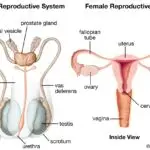
- Testes: These are two oval-shaped organs that produce sperm and male hormones like testosterone.
- Penis: The organ used for sexual intercourse and urination. It carries sperm into the female reproductive system.
- Scrotum: A sac of skin that holds the testes outside the body to keep them cool.
- Vas deferens: Tubes that carry sperm from the testes to the urethra during ejaculation.
- Urethra: The tube that carries sperm and urine out of the body through the penis.
- Seminal vesicles and prostate gland: These glands produce fluids that nourish and protect the sperm.
Male Reproductive Organs
The testes produce sperm cells and the hormone testosterone. The scrotum holds the testes outside the body, the sperm ducts transport sperm, glands add fluids that form semen, and the penis passes urine or semen at different times through the urethra.
Use correct scientific terms and respect privacy. Pain, swelling or injury should be reported to a trusted adult and qualified health worker.
Teaching Methods
To deliver this lesson, the teacher will adopt the following methods: Description, Discussion, Visual Aids, Interactive Questioning, Think-Pair-Share, Hands-on Learning.
Instructional Procedures
To deliver this lesson, the teacher will adopt the following steps:
Step 1: Introduction (Set Induction)
Time: 5 mins
Teaching Skill: Set Induction
Teacher’s Activity: Ask pupils: “What do you know about how humans reproduce?”
Pupils’ Activity: Pupils respond and share what they know.
Step 2: Explanation of Organs
Time: 10 mins
Teaching Skill: Explanation
teacher’s Activity: Show and explain each male reproductive organ using charts and diagrams.
Pupils’ Activity: Pupils listen and observe the diagrams.
Step 3: Discussion of Functions
Time: 8 mins
Teaching Skill: Discussion
Teacher’s Activity: Ask pupils to discuss the function of each organ using the think-pair-share strategy.
Pupils’ Activity: Pupils discuss in pairs, than share with the class.
Step 4: Drawing and Labeling
Time: 7 mins
Teaching Skill: Activity
teacher’s Activity: Guide pupils in drawing and labeling the organs.
pupils’ Activity: Pupils draw and label the male reproductive organs.
Step 5: Note-Taking
Time: 5 mins
Teaching Skill: Note Taking
Teacher’s Activity: Direct pupils to copy down key points from the board.
Pupils’ Activity: Pupils write notes in their notebooks.
Step 6: Evaluation/Review
Time: 3 mins
Teaching Skill: Questioning
Teacher’s Activity: Ask questions about the organs and their functions.
Pupils’ Activity: Pupils answer questions from the teacher.
Objective-aligned checks:
- Identify and describe the main male reproductive organs and their functions.
- Demonstrate knowledge by drawing and labeling the male reproductive system.
Step 7: Conclusion
Time: 2 mins
Teaching Skill: Conclusion
Teacher’s Activity: Summarize the main points and clarify any confusion.
pupils’ Activity: Pupils listen and ask any remaining questions.
Lesson Keywords
- Testes – Organs that produce sperm and male hormones.
- Penis – Organ used for sexual intercourse and urination.
- Scrotum – Sac of skin that holds the testes.
- Vas deferens – Tubes that carry sperm from the testes.
- Urethra – Tube that carries sperm and urine out of the body.
- Seminal vesicles – Glands that produce fluids to nourish sperm.
- Prostate gland – Gland that produces fluids to protect sperm.
Lesson Evaluation
To evaluate the learning, the teacher asks pupils to:
- Name the main male reproductive organs.
- Describe the function of the testes.
- Explain the role of the penis in reproduction.
- Draw and label the male reproductive system.
- share one captivating thing they learned today about the male reproductive organs.
Assignment/Homework
- Research and write a short paragraph on the importance of the male hormone testosterone.
- Draw a detailed diagram of the male reproductive system and label all its parts.
- Explain the difference between the functions of the urethra and the vas deferens.
Differentiation
- For slower learners: Provide a pre-drawn template of the male reproductive organs for labeling.
- For advanced learners: Encourage fast learners to explain the functions of the organs in more detail to their peers.
- For visual/auditory/kinesthetic learners: Use diagrams, verbal explanations, and hands-on activities to cater to different learning styles.
Note for Teachers
This lesson is important for building awareness and understanding of human biology, which helps pupils develop a healthy attitude towards their bodies. Be sensitive to the fact that some pupils might feel uncomfortable discussing reproductive organs. Provide a safe and respectful environment for questions. Happy teaching!

Community Join the conversation Open discussion +