

Class: Primary Three
Term: Second term
Subject: Basic Science and Technology
Curriculum Theme: Computer Studies
Previous Lesson: Definition And Functions Of A System Unit
Topic: system Unit
Content/learning Area: What is a system Unit?, Components of a System Unit
Time Allocation: 40 minutes
Performance Objectives
By the end of the lesson, pupils should be able to:
- Cognitive Domain:
1. List two components of a system unit.
2. Explain the importance of understanding the components of a system unit.
- Affective Domain:
1. Show interest in learning about computer components.
- Psychomotor Domain:
1.Demonstrate assembling and disassembling a simple system unit model.
- Social Domain:
1. Collaborate with peers to create a list of components.
Reference Materials
- 9 – Years basic Education Curriculum
- abuja Educational Resource Center Scheme of work
- NAPPS National Unified Scheme of Work
- Online Details
- Relevant Textbooks
Instructional Materials
To deliver this lesson, the teacher will use the following materials:
- Whiteboard or chart
- Markers or pens
- Simple system unit model (optional)
- Pictures or diagrams of system unit components
Rationale for the Lesson
Understanding the system unit is crucial for basic computer literacy and forms a foundation for future learning about technology and its applications in daily life.
Prerequisite/previous Knowledge
Pupils have basic knowledge about computers.
Lesson Content
What is a System Unit?
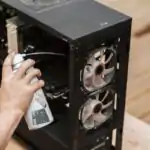
The system unit is the main part of a computer, sometimes called the “tower” or “chassis.” It processes information, stores data, and runs programs.
Components of a System Unit
The system unit houses several key components that enable the computer to function. These include:
the following are components of a system unit:
- Central Processing Unit (CPU): The “brain” of the computer, processing information and executing instructions.
- Memory (RAM): The computer’s short-term memory, holding information the CPU needs quickly.
- Motherboard: The main circuit board connecting all components.
- Hard Drive: Stores files and programs permanently.
- Power Supply: Provides electricity for the computer to run.
- Graphics Card (GPU): Handles the processing and output of images and videos.
- cooling System: Prevents overheating of components like the CPU and GPU.
Teaching Methods
To deliver this lesson, the teacher will adopt the following methods: Discussion, Exhibition, Question and answer.
Instructional Procedures
To deliver this lesson, the teacher will adopt the following steps:
Step 1: Introduction
Time: 5 minutes
Teaching Skill: Set Induction
Teacher’s Activity: Asks pupils what they know about computers and introduces the topic: System Unit.
Pupils’ Activity: respond to teacher’s questions and listen attentively.
Step 2: Explanation of Key Concepts
Time: 10 minutes
Teaching Skill: Explanation
Teacher’s Activity: Explains what a system unit is, using simple analogies.
Pupils’ Activity: Listen attentively and ask clarifying questions.
Step 3: Presentation/Guided Practice
Time: 10 minutes
Teaching Skill: Demonstration
Teacher’s Activity: Shows pictures/diagrams of system unit components and explains their functions. If a model is available, demonstrates assembling/disassembling.Pupils’ Activity: Observe the demonstration and participate in discussions.
Step 4: Self-reliant Practice
Time: 5 minutes
Teaching Skill: Guided Practice
Teacher’s Activity: guides pupils in listing components and their functions.
Pupils’ Activity: Work individually or in pairs to list components.
Step 5: Note-Taking
Time: 5 minutes
Teaching Skill: Note-Taking
Teacher’s Activity: Guides pupils in taking notes on key concepts.
Pupils’ Activity: Write down key points in their notebooks.
Step 6: Evaluation/Review
Time: 5 minutes
Teaching Skill: Questioning
Teacher’s Activity: Asks review questions to assess understanding.
Pupils’ Activity: Answer review questions.
Objective-aligned checks:
- List two components of a system unit.
- Explain the importance of understanding the components of a system unit.
- Show interest in learning about computer components.
Step 7: conclusion
time: 2 minutes
Teaching Skill: Summarizing
Teacher’s Activity: Summarizes the key concepts and assigns homework.
Pupils’ Activity: Listen attentively and note homework.
lesson Keywords
- System Unit – The main part of a computer that houses essential components.
- CPU – The “brain” of the computer, processing information.
- RAM – Short-term memory for speedy access to data.
- Motherboard – The main circuit board connecting all components.
- Hard Drive – Long-term storage for files and programs.
Lesson Evaluation
To evaluate the learning, the teacher asks pupils to:
- Name two components of a system unit and explain what they do.
- Why is it vital to understand the parts of a system unit?
- What is the job of the CPU?
- how is a hard drive different from RAM?
Assignment/Homework
- Draw and label the main components of a system unit.
- write a short paragraph explaining the function of each labeled component.
Differentiation
- For slower learners: Provide one-on-one assistance and use simpler language.
- for advanced learners: Introduce additional components or challenge them with more complex questions.
- For visual/auditory/kinesthetic learners: Use visual aids,verbal explanations,and hands-on activities to cater to different learning styles.
Note for Teachers
Ensure to use real-life examples and analogies to explain complex concepts. Encourage pupils to ask questions and participate actively in discussions.


Community Join the conversation Open discussion +