

Class: Primary Four
Term: Third Term
Subject: Basic Science and Technology
curriculum theme: basic Science
Previous Lesson: Meaning of liquid, Physical properties, Movement, and Examples of liquids
Topic: Forms of Energy
Content/Learning Area: Identify and define mechanical and electrical energy, Appreciate the importance and everyday applications of different forms of energy, Distinguish between mechanical and electrical energy through examples
Time Allocation: 40 minutes
Performance Objectives
By the end of the lesson, pupils should be able to:
- Cognitive Domain:
1. Identify and define mechanical and electrical energy.
2. Distinguish between mechanical and electrical energy through examples.
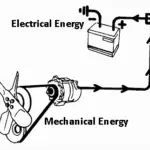
3. Explain how a fan uses electrical energy to generate mechanical energy.
- Affective Domain:
1. Appreciate the importance and everyday applications of different forms of energy.2. Show interest in learning about different forms of energy.
- Psychomotor Domain:
1. Participate actively in class discussions.
2. Complete the evaluation questions accurately.
- Social Domain:
1. Work collaboratively with peers during activities.
2. Listen attentively to the teacher and classmates.
Reference Materials
- 9 – Years Basic Education Curriculum
- Abuja Educational Resource Center Scheme of Work
- NAPPS National Unified Scheme of Work
- Online Details
- Relevant Textbooks
Instructional Materials
To deliver this lesson, the teacher will employ the help of the following materials:
- whiteboard or chart paper
- Markers or pens
- Pictures or diagrams illustrating mechanical and electrical energy
- Relevant textbooks
Rationale for the Lesson
Understanding different forms of energy is crucial for pupils’ comprehension of the world around them. This lesson lays the foundation for future learning in science and technology, highlighting the importance of energy in everyday life and various applications.
Prerequisite/Previous Knowledge
The teacher will start by asking pupils what they understand by the word “energy” and encourage them to share examples from their daily lives. This will help gauge their prior knowledge and create a smooth transition into the lesson.
Lesson Content
Forms of energy
Energy is the ability to do work. We’ll focus on two types: mechanical and electrical energy.
What is Mechanical Energy?
Mechanical energy is the energy an object has as of its movement or position. Anything that moves or can be moved has it.
Examples of Mechanical Energy
The following are examples of mechanical energy:
- A bicycle going downhill (kinetic energy – energy of motion).
- A windmill (wind turns the blades,creating mechanical energy).
- A ball thrown up (potential energy – energy of position at its highest point, kinetic energy as it falls).
- A moving car (kinetic energy).
- Water flowing in a river (kinetic energy).
what is Electrical Energy?
Electrical energy comes from electrons moving through something like wires. It powers many things, from lights to computers.
Examples of Electrical Energy
These include:
- A light bulb: Electrons flowing through the wires make it glow.
- An electric oven: Electron flow in the heating elements creates heat.
- A computer: Electrons flowing through circuits let it work.
- A television: Electron flow enables display and sound.
- A mobile phone: Electron flow powers its functions.
Teaching Methods
To deliver this lesson, the teacher will adopt the following methods: Interactive discussion, Question and answer, Use of visual aids
Instructional Procedures
To deliver this lesson, the teacher will adopt the following steps:
Step 1: Introduction
Time: 5 minutes
Teaching Skill: Set Induction
Teacher’s Activity: Review previous lesson on energy. Introduce the topic: Forms of Energy.
Pupils’ Activity: Respond to teacher’s questions,listen attentively.
Step 2: Explanation of Key Concepts
Time: 15 minutes
Teaching Skill: Explanation
Teacher’s Activity: Explain mechanical and electrical energy with clear examples.
Pupils’ Activity: Listen attentively, take notes.
Step 3: Exhibition/Guided practice
Time: 10 minutes
Teaching Skill: Presentation
Teacher’s Activity: Show pictures/videos of mechanical and electrical energy in action.
Pupils’ Activity: Observe, participate in discussions.
Step 4: Independent Practice
Time: 5 minutes
Teaching Skill: Guided Practice
Teacher’s Activity: Pupils answer questions individually.
Pupils’ Activity: Answer questions independently.
Step 5: Note-Taking
Time: 2 minutes
Teaching Skill: Note-taking
Teacher’s Activity: Guide pupils in summarizing key concepts.
Pupils’ Activity: Take notes.
Step 6: Evaluation/Review
Time: 3 minutes
Teaching Skill: Evaluation
Teacher’s Activity: Review key concepts and answer questions.Pupils’ Activity: Answer questions.
Objective-aligned checks:
- Identify and define mechanical and electrical energy.
- Distinguish between mechanical and electrical energy through examples.
- Explain how a fan uses electrical energy to generate mechanical energy.
Step 7: Conclusion
Time: 2 minutes
Teaching Skill: Summarizing
Teacher’s activity: Summarize the lesson and give assignment.
pupils’ Activity: Listen attentively.
Lesson Keywords
- Mechanical Energy – Energy possessed by an object due to its motion or position.
- Electrical Energy – Energy resulting from the flow of electric charge.
- Kinetic Energy – Energy of motion.
- Potential Energy – energy of position.
lesson Evaluation
To evaluate the learning, the teacher asks pupils to:
- What is mechanical energy? Give two examples.
- What is electrical energy? Give two examples.
- how does a fan use electrical energy to make mechanical energy?
- Can you think of other examples of mechanical and electrical energy we use daily?
- Why is it vital to understand different forms of energy?
Assignment/Homework
- List five examples of mechanical energy you see at home.
- list five examples of electrical energy you use at school.
- explain how a generator uses mechanical energy to produce electrical energy.
Differentiation
- For slower learners: Provide one-on-one assistance and use simpler examples.
- For advanced learners: Encourage them to explore additional examples and research other forms of energy.
- For visual/auditory/kinesthetic learners: Use visual aids, discussions, and hands-on activities to cater to different learning styles.
note for Teachers
Ensure to use real-life examples and demonstrations to make the lesson engaging and relatable for the pupils. Encourage active participation and provide constructive feedback.


Community Join the conversation Open discussion +