

Class: Primary Four
Term: Third Term
Subject: Basic Science and Technology
Curriculum Theme: Basic Science
Previous Lesson: Measuring Volume Of Liquids
Topic: Measuring Volume of Irregular Solids
Content/Learning Area: Measuring the volume of irregularly shaped objects by water displacement
Time Allocation: 40 minutes
Performance Objectives
By the end of the lesson, pupils should be able to:
- define volume and identify an irregular solid;
- measure an object by water displacement;
- calculate final reading minus initial reading and state the correct unit;
- handle water, glassware and test objects safely; and
- record and compare measurements in a group.
Reference Materials
- 9-Year Basic Education Curriculum
- Approved Primary 4 Basic Science textbook
- Teacher-prepared measurement chart
Instructional Materials
- measuring cylinder or graduated transparent container
- water, tray and towel
- small non-absorbent stones or metal objects that fit safely into the cylinder
- thread and recording sheet
Rationale for the Lesson
Regular solids can be measured with length formulas, but stones and many everyday objects have no simple regular shape. Water displacement gives pupils a practical way to find their volume.
Prerequisite/Previous Knowledge
Pupils can read a simple liquid scale and know millilitres and cubic centimetres as units of volume.
Lesson Content
Volume and Irregular Solids
Volume is the space occupied by an object. An irregular solid, such as a stone, has no simple length-by-width-by-height formula suitable for its whole shape.
Water Displacement Method
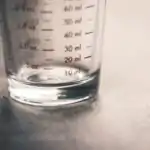
- Pour water into a measuring cylinder and read the bottom of the meniscus at eye level. Record this as the initial volume.
- Lower the object gently until it is fully under water. Remove trapped air bubbles.
- Record the new level as the final volume.
- Calculate: volume of solid = final volume − initial volume.
Example: initial water level = 50 mL; final level = 68 mL. Volume of the stone = 68 − 50 = 18 mL, which is equal to 18 cm³.
Limits and Safety
The method is unsuitable for objects that float, dissolve, absorb water, react with water or are too large for the container unless a safer adapted method is provided. Do not drop objects into glassware or measure electrical items.
Teaching Methods
Discussion, demonstration, guided investigation and cooperative learning.
Instructional Procedures
Step 1: Introduction
Time: 5 minutes
Teacher’s Activity: Shows a cube and a stone and asks how their volumes could be found.
Pupils’ Activity: Compare the shapes and suggest methods.
Step 2: Explanation and Demonstration
Time: 10 minutes
Teacher’s Activity: Models correct scale reading and water displacement.
Pupils’ Activity: Observe and identify the two readings.
Step 3: Guided Group Practice
Time: 12 minutes
Teacher’s Activity: Supervises safe measurement.
Pupils’ Activity: Measure one object, calculate and record its volume.
Step 4: Independent Practice
Time: 5 minutes
Pupils’ Activity: Solve one displacement example.
Step 5: Note-Taking
Time: 3 minutes
Pupils’ Activity: Copy the board summary and example.
Step 6: Evaluation/Review
Time: 3 minutes
Teacher’s Activity: Checks method, calculation, unit and safety.
Objective-aligned checks:
- define volume and identify an irregular solid.
- calculate final reading minus initial reading and state the correct unit.
- record and compare measurements in a group.
Step 7: Conclusion
Time: 2 minutes
Teacher’s Activity: Restates final minus initial.
Lesson Keywords
- volume — space occupied by an object
- irregular solid — solid without a simple regular shape
- displacement — movement of water caused by an immersed object
- meniscus — curved surface of a liquid in a container
Lesson Evaluation
- What is volume?
- Name two irregular solids.
- Why must the object be fully under water?
- Water rises from 35 mL to 52 mL. Find the object’s volume.
- Name one object for which this method is unsuitable.
Assignment/Homework
Draw a measuring cylinder before and after a stone is added. Label the initial level, final level and calculated volume.
Differentiation
- Support: Provide a large clear scale and subtraction frame.
- Extension: Ask pupils to compare two objects and explain possible measurement error.
- Accessibility: Assign roles such as reader, recorder and calculator.
Note for Teachers
Use unbreakable graduated containers where possible. Confirm that objects are clean, non-toxic and small enough to lower safely. Accept mL or cm³ for the displaced volume and explain that 1 mL = 1 cm³.

Community Join the conversation Open discussion +