

Class: Primary Four
Term: first Term
Subject: Basic Science and Technology
curriculum theme: Basic Science
Previous Lesson: Weather II
Topic: whether Instruments
Content/Learning Area: Examples of weather instruments, Identifying and differentiating different weather instruments
Time Allocation: 40 minutes
Performance Objectives
By the end of the lesson, pupils should be able to:
- Cognitive Domain:
1. State examples of weather instruments.2. Identify and differentiate different weather instruments.
- Psychomotor domain:
1. Use a diagram to identify weather instruments.
- Affective Domain:
1. Show interest in learning about weather instruments.
- Social Domain:
1. Work cooperatively with peers during group activities.
Reference Materials
- 9 – years basic Education Curriculum
- Abuja Educational Resource center Scheme of Work
- NAPPS National unified scheme of Work
- Relevant textbooks
Instructional Materials
To deliver this lesson, the teacher will use the following materials:
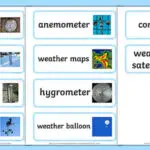
- Pictures of weather instruments
- Whiteboard or chart paper
- markers
Rationale for the Lesson
Understanding weather instruments is crucial for comprehending weather patterns and their impact on our daily lives. This knowledge is essential for future science studies and everyday decision-making.
Prerequisite/Previous Knowledge
The teacher will start by asking pupils what they know about the weather and how we can predict it. A brief discussion will follow, leading into the introduction of weather instruments.
Lesson Content
Weather Instruments
Weather instruments are tools that help us measure and understand the weather. They give us vital information about temperature, wind, rain, and air pressure.
Weather Instruments and their Uses
Thermometer
A thermometer measures temperature. It shows the temperature in degrees Celsius or Fahrenheit. You can find them in homes,hospitals,and weather stations.
Barometer
A barometer measures air pressure.This helps predict weather changes, like if it will rain or be sunny. Meteorologists use barometers to forecast the weather.
Rain gauge
A rain gauge measures how much rain falls. It helps track rainfall over time. Rain gauges are significant for understanding rainfall and managing water.
Wind Vane
A wind vane shows which way the wind is blowing. It’s like an arrow that turns to point in the direction the wind is coming from. you often see them on rooftops.
Teaching Methods
To deliver this lesson, the teacher will adopt the following methods: Discussion, Question and answer, Use of visuals.
Instructional Procedures
To deliver this lesson, the teacher will adopt the following steps:
Step 1: Introduction (Set Induction)
Time: 5 minutes
Teaching Skill: Questioning
Teacher’s Activity: Ask pupils what they know about weather and how we predict it.
Pupils’ Activity: Respond to the teacher’s questions.
Step 2: Clarification of Key Concepts
Time: 10 minutes
Teaching Skill: Explaining
Teacher’s Activity: Introduce the concept of weather instruments and their importance.
pupils’ Activity: Listen attentively and ask clarifying questions.
Step 3: Demonstration/Guided Practice
Time: 10 minutes
Teaching Skill: Demonstrating
Teacher’s Activity: Show pictures of different weather instruments and explain their uses.
Pupils’ Activity: Observe the pictures and listen to the explanations.
Step 4: Self-reliant Practice
Time: 5 minutes
Teaching Skill: Monitoring
Teacher’s Activity: Ask pupils to identify the weather instruments from the pictures.
pupils’ Activity: Identify the weather instruments and explain their uses.
step 5: note-Taking
Time: 5 minutes
Teaching Skill: Guiding
Teacher’s Activity: guide pupils in taking notes on the key features of each weather instrument.
Pupils’ Activity: take notes on the key features of each weather instrument.
Step 6: Evaluation/Review
Time: 5 minutes
Teaching Skill: Questioning
Teacher’s Activity: Ask review questions to assess understanding.
Pupils’ Activity: Answer the review questions.
Objective-aligned checks:
- State examples of weather instruments.
- Identify and differentiate different weather instruments.
- Use a diagram to identify weather instruments.
Step 7: Conclusion
Time: 5 minutes
Teaching Skill: Summarizing
Teacher’s Activity: Summarize the key concepts learned and assign homework.
pupils’ Activity: Listen to the summary and note the homework assignment.
Lesson Keywords
- Thermometer – An instrument for measuring and indicating temperature.
- Barometer – An instrument measuring atmospheric pressure, used especially in forecasting the weather.
- rain gauge – An instrument for collecting and measuring the amount of rainfall.
- Wind vane – An instrument that shows the direction of the wind.
- Meteorologist – A person who studies and reports on weather.
Lesson Evaluation
To evaluate the learning, the teacher asks pupils to:
- Name three weather instruments.
- Why are weather instruments important?
- How is a thermometer different from a wind vane?
- What does a barometer measure, and how does it help us understand the weather?
- What is the difference between a wind vane and a rain gauge?
Assignment/Homework
- Draw your favorite weather instrument.
- Write a short description of its use.
Differentiation
- For slower learners: The teacher will provide one-on-one assistance and use simpler language.
- For advanced learners: The teacher will encourage them to research additional weather instruments and their uses.
- For visual/auditory/kinesthetic learners: Use visual aids, verbal explanations, and hands-on activities to cater to different learning styles.
Note for Teachers
ensure to use real-life examples and visual aids to enhance pupils’ understanding. Encourage active participation and provide constructive feedback.



Community Join the conversation Open discussion +