

Class: Primary 5
Term: 2nd Term
Subject: Basic Science And Technology
Curriculum Theme: Basic Technology
previous Lesson: Energy Conversion, Electrical And Chemical Energy To Heat Energy
Topic: Energy Conversion: Electrical to Mechanical Energy
Content/Learning Area: Electrical to mechanical energy; Mechanical energy to electrical energy.
Time Allocation: 40 minutes
Performance Objectives
By the end of the lesson, pupils should be able to:
- Cognitive Domain: Define energy conversion and explain how electrical energy is converted to mechanical energy.
- Affective Domain: Appreciate the importance of energy conversion in daily life.
- Psychomotor Domain: Illustrate energy conversion using a simple diagram.
- Social Domain: Work in groups to discuss the relevance of energy conversion.
Reference Materials
The following resources were used in planning this lesson:
- 9 – Years Basic Education Curriculum Abuja Educational Resource Center
- Scheme of Work, NAPPS National Unified Scheme of Work
- Online Data from: Wikipedia – Mechanical energy
- Relevant Textbooks
instructional materials
To deliver this lesson, the teacher will use the following materials:
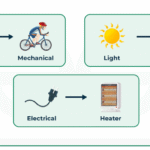
- Charts illustrating energy conversion
- Simple electric fan or motor
- Diagrams showing energy conversion
- Whiteboard and markers
Rationale for the Lesson
Understanding energy conversion helps pupils recognize how electricity powers machines and devices in daily life. This knowledge builds their gratitude for technology.
Prerequisite/Previous Knowledge
Pupils already know how electricity produces heat in devices, such as irons and kettles.
Lesson Content
Energy Conversion: Electrical to Mechanical Energy
Energy conversion means changing energy from one form to another. Electrical energy can turn into mechanical energy, and vice versa.
The following are examples of energy conversion:
- Electrical to Mechanical Energy
– Electrical energy powers machines like fans and electric motors.- When electricity flows through the motor, it creates movement or mechanical energy.
– Electric drills use electrical energy to rotate and perform tasks.
- Mechanical to Electrical Energy
– Mechanical energy is used in generators to produce electricity.
– For example, wind turbines convert wind (mechanical energy) into electricity.
– Hydroelectric dams use the mechanical energy of flowing water to generate electricity.
Electrical Energy Changing to Mechanical Energy
An electric motor changes electrical energy into mechanical movement. Fans rotate their blades, blenders turn cutters, pumps move water and washing machines rotate drums because motors produce motion.
The useful output is movement, although some energy also becomes sound and heat. Switch off and unplug faulty equipment; pupils must not insert fingers or objects into moving parts.
Teaching Methods
To deliver this lesson, the teacher will adopt the following methods: Set Induction, Explanation, Exhibition, Interactive Discussion, Note-Taking, Oral Questioning, Summarization
Instructional Procedures
To deliver this lesson, the teacher will adopt the following steps:
Step 1: Introduction (Set Induction)
Time: 5 mins
Teaching Skill: Set Induction
Teacher’s Activity: Asks pupils to mention devices they use that convert electrical energy.
Pupils’ Activity: Respond by naming devices like fans and blenders.
Step 2: Explanation of Electrical to Mechanical Energy
Time: 10 mins
Teaching Skill: Expository
Teacher’s Activity: Explains how electrical energy is converted to mechanical energy, using an electric fan diagram.Pupils’ Activity: Listen, observe the diagram, and ask questions.
Step 3: Demonstration of Energy Conversion
Time: 10 mins
Teaching Skill: Demonstration
Teacher’s Activity: Demonstrates energy conversion using a simple electric motor or fan.
Pupils’ Activity: Observe and describe what they see during the demonstration.
Step 4: Discussion on Daily Uses of Energy Conversion
Time: 5 mins
Teaching Skill: Interactive
Teacher’s Activity: Divides class into groups to discuss where energy conversion is used daily.
Pupils’ Activity: Share ideas within groups and present key points.
Step 5: Note-Taking
Time: 5 mins
Teaching Skill: note-writing
Teacher’s Activity: Guides pupils to write key points in their notebooks.
pupils’ Activity: Copy notes from the board into their notebooks.
Step 6: Evaluation/Review
Time: 3 mins
Teaching Skill: Oral questioning
Teacher’s Activity: Asks questions to assess understanding of energy conversion.
Pupils’ Activity: Answer questions orally based on the lesson.
step 7: Conclusion
Time: 2 mins
Teaching Skill: Summarization
Teacher’s Activity: Recaps the lesson and connects it to the next topic.
Pupils’ Activity: Listen and ask further questions if unclear.
Lesson Keywords
- Energy Conversion – Changing energy from one form to another.
- Electrical Energy – Energy derived from electric potential or kinetic energy of electrons.
- Mechanical Energy – The energy of an object due to its motion or position.
- Electric Motor – A device that converts electrical energy into mechanical energy.
- Generator – A device that converts mechanical energy into electrical energy.
Lesson Evaluation
To evaluate the learning, the teacher asks pupils to:
- Define energy conversion.
- List two examples of electrical to mechanical energy conversion.
- explain how mechanical energy is converted to electrical energy.
- Draw and label a simple diagram of an electric motor.
Assignment/Homework
- List five devices that convert electrical energy to mechanical energy.
- Research and write a short paragraph on how hydroelectric power plants work.
- Explain the importance of energy conversion in our daily lives.
Differentiation
- For slower learners: Provide simplified diagrams and one-on-one explanations.
- For advanced learners: challenge them to research different types of generators and their efficiency.
- For visual/auditory/kinesthetic learners: Use visual aids, verbal explanations, and hands-on demonstrations.
Note for Teachers
Ensure the demonstration uses simple,familiar devices to make the concept relatable. Encourage pupils to ask questions to clarify their understanding. Happy teaching!

Community Join the conversation Open discussion +