

Class: Primary Four
Term: Third Term
Subject: Basic Science and Technology
Curriculum Theme: Basic Science
Previous Lesson: Water Cycle
Topic: Water Cycle and Rainfall
Content/Learning Area: What is Rainfall?,Formation of rain,Importance of Rain
Time Allocation: 40 minutes
Performance Objectives
By the end of the lesson,pupils should be able to:
- Cognitive Domain:
1.Explain the process of rain formation as part of the water cycle.
2. Draw and label the stages of the water cycle including rain formation.
- Psychomotor Domain:
1. Draw and label the stages of the water cycle including rain formation.
- Affective Domain:
1. Show thankfulness for the natural processes that contribute to weather patterns.
- Social Domain:
1. Discuss in groups the importance of rainfall to the environment and community.
Reference Materials
- 9 – Years Basic education Curriculum
- Abuja Educational resource Center Scheme of Work
- NAPPS National Unified Scheme of Work
- Relevant Textbooks
Instructional materials
To deliver this lesson, the teacher will use the following materials:
- Whiteboard or chart
- Markers or chalk
- Pictures or diagrams of the water cycle
Rationale for the Lesson
Understanding the water cycle and rainfall is crucial for appreciating the natural world and the importance of water conservation. This knowledge builds a foundation for future science lessons and promotes environmental awareness.
Prerequisite/Previous Knowledge
The teacher will start by asking pupils what they already know about rain and where it comes from. A brief discussion will follow, leading into the lesson’s topic.
Lesson Content
Water Cycle and Rainfall
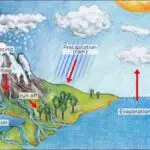
The water cycle is a continuous process where water moves from the Earth’s surface to the atmosphere and back again. It’s essential for life.
What is Rainfall?
Rainfall is water falling from the atmosphere as liquid drops. It’s a vital part of the water cycle.
Formation of Rain
Rain formation involves several key stages where water transforms and moves thru the atmosphere.
The following are the stages of rain formation:
- Evaporation: The sun heats water, turning it into water vapor.
- Condensation: As water vapor rises, it cools and condenses into tiny water droplets, forming clouds.
- Cloud Formation: More water vapor condenses, making the droplets grow.
- Precipitation: When droplets get heavy,they fall as rain,snow,sleet,or hail.
Importance of Rain
Rain is essential for sustaining life and maintaining ecological balance.
The following are some reasons why rain is crucial:
- Replenishing freshwater supplies: Rain fills rivers, lakes, and groundwater.
- supporting agriculture and food production: Rain waters crops and livestock.
- Maintaining ecosystem balance: Rain provides water for plants and animals.
- Regulating climate: Rain helps regulate the Earth’s temperature.
- Enhancing soil fertility: Rain adds nutrients to the soil.
- Supporting recreational activities: Rain provides water for activities like swimming.
- Driving the water cycle: Rain is crucial for the continuous water cycle.
- Supporting plant growth: Rain provides the necessary moisture for plants to grow and thrive.
- Providing drinking water: Rainwater is a source of drinking water for many communities, especially in rural areas.
Teaching Methods
To deliver this lesson, the teacher will adopt the following methods: Discussion, Question and answer, Visual aids
Instructional Procedures
To deliver this lesson, the teacher will adopt the following steps:
Step 1: Introduction
Time: 5 minutes
Teaching Skill: Set Induction
Teacher’s Activity: Ask pupils what they know about rain and the water cycle.
pupils’ Activity: Share their prior knowledge and answer questions.
Step 2: Clarification of Key Concepts
Time: 10 minutes
Teaching Skill: Explaining
Teacher’s Activity: Explain the water cycle and the formation of rain using diagrams and examples.
Pupils’ Activity: Listen attentively and ask clarifying questions.
Step 3: Presentation/Guided Practice
Time: 10 minutes
Teaching Skill: demonstrating
Teacher’s Activity: Show a diagram of the water cycle and explain each stage, focusing on rain formation.
pupils’ Activity: Observe the diagram and participate in the clarification.
Step 4: Independent Practice
Time: 5 minutes
Teaching Skill: Monitoring
Teacher’s Activity: Guide pupils as they draw and label the stages of the water cycle.
Pupils’ activity: Draw and label the water cycle, focusing on rain formation.
Step 5: Note-Taking
Time: 5 minutes
Teaching Skill: Note-taking
Teacher’s Activity: Guide pupils in taking notes on key concepts.
Pupils’ Activity: Write down important points from the lesson.
Step 6: Evaluation/Review
Time: 5 minutes
Teaching Skill: Questioning
Teacher’s Activity: Ask review questions to assess understanding.
Pupils’ Activity: Answer questions to demonstrate understanding.
Objective-aligned checks:
- Explain the process of rain formation as part of the water cycle.
- Draw and label the stages of the water cycle including rain formation.
- Show thankfulness for the natural processes that contribute to weather patterns.
Step 7: Conclusion
Time: 5 minutes
teaching Skill: Summarizing
Teacher’s activity: Summarize the key points about the water cycle and rainfall,emphasizing the importance of water conservation and appreciating natural processes.
Pupils’ Activity: Listen to the summary and ask any remaining questions.
Lesson Keywords
- Evaporation – The process of water turning into vapor.
- Condensation – The process of water vapor turning into liquid.
- precipitation – Water falling from the atmosphere as rain, snow, sleet, or hail.
- Water Cycle – The continuous movement of water on, above, and below the surface of the Earth.
- Runoff – Water that flows over the land surface.
Lesson Evaluation
To evaluate the learning, the teacher asks pupils to:
- Describe how rain forms.
- Draw and label the water cycle.
- Why is rain important?
- How can we save water?
- What happens with too much or too little rain?
Assignment/Homework
- Research and write a short paragraph on the different types of rainfall (e.g., convectional, orographic, cyclonic).
- Create a poster illustrating ways to conserve water at home and in school.
- Observe and record the weather conditions for a week, noting any rainfall and its effects on the environment.
Differentiation
- For slower learners: Provide one-on-one support and simplified explanations.
- For advanced learners: Encourage further research on different types of precipitation.
- For visual/auditory/kinesthetic learners: Use visual aids,discussions,and hands-on activities to cater to different learning styles.
Note for Teachers
Ensure to use local examples and visual aids that resonate with the pupils’ environment to enhance understanding. Encourage interactive discussions and hands-on activities to reinforce learning.


Community Join the conversation Open discussion +