

Class: Senior Secondary School 1 (SS1, SS 1, SSS1, SSS 1)
Term: 1st Term
Week: 5
Age: 15 years
Duration: 45 minutes
Subject: Geography
Curriculum Theme: The Earth and Space
Previous Lesson: Geography Careers in Geospatial Work, Planning, Surveying and Environment.
Topic: The Solar System
Subject Matter: Definition of solar system, components of the solar system, characteristics of planets and other bodies, size of the Earth, shape of the Earth, position of the Earth in relation to the Sun.
Specific Objectives
By the end of the lesson, pupils should be able to:
Cognitive Domain:
- Define the solar system.
- List the major components of the solar system.
- State at least three characteristics of planets.
- Describe the size and shape of the Earth.
- Explain the Earth’s position relative to the Sun.
Affective Domain:
- Appreciate the vastness and orderliness of the solar system.
- Show interest in learning more about celestial bodies.
Psychomotor Domain:
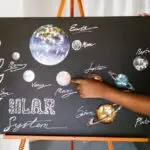
- Model the solar system using available materials.
- Draw a simple diagram illustrating the solar system.
Social Domain:
- Collaborate effectively with peers during group activities.
Reference Materials
The following resources were used in planning this lesson:
- 9 Years Basic Education Curriculum
- State Unified Scheme of Work
- Essential Geography for Senior Secondary Schools by O.A. Iwena
Instructional Materials
The teacher will teach this lesson with the aid of:
- A globe
- Aerial photographs of the Earth
- Illustrative diagrams of the solar system
- Charts showing the planets and their characteristics
- Models of planets (if available)
Rationale for the Lesson
This lesson helps pupils understand the structure of the solar system, including the Earth’s place within it. It enables them to grasp fundamental concepts about our planet’s characteristics and its relationship with the Sun, which is important for understanding climate, seasons, and day and night.
Prerequisite/Previous Knowledge
Pupils are expected to have some basic knowledge of the sky, stars, and the Earth from their primary and junior secondary school studies.
Lesson Content/Board Summary
The Solar System
Definition of the Solar System
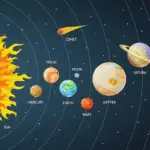
The solar system is a planetary system consisting of the Sun and all the celestial objects gravitationally bound to it. These objects include planets, dwarf planets, moons, asteroids, comets, and meteoroids.
Components of the Solar System
The solar system is composed of several key elements:
- The Sun: A star at the center of the solar system, providing light and heat.
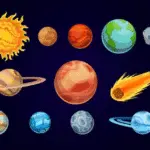
- Planets: Eight major planets (Mercury, Venus, Earth, Mars, Jupiter, Saturn, Uranus, Neptune) that orbit the Sun.
- Dwarf Planets: Smaller celestial bodies like Pluto, Eris, Ceres, Makemake, and Haumea.
- Natural Satellites (Moons): Bodies that orbit planets.
- Asteroids: Small, rocky bodies orbiting the Sun, mostly found in the asteroid belt between Mars and Jupiter.
- Comets: Icy, dusty bodies that orbit the Sun, often with a visible tail when near the Sun.
- Meteoroids: Small fragments of rock or dust in space.
Characteristics of Planets
Planets in the solar system have various characteristics:
- They orbit the Sun in elliptical paths.
- They rotate on their own axes, causing day and night.
- They reflect light from the Sun, as they do not produce their own light.
- They vary greatly in size, composition, and atmospheric conditions.
- Planets are broadly categorized into inner, rocky (terrestrial) planets (Mercury, Venus, Earth, Mars) and outer, gas giant planets (Jupiter, Saturn, Uranus, Neptune).
Size of the Earth
The Earth is the fifth largest planet in the solar system. Its equatorial diameter is approximately 12,756 kilometers, and its polar diameter is about 12,714 kilometers, making it slightly flattened at the poles and bulging at the equator.
Shape of the Earth
The Earth is not a perfect sphere; it has an oblate spheroid shape. This means it is slightly flattened at the poles and bulges out at the equator due to its rotation.
Position of the Earth in Relation to the Sun
The Earth is the third planet from the Sun. It orbits the Sun at an average distance of about 150 million kilometers. This position is suitable for life as it provides moderate temperatures and liquid water, unlike planets closer or farther from the Sun.
Teaching Methods/Instructional Techniques
Discussion, Lecture, Demonstration, Question and Answer, Visual Aids
Instructional Procedures
Step 1: Introduction
Time: 5 minutes
Teaching Skill: Set Induction
Teacher’s Activity: The teacher greets the pupils and asks them to look up at the sky at night. The teacher then asks what they observe (stars, moon, etc.) and if they know what the Earth is a part of. This leads to the topic of the solar system.
Pupils’ Activity: Pupils respond to the teacher’s questions and share their observations about the night sky.
Learning Point: Pupils are introduced to the concept of celestial bodies and the solar system.
Step 2: Definition of the Solar System
Time: 10 minutes
Teaching Skill: Explanation/Definition
Teacher’s Activity: The teacher defines the solar system, emphasizing the Sun as its center and all other bodies orbiting it due to gravity. The teacher writes the definition on the board.
Pupils’ Activity: Pupils listen attentively, take notes, and orally repeat the definition.
Learning Point: Pupils learn the definition of the solar system.
Step 3: Components of the Solar System
Time: 10 minutes
Teaching Skill: Illustration/Listing
Teacher’s Activity: The teacher uses a chart of the solar system and models (if available) to identify and explain each major component: Sun, planets, dwarf planets, moons, asteroids, and comets. The teacher lists these components on the board.
Pupils’ Activity: Pupils observe the charts and models, identify the components, and list them in their notebooks.
Learning Point: Pupils can identify and list the main components of the solar system.
Step 4: Characteristics of Planets
Time: 5 minutes
Teaching Skill: Explanation/Description
Teacher’s Activity: The teacher discusses some general characteristics of planets, such as orbiting the Sun, rotating on an axis, and reflecting sunlight. The teacher also mentions the distinction between terrestrial and gas giant planets.
Pupils’ Activity: Pupils listen and note the characteristics of planets.
Learning Point: Pupils understand basic features that define planets.
Step 5: Size and Shape of the Earth
Time: 5 minutes
Teaching Skill: Demonstration/Observation
Teacher’s Activity: The teacher uses a globe and aerial photographs to demonstrate the Earth’s oblate spheroid shape and discusses its approximate size (diameters). The teacher explains why it is not a perfect sphere.
Pupils’ Activity: Pupils observe the globe and photographs, and describe the Earth’s shape and size.
Learning Point: Pupils understand that the Earth is an oblate spheroid and its approximate dimensions.
Step 6: Position of the Earth in Relation to the Sun
Time: 5 minutes
Teaching Skill: Explanation/Relating
Teacher’s Activity: The teacher explains that Earth is the third planet from the Sun and discusses the significance of this position for supporting life, mentioning the average distance from the Sun.
Pupils’ Activity: Pupils listen and understand the Earth’s position and its implications.
Learning Point: Pupils know the Earth’s position in the solar system and its importance.
Step 7: Evaluation/Review
Time: 5 minutes
Teaching Skill: Questioning/Assessment
Teacher’s Activity: The teacher evaluates the learning by asking the following questions:
- Define the solar system.
- Mention any four components of the solar system.
- State two characteristics of planets.
- Describe the shape of the Earth.
- Explain the Earth’s position relative to the Sun.
Pupils’ Activity: Pupils answer orally and in writing.
Learning Point: Pupils demonstrate understanding of the lesson.
Step 8: Conclusion
Time: 5 minutes
Teaching Skill: Summarization/Assignment
Teacher’s Activity: The teacher summarizes the main points of the lesson, reiterating the definition, components, and Earth’s place in the solar system. The teacher then gives homework: “Draw and label a simple diagram of the solar system.”
Pupils’ Activity: Pupils listen to the summary and copy down the homework.
Learning Point: Pupils reinforce their understanding and are given an activity to practice what they have learned.
Lesson Keywords
- Solar System – The Sun and all the celestial objects gravitationally bound to it.
- Planet – A large celestial body orbiting a star, reflecting its light.
- Sun – The star at the center of our solar system.
- Orbit – The curved path of a celestial object around a star or planet.
- Rotation – The action of rotating around an axis or center.
- Oblate Spheroid – The shape of the Earth, slightly flattened at the poles and bulging at the equator.
Differentiation
For pupils who grasp concepts quickly, the teacher can provide additional questions on the formation of the solar system or characteristics of specific planets. For pupils requiring more support, the teacher will provide simplified diagrams and offer one-on-one guidance during the modeling activity, encouraging peer support within groups.
Note for teachers using this lesson plan
Teachers should ensure all instructional materials are readily available before the lesson. Encourage pupils to ask questions and foster a collaborative learning environment. Emphasize the vastness of space and the unique conditions on Earth that support life.
Community Join the conversation Open discussion +