

Note for teachers using this lesson plan
This lesson focuses on helping students understand the arrangement of the sun and planets in our solar system. Ensure you have diagrams, models, or digital resources ready to visually demonstrate the planets’ order. Emphasise that the sun is at the centre and guide students to accurately place the planets in their correct sequence. By the end, students should be able to identify and describe the relative positions of the sun and planets.
Class: SS 1
Term: First Term
Week: 8
Age: 15 years
Duration: 60 minutes
Subject: Geography
Curriculum Theme: Earth Systems and Environmental
Focal competence: Identify components of the solar system, Earth’s position and motion within it, and how these influence day and night, seasons, and planetary relationships
Key competencies/values: Critical Thinking; Collaboration; ICT and Digital Competencies; Digital Competencies
Skills:
- Identifying and describing the solar system
Previous Lesson: Proof that the Earth is spherical
Topic: The Earth And The Solar System: Position Of The Sun And Other Planets
Subject Matter: Position of the sun and other planets
Specific Objectives
By the end of the lesson, pupils/students should be able to:
Cognitive Domain
- Identify the position of the sun and other planets.
- Describe the position of the sun in relation to the planets in the solar system.
Affective Domain
- Appreciate the vastness and order of the solar system.
- Show curiosity about the celestial bodies in our solar system.
Psychomotor Domain
- Arrange the planets in their correct order from the sun.
- Create a simple poster illustrating the planets’ positions.
Reference Materials
The following resources were used in planning this lesson:
- 2025 New Revised Senior Secondary Education Curriculum (SSEC)
- Relevant State Unified Scheme of Work
- The HeadTeacher Scheme of work For The New Revised Senior Secondary Education Curriculum (SSEC)
- Senior Secondary Geography Textbook for SS 1
Instructional Materials
The teacher will teach this lesson with the aid of:
- Diagrams or charts of the solar system
- Video or animation on the solar system
- Photos of Earth from space
- Globe
- Torch light/Flashlight
- Markers, drawing paper, and crayons for poster creation
Rationale for the Lesson
Understanding the position of the sun and planets is fundamental to comprehending Earth’s place in the universe and its relationship with other celestial bodies. This knowledge forms the basis for studying phenomena like seasons, day and night, and the broader dynamics of our solar system. It also helps students develop spatial reasoning and a sense of scale.
Prerequisite/Previous Knowledge
Students should have a basic understanding of what a planet is and that the Earth is a planet. They should also know that the sun is a star.
Lesson Content/Board Summary
The Earth And The Solar System: Position Of The Sun And Other Planets
The Sun as the Centre of the Solar System
The sun is a star and the central body of our solar system. All planets, dwarf planets, asteroids, and comets orbit the sun due to its immense gravitational pull. It is the primary source of light and heat for all bodies within the solar system.
Order of the Planets from the Sun
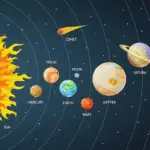
The planets in our solar system orbit the sun in a specific order. They are arranged based on their average distance from the sun. The eight major planets, in increasing order of distance from the sun, are:
- Mercury: The closest planet to the sun.
- Venus: The second planet from the sun, known for its thick, hot atmosphere.
- Earth: The third planet from the sun, our home planet.
- Mars: The fourth planet from the sun, often called the “Red Planet.”
- Jupiter: The fifth planet from the sun and the largest planet in our solar system.
- Saturn: The sixth planet from the sun, famous for its prominent ring system.
- Uranus: The seventh planet from the sun, an ice giant.
- Neptune: The eighth and farthest major planet from the sun, also an ice giant.
It is important to note that while we arrange them by relative position, the actual distances and sizes are not to scale in simple diagrams.
Distinction Between Planetary Position and Earth’s Motion
It is important to distinguish between the *position* of the planets in the solar system and the *motion* of Earth itself.
- Planetary Position: This refers to the fixed order and arrangement of the planets around the sun at any given moment. It describes where each planet is located relative to the sun and other planets in its orbit.
- Earth’s Motion: This refers to two main types of movement:
- Rotation: Earth spins on its axis, causing day and night. This is an internal movement of Earth.
- Revolution: Earth orbits the sun, causing the seasons. This is Earth’s movement around the sun, which defines its position in its orbit over time.
While Earth’s revolution determines its changing position in its orbit throughout the year, the overall *order* of planets from the sun remains constant.
Teaching Methods/Instructional Techniques
Discussion, Explanation, Question and Answer, Demonstration, Visual Aids, Group Work, Practical Activity
Instructional Procedures
Step 1: Introduction
Time: 5 minutes
Teaching Skill: Activating Prior Knowledge
Teacher’s Activity: The teacher greets the students and asks them to recall what they know about the sun and planets. The teacher then introduces the topic: “The Earth and the Solar System: Position of the Sun and Other Planets.”
Pupils’ Activity: Pupils respond to questions about the sun and planets and listen attentively to the introduction.
Learning Point: Solar system components
Step 2: The Sun as the Centre
Time: 10 minutes
Teaching Skill: Explanation/Demonstration
Teacher’s Activity: The teacher uses a diagram or video of the solar system to explain that the sun is a star and the central body around which all planets orbit. The teacher uses a torch (sun) and a globe (Earth) to demonstrate the concept of orbit.
Pupils’ Activity: Pupils observe the demonstration, ask questions, and identify the sun as the centre of the solar system.
Learning Point: Sun’s central role
Step 3: Identifying Planets and Their Order
Time: 15 minutes
Teaching Skill: Guided Identification/Visual Learning
Teacher’s Activity: The teacher guides students to use a diagram or animation of the planetary system to identify the eight major planets. The teacher then explicitly states and writes the correct order of the planets from the sun on the board: Mercury, Venus, Earth, Mars, Jupiter, Saturn, Uranus, Neptune.
Pupils’ Activity: Pupils identify the planets from the diagram/animation and repeat their names in the correct order after the teacher.
Learning Point: Planets’ correct order
Step 4: Describing Relative Positions
Time: 10 minutes
Teaching Skill: Description/Clarification
Teacher’s Activity: The teacher describes the position of each planet in relation to the sun and other planets (e.g., Mercury is closest, Neptune is farthest, Earth is third). The teacher ensures students understand that this is about relative placement, not scale.
Pupils’ Activity: Pupils listen and describe the relative positions of selected planets when prompted by the teacher.
Learning Point: Relative planetary positions
Step 5: Distinguishing Position from Motion
Time: 5 minutes
Teaching Skill: Conceptual Differentiation
Teacher’s Activity: The teacher explains the difference between the planets’ fixed order (position) and Earth’s rotation (day/night) and revolution (seasons). The teacher clarifies that this lesson focuses on the arrangement, not the dynamics of motion.
Pupils’ Activity: Pupils listen and ask questions to clarify the distinction between planetary position and Earth’s motion.
Learning Point: Position vs. motion
Step 6: Poster Creation Activity
Time: 5 minutes
Teaching Skill: Practical Application/Collaboration
Teacher’s Activity: The teacher divides students into groups and guides them to create simple posters illustrating the sun and the planets in their correct order. They are encouraged to label each planet.
Pupils’ Activity: Pupils work in groups to create posters of the solar system, arranging the planets correctly.
Learning Point: Solar system model creation
Step 7: Evaluation/Review
Time: 5 minutes
Teaching Skill: Questioning/Assessment
Teacher’s Activity: The teacher evaluates the learning by asking the following questions:
- What is the central body of our solar system?
- Name the planets in their correct order from the sun.
- Describe the position of Earth in relation to the sun and other planets.
- How is planetary position different from Earth’s rotation?
Pupils’ Activity: Pupils answer orally and in writing.
Learning Point: Planetary position identification
Step 8: Note-Taking
Time: 10 minutes
Teaching Skill: Guided Writing
Teacher’s Activity: The teacher guides pupils/students to copy the essential Board Summary notes on the position of the sun and other planets into their notebooks.
Pupils’ Activity: Pupils/students copy the notes carefully into their notebooks.
Learning Point: Notes on solar system
Step 9: Conclusion
Time: 5 minutes
Teaching Skill: Consolidation
Teacher’s Activity: The teacher briefly recaps the main points of the lesson, re-emphasising the sun’s central role and the correct order of the planets. The teacher encourages students to continue exploring the solar system.
Pupils’ Activity: Pupils listen and ask any final questions.
Learning Point: Solar system understanding
Continuous Assessment/Further Study
Type: Homework
Instruction: Answer the following questions in your notebook.
- Draw a diagram of the solar system, placing the sun at the centre and arranging all eight planets in their correct order. Label each planet.
- Explain in your own words why the sun is considered the centre of our solar system.
- Research and write down one unique fact about the planet closest to the sun and one unique fact about the planet farthest from the sun.
Lesson Keywords
- Solar System – The sun and all the celestial bodies that orbit it.
- Sun – The star at the centre of our solar system.
- Planet – A large celestial body that orbits a star, is massive enough to be rounded by its own gravity, and has cleared its orbital path of other debris.
- Orbit – The curved path of a celestial object around a star, planet, or moon.
- Position – The location of an object relative to others.
- Rotation – The spinning of a celestial body on its axis.
- Revolution – The movement of one celestial body around another.
Differentiation
For struggling learners: Provide pre-labelled diagrams of the solar system for them to trace or colour. Use mnemonic devices (e.g., “My Very Eager Mother Just Served Us Noodles”) to help them remember the order of the planets. Pair them with stronger students for the poster activity.
For advanced learners: Challenge them to research and include dwarf planets (like Pluto) in their diagrams, explaining why they are not considered major planets. Ask them to consider the relative sizes of the planets (though not to scale in their drawing) and discuss factors that determine a planet’s temperature based on its position.
Suggested Lesson Videos
For further visual learning, search on YouTube for:
Community Join the conversation Open discussion +