

Class: Junior Secondary School 1 (JSS1, JSS 1)
Term: 3rd Term
Week: 8
Age: 12 years
Duration: 45 minutes
Subject: Basic Science
Curriculum Theme: Basic Science And Technology
Previous Lesson: Effects of Gravitation on Objects in Gravitation and Weightlessness.
Topic: Earth In Space
Subject Matter: The Solar System; Rotation And Revolution Of The Earth And Moon; Eclipse Of The Sun And Moon; Seasons Of The Year.
Specific Objectives
By the end of the lesson, pupils should be able to:
Cognitive Domain:
- List the components of the solar system.
- Define rotation and revolution of the Earth and Moon.
- Explain the effects of Earth’s rotation and revolution.
- Describe how solar and lunar eclipses occur.
- State the causes and types of seasons.
Affective Domain:
- Appreciate the orderliness and vastness of the solar system.
- Develop interest in studying celestial bodies and natural phenomena.
- Value the importance of the sun to life on Earth.
Psychomotor Domain:
- Illustrate the arrangement of the solar system.
- Draw simple diagrams of solar and lunar eclipses.
- Demonstrate Earth’s rotation and revolution using models.
Social Domain:
- Share ideas with peers about the Earth and other celestial bodies.
- Collaborate in group activities to discuss Earth movements.
Reference Materials
The following resources were used in planning this lesson:
- 9 Years Basic Education Curriculum for Basic Science.
- State Unified Scheme of Work for Basic Science JSS 1.
- MacMillan Basic Science for Junior Secondary Schools Book 1.
- National Geographic Kids: Space and Planets (www.kids.nationalgeographic.com).
Instructional Materials
The teacher will teach this lesson with the aid of:
- Charts of the Solar System.
- Charts and video clips showing Earth’s movements (rotation, revolution, eclipse, seasons).
- A globe and a torch to demonstrate rotation and revolution.
- Whiteboard/blackboard and markers/chalk.
Rationale for the Lesson
This lesson helps pupils understand the environment around them, including the sun, moon, and planets. It explains natural phenomena like day and night, seasons, and eclipses, which are part of their daily experience and observation.
Prerequisite/Previous Knowledge
Pupils have basic knowledge of the sun, moon, and stars. They have also observed the daily occurrence of day and night.
Lesson Content/Board Summary
Earth In Space
The Solar System
The solar system is a system of planets and other celestial bodies that orbit around a central star called the Sun.
The following are the main components of the solar system:
- The Sun (the central star)
- Eight planets (Mercury, Venus, Earth, Mars, Jupiter, Saturn, Uranus, Neptune)
- Dwarf planets (e.g., Pluto)
- Moons (natural satellites orbiting planets)
- Asteroids (rocky bodies orbiting the Sun)
- Comets (icy bodies orbiting the Sun)
- Meteoroids (small rocky or metallic bodies)
The planets orbit the Sun in elliptical paths called orbits.
Rotation And Revolution Of The Earth And Moon
Rotation is the spinning movement of a celestial body on its own axis. The Earth rotates on its axis once every 24 hours.
The following are the effects of Earth’s rotation:
- It causes day and night.
- It causes the apparent movement of the sun, moon, and stars across the sky.
- It causes the rising and setting of the sun.
Revolution is the movement of a celestial body in an orbit around another body. The Earth revolves around the Sun once every 365¼ days (one year).
The following are the effects of Earth’s revolution:
- It causes the different seasons of the year.
- It determines the length of a year.
The Moon also rotates on its axis and revolves around the Earth. Its revolution around the Earth takes approximately 27.3 days which is also called a lunar month.
Eclipse Of The Sun And Moon
An eclipse occurs when one celestial body blocks the light from another celestial body, casting a shadow.
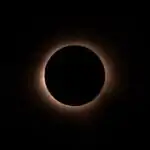
Solar Eclipse: This occurs when the Moon passes between the Sun and the Earth, blocking the Sun’s light and casting a shadow on Earth. During a total solar eclipse, the Moon completely covers the Sun.
Lunar Eclipse: This occurs when the Earth passes between the Sun and the Moon, casting a shadow on the Moon. During a total lunar eclipse, the Earth’s shadow completely covers the Moon, making it appear reddish.
Seasons Of The Year
Seasons are periods of the year characterized by specific weather conditions, resulting from the Earth’s revolution around the Sun and the tilt of its axis.
The following are the causes of seasons:
- The Earth’s tilt (axial tilt) of approximately 23.5 degrees relative to its orbit.
- The Earth’s revolution around the Sun.
The major seasons experienced globally are:
- Summer
- Autumn (Fall)
- Winter
- Spring
In Nigeria, the main seasons are the dry season and the rainy (wet) season.
Teaching Methods/Instructional Techniques
Discussion, Lecture, Demonstration, Question and Answer, Visual Aids
Instructional Procedures
Step 1: Introduction
Time: 5 minutes
Teaching Skill: Set Induction
Teacher’s Activity: The teacher greets the pupils and asks them to state what causes day and night. The teacher then introduces the topic “Earth in Space” and relates it to their answers.
Pupils’ Activity: Pupils respond to the teacher’s questions and listen attentively to the introduction.
Learning Point: Pupils are introduced to the topic and relate it to prior knowledge.
Step 2: The Solar System
Time: 10 minutes
Teaching Skill: Explanation/Demonstration
Teacher’s Activity: The teacher uses charts of the solar system to explain its components, defining the solar system and listing the planets in order from the sun. The teacher explains that planets orbit the sun.
Pupils’ Activity: Pupils observe the charts, listen, and identify the components of the solar system. They may ask questions for clarification.
Learning Point: Pupils identify and understand the components of the solar system.
Step 3: Rotation and Revolution of the Earth and Moon
Time: 8 minutes
Teaching Skill: Explanation/Demonstration
Teacher’s Activity: The teacher defines rotation and revolution, demonstrating both using a globe and a torch (representing the sun). The teacher explains the effects of Earth’s rotation (day/night) and revolution (seasons, year length). The moon’s movements are also briefly explained.
Pupils’ Activity: Pupils observe the demonstration, listen to explanations, and note the definitions and effects.
Learning Point: Pupils understand Earth’s and Moon’s movements and their effects.
Step 4: Eclipse of the Sun and Moon
Time: 8 minutes
Teaching Skill: Explanation/Visualisation
Teacher’s Activity: The teacher explains what an eclipse is. Using charts and simple diagrams, the teacher describes how solar and lunar eclipses occur, showing the alignment of the Sun, Earth, and Moon in each case.
Pupils’ Activity: Pupils observe the charts/diagrams, listen to the explanations, and ask questions about eclipses.
Learning Point: Pupils understand the concept of eclipses and how solar and lunar eclipses happen.
Step 5: Seasons of the Year
Time: 5 minutes
Teaching Skill: Explanation
Teacher’s Activity: The teacher explains what seasons are and states that they are caused by Earth’s tilt and revolution around the sun. The major global seasons are mentioned, as well as Nigeria’s main seasons.
Pupils’ Activity: Pupils listen and identify the causes and types of seasons.
Learning Point: Pupils understand the causes and types of seasons.
Step 6: Class Discussion/Activity
Time: 4 minutes
Teaching Skill: Facilitation/Questioning
Teacher’s Activity: The teacher encourages pupils to discuss how the information learned relates to their daily observations (e.g., why days are longer at certain times of the year, or the difference between the dry and rainy seasons).
Pupils’ Activity: Pupils participate in the discussion, sharing their observations and thoughts.
Learning Point: Pupils connect the lesson content to real-life experiences.
Step 7: Evaluation/Review
Time: 5 minutes
Teaching Skill: Questioning/Assessment
Teacher’s Activity: The teacher evaluates the learning by asking the following questions:
- List any three components of the solar system.
- Define rotation and revolution.
- State two effects of Earth’s rotation.
- Briefly explain how a solar eclipse occurs.
- What are the two main causes of seasons?
Pupils’ Activity: Pupils answer orally and in writing.
Learning Point: Pupils demonstrate understanding of the lesson.
Step 8: Conclusion
Time: 5 minutes
Teaching Skill: Summarisation/Assignment
Teacher’s Activity: The teacher summarizes the key points of the lesson, emphasizing the interconnectedness of Earth’s movements and natural phenomena. The teacher assigns homework: Draw and label a simple diagram of the solar system.
Pupils’ Activity: Pupils listen to the summary and copy down the homework.
Learning Point: Pupils consolidate their learning and are given an activity to reinforce understanding.
Home Task: Record two correct examples of Earth In Space from the lesson or home environment and explain each in your own words.
Lesson Keywords
- Solar System – A system of planets and other celestial bodies orbiting a star.
- Planet – A large celestial body orbiting a star.
- Rotation – The spinning of a body on its own axis.
- Revolution – The movement of one body around another in an orbit.
- Eclipse – An event where one celestial body blocks light from another, casting a shadow.
- Seasons – Periods of the year with distinct weather patterns, caused by Earth’s tilt and revolution.
- Axis – An imaginary line through the center of a body, around which it rotates.
- Orbit – The curved path of a celestial object around a star, planet, or moon.
Differentiation
For pupils who grasp concepts quickly, the teacher can encourage them to research more about specific planets or other celestial bodies. For pupils who need more support, the teacher will use more simplified language, provide extra visual aids, and pair them with faster learners for peer tutoring during activities.
Note for teachers using this lesson plan
Encourage pupils to ask questions and share their observations about the sky and weather. Use real-life examples to make the concepts relatable. If possible, show short, engaging video clips to illustrate complex movements like eclipses and seasons. Emphasize safety during any outdoor observation, especially regarding looking directly at the sun.

Community 2 comments Open discussion +