

Note for teachers using this lesson plan
This lesson introduces students to the Earth and the Solar System. Ensure you have visual aids like photos of Earth from space, a globe, and a video clip or animation of the solar system ready. Encourage active participation in discussions and observations. By the end of the lesson, students should be able to define the solar system, identify its planets, and describe the Earth’s size and shape.
Class: SS 1
Term: First Term
Week: 6
Age: 15 years
Duration: 60 minutes
Subject: Geography
Curriculum Theme: Earth Systems and Environmental
Focal competence: Identify components of the solar system, Earth’s position and motion within it, and how these influence day and night, seasons, and planetary relationships
Key competencies/values: Critical Thinking; Collaboration; ICT and Digital Competencies; Digital Competencies
Skills:
- Identifying and describing the solar system
Previous Lesson: Physical Features in the Immediate Environment and Their Types
Topic: The Earth And The Solar System
Subject Matter: Meaning of The Earth and the Solar System, Planets of the solar system, The Earth
Specific Objectives
By the end of the lesson, pupils/students should be able to:
Cognitive Domain
- Define The Earth and the Solar System.
- Identify different planets of the solar system.
- Describe the size and shape of the Earth.
Affective Domain
- Appreciate the vastness and order of the solar system.
- Collaborate effectively in group discussions about Earth’s characteristics.
Psychomotor Domain
- Draw different planets of the solar system.
- Point out Earth’s features on a globe.
Social Domain
- Participate actively in class discussions about the solar system.
Reference Materials
The following resources were used in planning this lesson:
- 2025 New Revised Senior Secondary Education Curriculum (SSEC)
- Relevant State Unified Scheme of Work
- A suitable Geography textbook for SS 1
- The HeadTeacher Scheme of work For The New Revised Senior Secondary Education Curriculum (SSEC)
Instructional Materials
The teacher will teach this lesson with the aid of:
- Video or animation on the solar system
- Photos of Earth from space
- Globe
- Torch light/Flashlight
- Chart showing the planets of the solar system
Rationale for the Lesson
This lesson provides foundational knowledge about our planet and its place in the universe. Understanding the Earth’s characteristics and its relationship with other celestial bodies helps students grasp fundamental geographical concepts and appreciate the unique conditions that support life on Earth. It also fosters a sense of wonder and encourages critical thinking about the natural world.
Prerequisite/Previous Knowledge
Students should have basic knowledge of the sky, stars, and the Sun from their primary and junior secondary education.
Lesson Content/Board Summary
The Earth And The Solar System
Meaning of The Earth and the Solar System
The Solar System is a vast system consisting of the Sun and all the celestial bodies gravitationally bound to it. These bodies include eight planets, their moons, dwarf planets, asteroids, comets, and meteoroids. The Sun is the central star around which all these objects orbit.
The Earth is the third planet from the Sun and the only known celestial body to harbour life. It is unique due to its abundant liquid water, a protective atmosphere, and a stable climate that supports a diverse range of ecosystems.
Planets of the Solar System
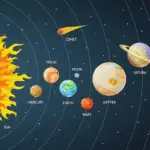
There are eight planets in our solar system, orbiting the Sun in elliptical paths. They are generally divided into two groups: the inner, rocky planets and the outer, gas/ice giants. The planets in order from the Sun are:
- Mercury: The smallest planet and closest to the Sun. It has no atmosphere and experiences extreme temperature variations between day and night.
- Venus: The second planet from the Sun, similar in size to Earth. It has a very thick, toxic atmosphere that traps heat, making it the hottest planet in our solar system.
- Earth: The third planet from the Sun, known for its unique ability to support life due to the presence of liquid water and a suitable atmosphere.
- Mars: The fourth planet from the Sun, often called the “Red Planet” due to its iron-rich surface. It has a thin atmosphere and polar ice caps.
- Jupiter: The fifth and largest planet in the solar system. It is a gas giant, primarily composed of hydrogen and helium, and is famous for its Great Red Spot, a massive storm.
- Saturn: The sixth planet from the Sun and the second largest. It is well-known for its prominent and beautiful system of rings, which are made of ice particles and rocky debris.
- Uranus: The seventh planet from the Sun, an ice giant that rotates on its side, making it appear to roll along its orbit.
- Neptune: The eighth and farthest known planet from the Sun. It is also an ice giant, characterized by strong winds and a very cold, dark environment.
The Earth
Shape of the Earth
The Earth is not a perfect sphere; its shape is best described as an oblate spheroid. This means it is slightly flattened at the poles and bulges at the equator. This shape is a result of the Earth’s rotation, which creates a centrifugal force that pushes matter outwards at the equator.
Evidence supporting the Earth’s spherical (oblate spheroid) shape includes:
- Circumnavigation: Sailors like Ferdinand Magellan have sailed around the world, proving it has no edge.
- Ships appearing/disappearing hull first: When a ship sails away, its hull disappears below the horizon before its mast, indicating the curvature of the Earth.
- Satellite images: Photographs taken from space clearly show the Earth as a sphere.
- Lunar eclipse shadow: During a lunar eclipse, the Earth casts a round shadow on the Moon, which is only possible if the Earth is spherical.
- Varying gravitational force: The force of gravity is slightly stronger at the poles than at the equator due to the Earth’s shape.
Size of the Earth
The Earth is the fifth largest planet in the solar system. Its approximate dimensions are:
- Equatorial Diameter: Approximately 12,756 kilometers (7,926 miles).
- Polar Diameter: Approximately 12,714 kilometers (7,900 miles).
- Circumference at the Equator: Approximately 40,075 kilometers (24,901 miles).
- Surface Area: Approximately 510 million square kilometers.
Teaching Methods/Instructional Techniques
Discussion, Demonstration, Guided Practice, Question and Answer, Explanation, Observation, Video Presentation, Group Work
Instructional Procedures
Step 1: Introduction
Time: 5 minutes
Teaching Skill: Questioning/Engaging
Teacher’s Activity: The teacher greets the students and asks them questions about what they observe in the sky (Sun, Moon, stars) and what they know about our planet. The teacher then introduces the topic: “The Earth and The Solar System.”
Pupils’ Activity: Pupils respond to the teacher’s questions and listen attentively to the introduction.
Learning Point: Activating prior knowledge
Step 2: Meaning of The Earth and the Solar System
Time: 10 minutes
Teaching Skill: Explanation/Definition
Teacher’s Activity: The teacher explains the meaning of the Solar System, identifying the Sun as its centre and describing the various celestial bodies that orbit it. The teacher also defines the Earth as the third planet and highlights its unique characteristics.
Pupils’ Activity: Pupils listen, ask questions for clarification, and contribute to the discussion.
Learning Point: Definition of solar system
Step 3: Identifying Planets of the Solar System
Time: 10 minutes
Teaching Skill: Visualisation/Identification
Teacher’s Activity: The teacher guides students to watch a video clip or animation on the solar system, pointing out each planet and its position relative to the Sun. The teacher then uses a chart to name and identify each planet in order.
Pupils’ Activity: Pupils observe the video/animation, identify the planets, and repeat their names after the teacher.
Learning Point: Planet identification
Step 4: Discussing Characteristics of Planets
Time: 10 minutes
Teaching Skill: Description/Elaboration
Teacher’s Activity: The teacher discusses brief characteristics of each planet, highlighting key features like size, composition (rocky or gas), and notable attributes (e.g., Saturn’s rings, Mars’ red colour).
Pupils’ Activity: Pupils listen, take brief notes, and ask questions about specific planets.
Learning Point: Planetary characteristics
Step 5: Exploring Earth’s Shape
Time: 8 minutes
Teaching Skill: Demonstration/Discussion
Teacher’s Activity: The teacher uses a globe and photos of Earth from space to demonstrate and discuss the Earth’s shape as an oblate spheroid. The teacher guides students to discuss in groups the photos and describe the shape, then explains the evidence for this shape.
Pupils’ Activity: Pupils observe the globe and photos, discuss in groups, describe Earth’s shape, and listen to the explanation of evidence.
Learning Point: Earth’s oblate shape
Step 6: Exploring Earth’s Size
Time: 5 minutes
Teaching Skill: Explanation/Comparison
Teacher’s Activity: The teacher discusses the Earth’s size, mentioning its diameter and comparing it to other planets to give students a sense of scale. The teacher highlights that Earth is the fifth largest planet.
Pupils’ Activity: Pupils listen and grasp the concept of Earth’s size relative to other planets.
Learning Point: Earth’s relative size
Step 7: Evaluation/Review
Time: 5 minutes
Teaching Skill: Questioning/Assessment
Teacher’s Activity: The teacher evaluates the learning by asking the following questions:
- What is the Solar System?
- Name any four planets in our solar system.
- Describe the shape of the Earth.
- Mention two pieces of evidence that prove the Earth is spherical.
Pupils’ Activity: Pupils answer orally and in writing.
Learning Point: Understanding key concepts
Step 8: Note-Taking
Time: 10 minutes
Teaching Skill: Guided Writing
Teacher’s Activity: The teacher guides pupils/students to copy the essential Board Summary notes on the meaning of the Earth and Solar System, the planets, and Earth’s shape and size into their notebooks.
Pupils’ Activity: Pupils/students copy the notes carefully into their notebooks.
Learning Point: Recording lesson information
Step 9: Conclusion
Time: 2 minutes
Teaching Skill: Summarisation
Teacher’s Activity: The teacher briefly recaps the main points of the lesson, emphasizing the Earth’s unique position and characteristics within the solar system. The teacher encourages students to continue exploring space.
Pupils’ Activity: Pupils listen and reflect on the lesson.
Learning Point: Consolidating lesson knowledge
Continuous Assessment/Further Study
Type: Homework
Instruction: Answer the following questions in your notebook:
- Define the term “Solar System” in your own words.
- List all eight planets of the solar system in their correct order from the Sun.
- Using colours, draw and label the eight planets of the solar system.
- Explain why the Earth is considered an “oblate spheroid” rather than a perfect sphere.
Lesson Keywords
- Earth – The third planet from the Sun, known for supporting life.
- Solar System – A system of planets, moons, and other celestial bodies orbiting a central star (the Sun).
- Planets – Large celestial bodies that orbit a star, clearing their orbital path.
- Mercury – The smallest planet, closest to the Sun.
- Venus – The second planet, known for its extreme heat and thick atmosphere.
- Mars – The fourth planet, often called the “Red Planet.”
- Jupiter – The largest planet, a gas giant.
- Saturn – The sixth planet, famous for its prominent rings.
- Uranus – The seventh planet, an ice giant that rotates on its side.
- Neptune – The eighth and farthest planet, an ice giant with strong winds.
- Oblate Spheroid – A sphere that is slightly flattened at the poles and bulging at the equator.
Differentiation
Support: For students who struggle with identifying the planets, provide mnemonic devices or simplified diagrams. Pair them with stronger students for group activities. Focus on identifying the first four planets and the Earth’s basic shape.
Extension: Encourage advanced students to research dwarf planets (e.g., Pluto) and their distinction from main planets, or to explore the conditions necessary for life on Earth and why other planets lack them. They could also investigate the history of space exploration.
Suggested Lesson Videos
Search on YouTube: The Earth and Solar System for SS1 Geography
Community Join the conversation Open discussion +