

class: Primary One
Term: First Term
Subject: Cultural & Creative Arts
Curriculum Theme:
Previous Lesson: Location of Craft Works
topic: Planning of Clay for Moulding
Content/Learning Area: Preparation of Clay for Moulding, What is Clay?, Collection of Clay, Kneading of Clay, Removal of Impurities in Clay
Time allocation: 40 minutes
Performance Objectives
By the end of the lesson, pupils should be able to:
- Cognitive Domain:
1.Explain the process of preparing clay for moulding.
2. Identify the importance of removing impurities from clay.
3. List examples of objects made from clay.
- Affective Domain:
1.Show recognition for the versatility of clay.
2. Develop patience and attention to detail in preparing clay.
- Psychomotor Domain:
1. Demonstrate the process of kneading clay.
2. Show how to use a sieve to remove impurities from clay.
- Social Domain:
1. Work cooperatively with peers during group activities.
Reference Materials
- 9 – Years Basic Education Curriculum
- Abuja Educational Resource center Scheme of Work
- NAPPS national unified Scheme of Work
- Relevant textbooks
Instructional Materials
To deliver this lesson, the teacher will use the following materials:
- Clay
- Sieve
- Water
- Pictures/charts showing clay preparation
- Whiteboard or chart paper
Rationale for the Lesson
This lesson introduces pupils to the basic process of preparing clay for moulding, a fundamental skill in art and craft. Understanding this process helps them appreciate the materials and techniques involved in creating various objects.
Prerequisite/Previous knowledge
The teacher will start by asking pupils what they know about clay and showing pictures of objects made from clay. A brief discussion will follow, leading into the lesson’s topic.
Lesson Content
preparation of Clay for Moulding
Clay is a natural material used to make many things like pots, sculptures, and tiles. Before using it, we must prepare it correctly. Learning about clay is vital for this process.
What is Clay?
Clay is a type of soil with very fine particles. It’s sticky when wet and hardens when dry. It’s found in many places and has been used for a long time.
Collection of Clay
The process of gathering clay involves identifying suitable sources and ensuring the clay is of good quality for moulding.
First, collect clay. You can find it in:
- Riverbeds
- Hillsides
- Quarries
Make sure the clay is free of large stones, roots, and other things.
kneading of clay
Kneading clay is essential to achieve a smooth, workable consistency by removing air pockets and ensuring uniform moisture distribution.
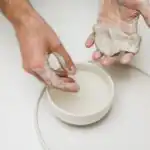
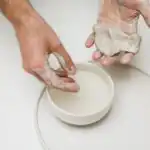
After collecting the clay, knead it. Kneading means pressing, folding, and stretching the clay to make it smooth and easy to work with. This removes air bubbles.
Removal of impurities in Clay
Removing impurities ensures the clay is smooth and free from particles that could compromise the final product.
Clay often has impurities like small stones, twigs, and leaves. These make it hard to mould and affect the final product.Use a sieve (a mesh tool) to remove these impurities. The sieve lets small particles through but keeps the larger ones.
Teaching Methods
To deliver this lesson, the teacher will adopt the following methods: Discussion, Presentation, Practical Activity
instructional procedures
To deliver this lesson, the teacher will adopt the following steps:
step 1: Introduction (Set Induction)
Time: 5 minutes
teaching Skill: Questioning, Discussion
Teacher’s Activity: Asks pupils what they know about clay and shows pictures of objects made from clay.
Pupils’ Activity: Respond to teacher’s questions and observe the pictures.
Step 2: Explanation of Key Concepts
Time: 10 minutes
Teaching Skill: explanation, Demonstration
Teacher’s Activity: Explains the steps involved in preparing clay for moulding, emphasizing the importance of removing impurities.
Pupils’ Activity: Listen attentively and ask clarifying questions.
Step 3: Demonstration/Guided practice
Time: 15 minutes
Teaching Skill: Demonstration, Guided practice
Teacher’s Activity: demonstrates the process of kneading clay and using a sieve to remove impurities.
Pupils’ Activity: Observe the demonstration and participate in guided practice under teacher supervision.
Step 4: Self-reliant Practice
Time: 5 minutes
Teaching Skill: Monitoring, Feedback
Teacher’s Activity: Supervises pupils as they independently prepare their clay.Pupils’ Activity: Prepare clay independently, applying the learned techniques.
Step 5: Note-taking
Time: 2 minutes
Teaching Skill: Note-Taking
Teacher’s activity: Guides pupils in taking notes on the key steps of clay preparation.
Pupils’ Activity: Take notes on the key steps.
Step 6: Evaluation/Review
Time: 3 minutes
Teaching Skill: Questioning, Feedback
Teacher’s Activity: Asks evaluation questions and provides feedback.
Pupils’ Activity: Answer evaluation questions.
Objective-aligned checks:
- Explain the process of preparing clay for moulding.
- Identify the importance of removing impurities from clay.
- List examples of objects made from clay.
Step 7: Conclusion
Time: 2 minutes
Teaching Skill: Summarizing
Teacher’s Activity: Summarizes the key steps in preparing clay for moulding and encourages pupils to continue practicing their skills.
Pupils’ Activity: Listen to the summary and ask any remaining questions.
Lesson Keywords
- Clay – A type of soil used for making pottery and other objects.
- Kneading – The process of pressing and folding clay to make it smooth.
- Impurities – unwanted materials in clay, like stones and twigs.
- sieve – A tool used to remove impurities from clay.
- Moulding – Shaping clay into a desired form.
Lesson Evaluation
To evaluate the learning, the teacher asks pupils to:
- What are the steps in preparing clay for moulding?
- Why is it important to remove impurities from clay?
- Name three things that can be made from clay.
- What tool helps remove impurities from clay?
Assignment/Homework
- Collect a small amount of clay from your surroundings.
- List the steps you would take to prepare the clay for moulding.
- Draw a picture of an object that can be made from clay.
Differentiation
- For slower learners: Provide one-on-one assistance during the practical activity.
- For advanced learners: Encourage them to experiment with different clay preparation techniques.
- For visual/auditory/kinesthetic learners: Use visual aids, verbal instructions, and hands-on activities to cater to different learning styles.
Note for Teachers
Ensure that pupils understand the importance of each step in preparing clay for moulding. Provide clear demonstrations and hands-on practice to reinforce learning. Supervise pupils closely during the practical activity to ensure safety and proper technique.
Community Join the conversation Open discussion +