

Class: Primary 1
Term: 2nd Term
Subject: Cultural And Creative Arts
Previous Lesson: Drawing And Painting Of Craft Work
Topic: Beads decoration
Content/Learning Area: Identification of beads for different occasions, Uses of beads, making different types of bead.
Time Allocation: 40 minutes
Performance Objectives
By the end of the lesson, pupils should be able to:
- Cognitive Domain: Identify different types of beads and their uses.
- Affective Domain: Show interest in learning about bead decoration.
- Psychomotor Domain: Create simple bead designs using beads provided.
- Social domain: Work collaboratively in groups to make bead decorations.
Reference Materials
The following resources were used in planning this lesson:
- 9 – Years Basic Education Curriculum
- Abuja Educational Resource Centre Scheme of Work
- NAPPS National Unified Scheme of Work
- Online Facts from: Wikipedia – Bead
Instructional Materials
To deliver this lesson, the teacher will use the following materials:
- Different types of beads (plastic, glass, clay, wood, metal)
- Thread and needle
- Pre-made bead decorations
- A chart showing types and uses of beads
Rationale for the Lesson
Learning about beads decoration helps pupils appreciate art, develop creativity, and understand cultural importance in decorating for occasions.
Prerequisite/Previous knowledge
Pupils are familiar with observing craft items and may have seen or worn bead decorations at home or during events.
Lesson Content
Beads Decoration: Identification, Uses & Making
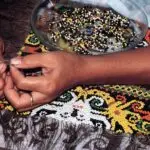
Beads Decoration refers to the use of beads to make attractive items like necklaces, bracelets, and cultural ornaments.
Identification of Beads:
Beads come in various materials, each with unique characteristics and uses. The following are examples:
- Plastic Beads – Used for simple jewellery.
- Glass Beads – It is used for shiny and decorative purposes.
- clay Beads – Often used in customary ceremonies.
- Wood Beads – Often used for natural-looking accessories.
- Metal Beads – Common in luxury items.
- Stone Beads – These are durable and often used in high-quality jewelry.
- Seed beads – Small and uniform,ideal for intricate patterns and weaving.
Uses of Beads:
Beads are versatile and have numerous applications across different cultures and crafts. These include:
- Making necklaces and bracelets.
- Decorating cultural attire.
- Enhancing artistic projects.
- Representing social status.
- Creating decorative household items.
- Embellishing bags and shoes.
- Making rosaries and prayer beads.
Steps to Make Beads:
Creating beadwork involves a series of steps to ensure a beautiful and durable finished product. These steps include:
- Select your bead type.
- Cut the thread to the desired length.
- Insert beads into the thread one by one.
- Tie the ends securely to form a loop.
- Adjust the design as desired.
- Add a clasp for easy wearing.
- Check for any loose ends and trim them.
Teaching Methods
To deliver this lesson, the teacher will adopt the following methods: Visual Aids, description, Exhibition, Group Work, Practical.
Instructional Procedures
To deliver this lesson, the teacher will adopt the following steps:
Step 1: Introduction
Time: 5 mins
Teaching Skill: Set induction
Teacher’s Activity: Shows pupils different types of beads and asks if they recognize any.
Pupils’ Activity: Respond to questions about beads.
Step 2: identification of Beads
Time: 10 mins
Teaching Skill: Explanation
Teacher’s Activity: Explains types of beads and displays their uses.
Pupils’ Activity: Observe and name types of beads displayed.
Step 3: Uses of Beads
Time: 10 mins
teaching skill: Demonstration
Teacher’s Activity: Explains how beads are used in necklaces, bracelets, and cultural events.
Pupils’ Activity: Share experiences of seeing beads in use.
Step 4: Making Beads
Time: 10 mins
Teaching Skill: Practical
Teacher’s Activity: guides pupils to make simple bead patterns using threads.
Pupils’ Activity: Follow teacher’s steps to create bead designs.
Step 5: Note-taking
Time: 5 mins
Teaching Skill: Explanation
Teacher’s Activity: Guides pupils in copying the note into their books.
Pupils’ Activity: Copy notes neatly into notebooks.
Step 6: Evaluation/Review
time: 5 mins
Teaching Skill: Asking Questions
Teacher’s Activity: Asks questions to review the lesson.
Pupils’ Activity: Answer questions based on the lesson.
step 7: Conclusion
Time: 2 mins
Teaching Skill: Summarization
Teacher’s activity: Summarizes the main points of the lesson.Pupils’ Activity: Listen attentively to the summary.
Lesson Keywords
- Beads – Small decorative objects used in jewelry and crafts.
- Decoration – The act of making something look more attractive.
- Necklace – A piece of jewelry worn around the neck.
- Bracelet – A piece of jewelry worn around the wrist.
- Craft – An activity involving skill in making things by hand.
Lesson Evaluation
To evaluate the learning, the teacher asks pupils to:
- Name three types of beads and their uses.
- Mention two occasions where beads are commonly used.
- Describe the steps to make a simple bead design.
- Create a small bead bracelet or necklace.
Assignment/Homework
- Collect different types of beads from home.
- Draw a picture of a beaded necklace or bracelet.
- Write a short paragraph on how beads are used in their culture.
Differentiation
- For slower learners: Provide pre-threaded needles and larger beads for easier handling.
- For advanced learners: Encourage them to create more complex patterns and designs.
- For visual/auditory/kinesthetic learners: Use visual aids, verbal instructions, and hands-on activities to cater to different learning styles.
Note for Teachers
This lesson plan is designed to engage young learners in both theoretical and practical activities. Ensure that all materials are safe and appropriate for their age. Guide the pupils patiently during the bead-making activity. Happy teaching!


Community Join the conversation Open discussion +