

Class: Junior Secondary School 1 (JSS1, JSS 1)
Term: 2nd Term
Week: 1
Age: 12 years
Duration: 45 minutes
Subject: Basic Science And Technology
Curriculum Theme: Basic Science
Previous Lesson:
Topic: Reproductive System
Subject Matter: Female and Male Internal and External Organs, Functions and Care of the Female and Male Reproductive Organs
Specific Objectives
By the end of the lesson, pupils should be able to:
- Cognitive Domain:
(a) Identify the male and female reproductive organs, both internal and external.
(b) Describe the functions of each reproductive organ.
(c) Explain ways to care for male and female reproductive organs. - Affective Domain:
(a) Develop respect and positive attitudes toward personal hygiene and reproductive health.
(b) Show concern for proper care of reproductive organs to prevent infections. - Psychomotor Domain:
(a) Demonstrate correct practices for maintaining reproductive health. - Social Domain:
(a) Participate in group discussions about the importance of reproductive health and hygiene.
Reference Materials
The following resources were used in planning this lesson:
- 9 Years Basic Education Curriculum
- Lagos State Unified Scheme of work for Junior Secondary Schools
- Britannica – Human reproductive system | Definition, Diagram & Facts
- Relevant Textbooks
Instructional Materials
The teacher will teach this lesson with the aid of:
- Anatomical charts of male and female reproductive systems
- Models of male and female reproductive organs
- Flash cards with organ names and functions
- Whiteboard and markers
- Short educational video clips on reproductive health
Rationale for the Lesson
This lesson enables pupils to identify reproductive organs, understand their functions, and learn proper care to maintain reproductive health and prevent diseases.
Prerequisite/Previous Knowledge
Pupils have basic knowledge of human body systems, personal hygiene, and general health maintenance. They have also been introduced to the concept of growth and puberty in previous lessons.
Lesson Content/Board Summary
Female And Male Reproductive Organs
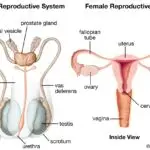
The reproductive system consists of organs that allow humans to produce offspring and ensure the continuation of the species. It is divided into male and female systems with internal and external organs.
Female Reproductive Organs
The female reproductive system includes organs that produce eggs, support fertilization, and provide an environment for fetal development.
The following are the female reproductive organs:
- Ovaries – produce eggs (ova) and hormones like estrogen and progesterone.
- Fallopian Tubes – transport eggs from the ovary to the uterus.
- Uterus – provides a site for implantation and fetal development.
- Vagina – serves as a canal for menstrual flow, intercourse, and childbirth.
- External Organs (Vulva) – includes the labia and clitoris, protecting internal organs and aiding sexual arousal.
Male Reproductive Organs
The male reproductive system includes organs that produce sperm, deliver it to the female reproductive system, and produce male sex hormones.
The following are the male reproductive organs:
- Testes – produce sperm and testosterone.
- Epididymis – stores sperm until mature.
- Vas Deferens – transports sperm from the testes to the urethra.
- Penis – delivers sperm into the female reproductive tract.
- External Organs (Scrotum) – holds and protects testes, regulating temperature for sperm production.
Functions of Reproductive Organs
Each organ in the male and female reproductive systems has a specific role in reproduction and maintaining health.
These include:
- Production of gametes (sperm and eggs).
- Transport of gametes for fertilization.
- Secretion of sex hormones to regulate reproductive functions.
- Providing suitable environment for fertilization and fetal development.
- Protection of reproductive organs from infections.
Care of Reproductive Organs
Proper care of the female And Male reproductive organs prevents infections, maintains fertility, and promotes overall health.
The following are ways to care for the female And Male reproductive organs:
- Maintain proper hygiene of genital areas.
- Wear clean and appropriate clothing to avoid irritation.
- Avoid harmful substances like alcohol and tobacco that affect reproductive health.
- Regular medical check-ups and timely treatment of infections.
- Practice safe behaviors and educate oneself about reproductive health.
Teaching Methods/Instructional Techniques
Discussion, Lecture, Explanation, Demonstration, Group Work, Visual Aids, Question and Answer
Instructional Procedures
To deliver this lesson, the teacher will adopt the following steps:
Step 1: Introduction
Time: 5 minutes
Teaching Skill: Set Induction
Teacher’s Activity: Teacher engages pupils by asking questions about body parts they have learned previously and introduces the topic of reproductive organs.
Pupils’ Activity: Pupils respond and recall previous knowledge on body systems.
Learning Point: Pupils are prepared to learn about the reproductive system.
Step 2: Female Reproductive Organs
Time: 10 minutes
Teaching Skill: Explanation
Teacher’s Activity: Teacher explains the internal and external female reproductive organs using charts and models.
Pupils’ Activity: Pupils observe, take notes, and identify organs on charts or models.
Learning Point: Pupils understand the structure and function of female reproductive organs.
Step 3: Male Reproductive Organs
Time: 10 minutes
Teaching Skill: Explanation
Teacher’s Activity: Teacher describes the male reproductive organs and their functions using charts and models.
Pupils’ Activity: Pupils identify organs and copy functions in their notes.
Learning Point: Pupils understand the structure and function of male reproductive organs.
Step 4: Functions of Reproductive Organs
Time: 5 minutes
Teaching Skill: Discussion
Teacher’s Activity: Teacher lists the functions of each reproductive organ and relates them to human reproduction.
Pupils’ Activity: Pupils participate by answering questions and linking functions to organs.
Learning Point: Pupils understand the role of reproductive organs in human reproduction.
Step 5: Care of Reproductive Organs
Time: 5 minutes
Teaching Skill: Demonstration
Teacher’s Activity: Teacher demonstrates proper hygiene practices and discusses ways to care for reproductive organs.
Pupils’ Activity: Pupils observe and discuss daily practices to maintain reproductive health.
Learning Point: Pupils know practical ways to protect and care for reproductive organs.
Step 6: Note-Taking
Time: 5 minutes
Teaching Skill: Explanation
Teacher’s Activity: Teacher writes the summary on the board for pupils to copy.
Pupils’ Activity: Pupils write the board summary in their exercise books.
Learning Point: Pupils have a written record for future reference.
Step 7: Evaluation/Review
Time: 3 minutes
Teaching Skill: Questioning
Teacher’s Activity: The teacher evaluates the learning by asking the following questions:
- Name two internal and two external female reproductive organs.
- List the functions of the testes and ovaries.
- Mention two ways to care for reproductive organs.
Pupils’ Activity: Pupils respond orally or in writing.
Learning Point: Pupils demonstrate understanding of the lesson objectives.
Step 8: Conclusion
Time: 2 minutes
Teaching Skill: Reinforcement
Teacher’s Activity: Teacher summarizes key points, reinforces hygiene importance, and encourages questions.
Pupils’ Activity: Pupils listen and ask clarifying questions.
Learning Point: Pupils appreciate the importance of reproductive health and care.
Home Task: Record two correct examples of Reproductive System from the lesson or home environment and explain each in your own words.
Lesson Keywords
- Reproductive system – organs responsible for producing offspring
- Ovary – female organ that produces eggs
- Testes – male organ that produces sperm
- Fertilization – process where sperm meets egg
- Hygiene – practices that keep reproductive organs clean and healthy
Differentiation
Teacher supports slower learners with visual aids and simplified explanations while encouraging advanced learners to lead discussions and explain organ functions to peers.
Note for teachers using this lesson plan
Ensure sensitivity when teaching about reproductive organs; maintain privacy and avoid embarrassment. Encourage open discussion about hygiene and care practices. Use models and diagrams for clarity.
Community Join the conversation Open discussion +