

Class: primary Three
Term: Third Term
Subject: Basic Science and Technology
Curriculum Theme: Basic Technology
Previous Lesson: Conversion of Energy
Topic: Mechanical Energy
Content/Learning Area: Defining mechanical energy,Examples of mechanical energy,Types of mechanical energy,How mechanical energy is used
Time Allocation: 40 minutes
Performance Objectives
By the end of the lesson,pupils should be able to:
- Cognitive Domain:
1. Define mechanical energy.
2. Identify different types of mechanical energy.
3. Explain how mechanical energy is used in everyday life.
- Psychomotor Domain:
1. Demonstrate understanding of mechanical energy through practical examples.
- Affective Domain:
1. Show interest in learning about different forms of energy.
- Social Domain:
1. Work collaboratively with peers to discuss examples of mechanical energy.
Reference Materials
- 9 – Years Basic Education Curriculum
- Abuja Educational Resource Center Scheme of Work
- NAPPS National Unified Scheme of Work
- Relevant Textbooks
Instructional Materials
To deliver this lesson, the teacher will employ the help of the following materials:
- Whiteboard or chart paper
- Markers or pens
- pictures or videos showing examples of mechanical energy
Rationale for the Lesson
Understanding mechanical energy is essential to grasping basic physics concepts. This lesson provides a foundation for future learning about energy transformations and the workings of simple machines, relevant to everyday life.
Prerequisite/Previous Knowledge
The teacher will start by asking pupils about their experiences with moving objects, such as rolling balls or swinging. This will lead into a discussion about the energy involved in these movements, setting the stage for the lesson on mechanical energy.
Lesson Content
Mechanical Energy
Mechanical energy is the energy an object possesses due to its motion or position. When something moves or is positioned in a specific way, it has mechanical energy. Learn more about mechanical energy here.
Examples of Mechanical Energy
Mechanical energy is evident in various everyday scenarios.
examples are:
- A ball rolling downhill
- A car driving
- A swing moving
- A person cycling
- A flowing river turning a water wheel
- A bouncing basketball
Types of Mechanical Energy
Mechanical energy can be categorized into two main types based on the state of the object.
They are:
- Kinetic energy: Energy of motion. The faster something moves, the more kinetic energy it has.
- Potential energy: Energy of position (when an object is still). The higher an object is, the more potential energy it has.
How Mechanical Energy is Used
Mechanical energy is harnessed in numerous ways to perform tasks and power various systems.These include:
- Powering machines (cars,bicycles,airplanes)
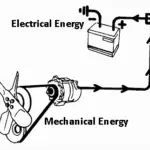
- Generating electricity
- Moving objects (lifting,pushing)
- Operating construction equipment like cranes and bulldozers
- Propelling boats and ships through water
- Driving turbines in power plants
Teaching Methods
To deliver this lesson, the teacher will adopt the following methods: Discussion,Exhibition,Group work
Instructional Procedures
To deliver this lesson,the teacher will adopt the following steps:
Step 1: Introduction (Set Induction)
Time: 5 minutes
Teaching Skill: Questioning
Teacher’s Activity: Asks pupils about their experiences with moving objects and introduces the concept of mechanical energy.
Pupils’ Activity: Share their experiences and listen to the introduction.
Step 2: Explanation of Key Concepts
Time: 10 minutes
Teaching Skill: Explanation
Teacher’s Activity: Explains the definition of mechanical energy, differentiating between kinetic and potential energy with clear examples.
Pupils’ Activity: Listen attentively and take notes.
Step 3: demonstration of Kinetic and Potential energy
Time: 10 minutes
Teaching Skill: Demonstration
Teacher’s Activity: Demonstrates examples of kinetic and potential energy using simple objects, like a ball and a raised book.
Pupils’ Activity: Observe the demonstrations and participate in discussions.
Step 4: Identifying Examples of Mechanical Energy
Time: 5 minutes
Teaching Skill: Guided Practise
Teacher’s Activity: Guides pupils in identifying examples of mechanical energy in their daily lives.
Pupils’ Activity: Work individually or in pairs to identify examples.
Step 5: Note-Taking
Time: 5 minutes
Teaching Skill: Note-Taking
Teacher’s Activity: Reviews key concepts and encourages pupils to take notes.
Pupils’ Activity: Take notes on the key concepts.
Step 6: Evaluation/Review
Time: 5 minutes
Teaching Skill: Questioning
Teacher’s Activity: Asks review questions to assess understanding.
Pupils’ Activity: Answer the review questions.
Objective-aligned checks:
- Define mechanical energy.
- Identify different types of mechanical energy.
- Explain how mechanical energy is used in everyday life.
Step 7: conclusion
Time: 2 minutes
Teaching Skill: Summarizing
Teacher’s Activity: Summarizes the key concepts of mechanical energy and assigns a short homework activity.
Pupils’ Activity: Listen to the summary and note the homework assignment.
Lesson Keywords
- Mechanical Energy – Energy possessed by an object due to its motion or position.
- Kinetic Energy – energy of motion.
- Potential Energy – Energy of position or stored energy.
Lesson Evaluation
To evaluate the learning, the teacher asks pupils to:
- what is mechanical energy?
- Give two examples of kinetic energy.
- Discuss how you see mechanical energy in your daily life.
- What’s the difference between kinetic and potential energy?
- Give an example of how mechanical energy is used daily.
Assignment/Homework
- Find more examples of mechanical energy in your surroundings.
- Explain how a bicycle uses mechanical energy.
- Differentiate between potential and kinetic energy with real-life examples.
Differentiation
- For slower learners: Provide one-on-one assistance and use simpler examples.
- For advanced learners: Encourage them to explore more complex examples and research additional facts.
- For visual/auditory/kinesthetic learners: Use visual aids, verbal explanations, and hands-on activities to cater to different learning styles.
Note for Teachers
Ensure to use real-life examples and demonstrations to make the concept of mechanical energy relatable and understandable for primary three pupils. Encourage active participation and provide constructive feedback.


Community Join the conversation Open discussion +